
&w=3840&q=75)
&w=3840&q=75)
&w=3840&q=75)
&w=3840&q=75)
&w=3840&q=75)
&w=3840&q=75)
&w=3840&q=75)
&w=3840&q=75)


54
JANSSONIUS (JOHANNES) (1588-1664)
The item was sold for 133 952 €
Fees include commission and taxes.
JANSSONIUS (JOHANNES) (1588-1664)
ERRATUM: No elements justify the provenance Château de La Brède.
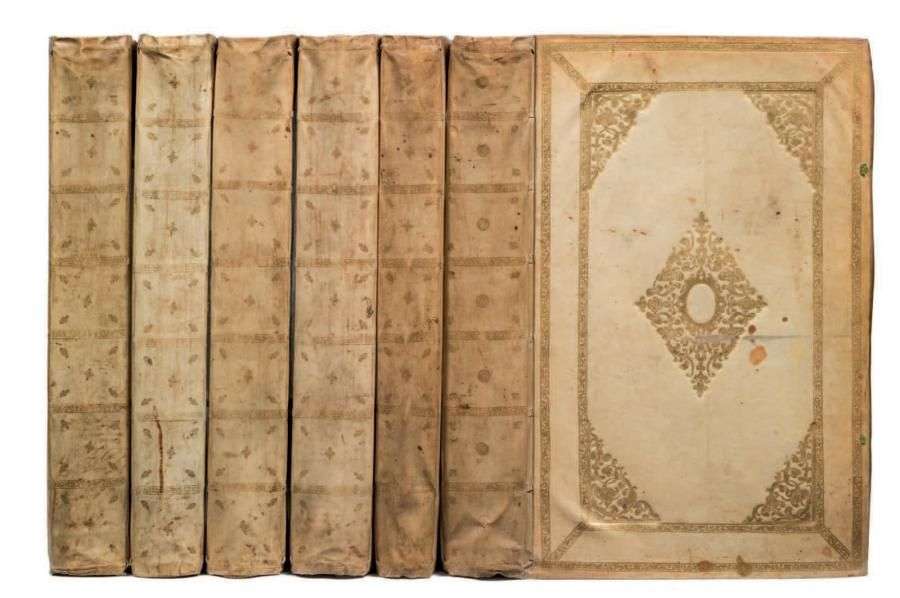
Nouvel Atlas ou Théâtre du Monde comprenant les tables et descriptions de toutes les régions du monde universel. Amsterdam, Jan Jansson, 1652, 1656, 1657.
6 volumes in-folio.
Full gilt vellum with period cover, boards decorated with a double frame of gilt fillets with large gilt irons in spandrels and large gilt motif in the center, spine decorated, gilt edges, traces of laces. Dimensions : 500 x 325 mm Volume I, First and second part : 2 frontispieces, (6) ff, 246 pp, (1) f. 23 and 78 plates. Volume II, First and second part : 2 frontispieces, 250 pp., (1) f., 68 and 40 plates. Volume III, 1 frontispiece, 306 pp. and 103 plates. Volume IV, 1 frontispiece, (2) ff. 380 pp, 46 pp, (1) f. and 56 plates. Volume V, 1 frontispiece, (1) f., 294 pp. and 23 plates. Volume VI, 1 frontispiece, (1) f., 314 pp. and 61 plates.
That is to say : 8 frontispieces with gold highlights and 452 copper-engraved maps on double page, mounted on tabs, all in period colors. One of the jewels of the golden century of the cartography of the Netherlands, a magnificent copy, complete, in its gilt vellum binding of the publisher, having belonged to Montesquieu. The "New Atlas" is the work of several generations of cartographers whose names are Mercator, Ortelius, Jodocus Hondius. 8 frontispieces with gold highlights and 452 double-page engraved maps, mounted on tabs, all in period colors. The New Altlas is the work of several generations of cartographers whose names are Mercator, Ortelius, Jodocus Hondius. The latter, founder of the dynasty, had acquired Mercator's copperplates. Monumental universal atlas, the work is the result of the association of the two brothers-in-law Henri Hondius and Jan Jansson, to better counter the competitor J. Blaeu. By a constant work of enrichment and update, they succeeded in drawing up maps of the most complete, even if it means to exploit shamelessly the information provided by their rival. To the corpus of the first four volumes were added a fifth volume for the maritime or nautical atlas, and in 1657, the sixth and last volume: the historical atlas for Antiquity. Thus reworked and enriched, Jansson's New Atlas became the prototype of the Atlas Major. Engraved in intaglio, each plate is illuminated by hand, forming the framed tableaus of Vermeer's "ceremonial chambers" or the Geographer's cabinet, as the maps were also sold individually. The beauty of the present collection is further enhanced by the careful coloring. Some wear and tear to the binding.
PROVENANCE
Château de la Brède. Although it does not appear in the catalog of the 1926 sale, nor among the 3000 volumes of the manuscript catalog drawn up by Montesquieu, it would have belonged to the latter, as indicated by a rather singular mark by way of a manuscript ex-libris. It is known that the author of the Spirit of Laws used to trace with a pen the outline of his round glasses. One of the margins bears witness to this here, in volume V, p.111.
REFERENCES
Koeman, Atlantes Neerlandici II, 1969, Me 114-116, 159, 173A, 179. - The Dutch Cartography, B.R., 1971, n° 23-24.
ERRATUM: No elements justify the provenance Château de La Brède.
Nouvel Atlas ou Théâtre du Monde comprenant les tables et descriptions de toutes les régions du monde universel. Amsterdam, Jan Jansson, 1652, 1656, 1657.
6 volumes in-folio.
Full gilt vellum with period cover, boards decorated with a double frame of gilt fillets with large gilt irons in spandrels and large gilt motif in the center, spine decorated, gilt edges, traces of laces. Dimensions : 500 x 325 mm Volume I, First and second part : 2 frontispieces, (6) ff, 246 pp, (1) f. 23 and 78 plates. Volume II, First and second part : 2 frontispieces, 250 pp., (1) f., 68 and 40 plates. Volume III, 1 frontispiece, 306 pp. and 103 plates. Volume IV, 1 frontispiece, (2) ff. 380 pp, 46 pp, (1) f. and 56 plates. Volume V, 1 frontispiece, (1) f., 294 pp. and 23 plates. Volume VI, 1 frontispiece, (1) f., 314 pp. and 61 plates.
That is to say : 8 frontispieces with gold highlights and 452 copper-engraved maps on double page, mounted on tabs, all in period colors. One of the jewels of the golden century of the cartography of the Netherlands, a magnificent copy, complete, in its gilt vellum binding of the publisher, having belonged to Montesquieu. The "New Atlas" is the work of several generations of cartographers whose names are Mercator, Ortelius, Jodocus Hondius. 8 frontispieces with gold highlights and 452 double-page engraved maps, mounted on tabs, all in period colors. The New Altlas is the work of several generations of cartographers whose names are Mercator, Ortelius, Jodocus Hondius. The latter, founder of the dynasty, had acquired Mercator's copperplates. Monumental universal atlas, the work is the result of the association of the two brothers-in-law Henri Hondius and Jan Jansson, to better counter the competitor J. Blaeu. By a constant work of enrichment and update, they succeeded in drawing up maps of the most complete, even if it means to exploit shamelessly the information provided by their rival. To the corpus of the first four volumes were added a fifth volume for the maritime or nautical atlas, and in 1657, the sixth and last volume: the historical atlas for Antiquity. Thus reworked and enriched, Jansson's New Atlas became the prototype of the Atlas Major. Engraved in intaglio, each plate is illuminated by hand, forming the framed tableaus of Vermeer's "ceremonial chambers" or the Geographer's cabinet, as the maps were also sold individually. The beauty of the present collection is further enhanced by the careful coloring. Some wear and tear to the binding.
PROVENANCE
Château de la Brède. Although it does not appear in the catalog of the 1926 sale, nor among the 3000 volumes of the manuscript catalog drawn up by Montesquieu, it would have belonged to the latter, as indicated by a rather singular mark by way of a manuscript ex-libris. It is known that the author of the Spirit of Laws used to trace with a pen the outline of his round glasses. One of the margins bears witness to this here, in volume V, p.111.
REFERENCES
Koeman, Atlantes Neerlandici II, 1969, Me 114-116, 159, 173A, 179. - The Dutch Cartography, B.R., 1971, n° 23-24.