
&w=3840&q=75)
&w=3840&q=75)
&w=3840&q=75)
&w=3840&q=75)
&w=3840&q=75)
&w=3840&q=75)
&w=3840&q=75)
&w=3840&q=75)


156
GUILLAUME BENNEMAN (1750 – 1811)
The item was sold for 11 700 €
Fees include commission and taxes.
GUILLAUME BENNEMAN (1750 – 1811)
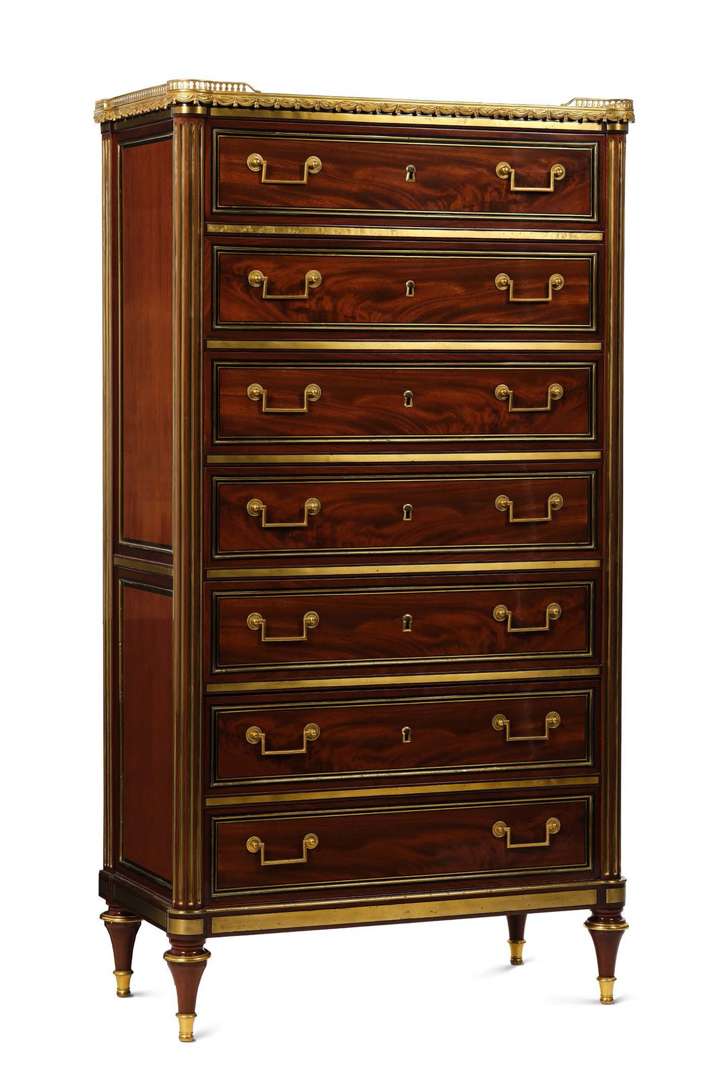
Rare piece of furniture in "semainier" simulating seven drawers in front, and opening to six compartments, the two bottom drawers being joined in one. It is made of flamed mahogany veneer and is decorated on each drawer front with a brass ring underlined by an ebony fillet. Each drawer is separated by a crosspiece, itself highlighted by a brass ring. The corners are with engaged columns, fluted and darkened with copper. The sides are composed of two panels with the same decoration of brass and ebony fillets and end on the side with a pilaster.
The top is covered with a white marble surrounded by a gilded bronze gallery with drapery motifs. The piece of furniture rests on four feet. Stamped by Guillaume Benneman. Parisian work from the end of the 18th century, around 1792.
Height : 156 cm - Width : 81 cm Depth : 45 cm
This type of furniture, heir of the chiffonier conceived at the time of the Regency, is characteristic of the end of the 18th century. Intended to receive the linen, the seven drawers symbolize the seven days of the week.
During his career as a cabinetmaker for the Crown, Benneman was often inspired by furniture supplied by Daguerre and executed by cabinetmakers such as Weisweiler or Saunier.
We find on this piece of furniture decorative elements specific to these cabinetmakers, such as the frieze in the form of drapery or the spinning feet.
This piece of furniture was probably made after 1792, since before that date, all of its production was destined for the Garde- Meuble Royal. Still borrowing all the characteristics of the Louis XVI style, our piece of furniture is in the lineage of the great furniture conceived for the aristocratic interiors.
Rare piece of furniture in "semainier" simulating seven drawers in front, and opening to six compartments, the two bottom drawers being joined in one. It is made of flamed mahogany veneer and is decorated on each drawer front with a brass ring underlined by an ebony fillet. Each drawer is separated by a crosspiece, itself highlighted by a brass ring. The corners are with engaged columns, fluted and darkened with copper. The sides are composed of two panels with the same decoration of brass and ebony fillets and end on the side with a pilaster.
The top is covered with a white marble surrounded by a gilded bronze gallery with drapery motifs. The piece of furniture rests on four feet. Stamped by Guillaume Benneman. Parisian work from the end of the 18th century, around 1792.
Height : 156 cm - Width : 81 cm Depth : 45 cm
This type of furniture, heir of the chiffonier conceived at the time of the Regency, is characteristic of the end of the 18th century. Intended to receive the linen, the seven drawers symbolize the seven days of the week.
During his career as a cabinetmaker for the Crown, Benneman was often inspired by furniture supplied by Daguerre and executed by cabinetmakers such as Weisweiler or Saunier.
We find on this piece of furniture decorative elements specific to these cabinetmakers, such as the frieze in the form of drapery or the spinning feet.
This piece of furniture was probably made after 1792, since before that date, all of its production was destined for the Garde- Meuble Royal. Still borrowing all the characteristics of the Louis XVI style, our piece of furniture is in the lineage of the great furniture conceived for the aristocratic interiors.