
&w=3840&q=75)
&w=3840&q=75)
&w=3840&q=75)
&w=3840&q=75)
&w=3840&q=75)
&w=3840&q=75)
&w=3840&q=75)
&w=3840&q=75)

148
ATTRIBUÉ À DAVID ROENTGEN (1743 - 1807)
The item was sold for 6 500 €
Fees include commission and taxes.
ATTRIBUÉ À DAVID ROENTGEN (1743 - 1807)
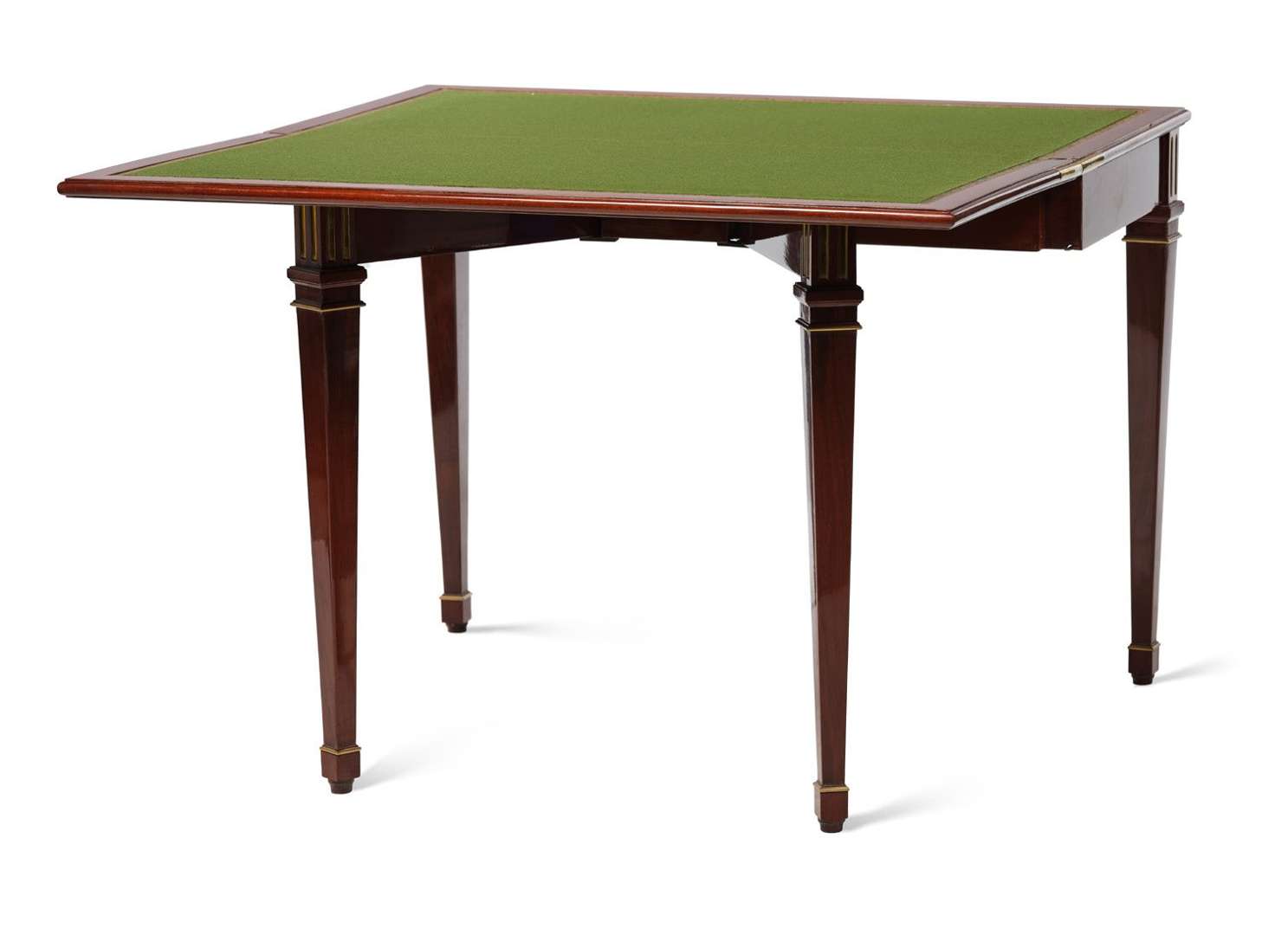
Rectangular mahogany game table with wallet top. When unfolded the top is covered with a green felt (replaced). The legs unscrew as on most of Roentgen's furniture. End of the 18th century.
Height : 72 cm - Width : 98 cm Depth : 48,5 cm (closed) (Minor accidents)
Son of Abraham Roentgen famous cabinetmaker established in Neuwied near Koblenz at the invitation of Count Johann Friedrich Alexander zu Wied-Neuwied, David Roentgen studied the furniture of his French competitors and for about twenty years sold his production as an international player, which was at that time a new way of doing business.
His workshop in the 1780's has about 80 workers, all highly qualified, coming from all over the world to work for him. In 1780 he was awarded a master's degree in Paris and became "mechanical cabinetmaker to the King and Queen". At the height of his artistic recognition, he went to Russia for the fourth time to deliver 130 pieces of furniture to the Czarina Catherine.
His countless deliveries throughout Europe led him to consider the problems of transporting furniture. This is how he came to think of making dismountable furniture, especially for tables whose legs could be damaged.
BIBLIOGRAPHY
H. Huth, Abraham und David Roentgen, Berlin, 1928
Rectangular mahogany game table with wallet top. When unfolded the top is covered with a green felt (replaced). The legs unscrew as on most of Roentgen's furniture. End of the 18th century.
Height : 72 cm - Width : 98 cm Depth : 48,5 cm (closed) (Minor accidents)
Son of Abraham Roentgen famous cabinetmaker established in Neuwied near Koblenz at the invitation of Count Johann Friedrich Alexander zu Wied-Neuwied, David Roentgen studied the furniture of his French competitors and for about twenty years sold his production as an international player, which was at that time a new way of doing business.
His workshop in the 1780's has about 80 workers, all highly qualified, coming from all over the world to work for him. In 1780 he was awarded a master's degree in Paris and became "mechanical cabinetmaker to the King and Queen". At the height of his artistic recognition, he went to Russia for the fourth time to deliver 130 pieces of furniture to the Czarina Catherine.
His countless deliveries throughout Europe led him to consider the problems of transporting furniture. This is how he came to think of making dismountable furniture, especially for tables whose legs could be damaged.
BIBLIOGRAPHY
H. Huth, Abraham und David Roentgen, Berlin, 1928