
&w=3840&q=75)
&w=3840&q=75)
&w=3840&q=75)
&w=3840&q=75)
&w=3840&q=75)
&w=3840&q=75)
&w=3840&q=75)
&w=3840&q=75)


GASTON LAFFITTE
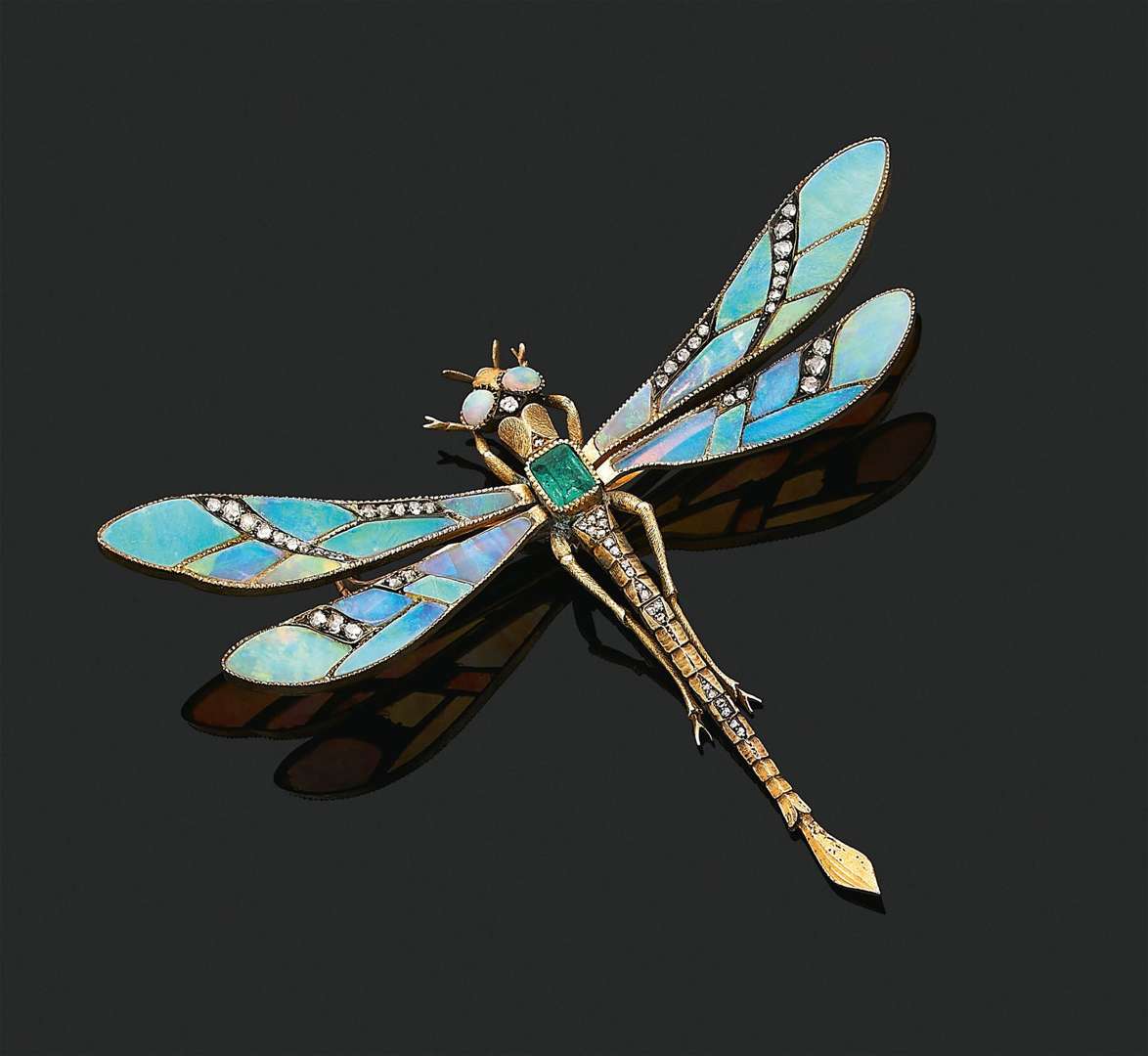
"DRAGONFLY" VIBRATING BROOCH
Fees include commission and taxes.
"DRAGONFLY" VIBRATING BROOCH
Opal, emerald, rose-cut diamonds,
18-carat gold (750)
Circa 1900 – Master’s mark
Length: 7 cm – Weight: 20.6 g
An opal, emerald, diamond and gold brooch
by Gaston Laffitte
Gaston Laffitte is one of those unassuming figures in the vast history of jewellery. He was a consummate artist, ‘a remarkable draughtsman, who also engraved and drew very well’, to quote Henri Vever in his famous work ‘Bijouterie Française au XIXe siècle’. Little is known about him; according to the Paris Guarantee Register, his career as a jeweller and medallist spanned from 1896 to 1932.
Most of his jewellery creations employ the language and forms of Art Nouveau jewellery, such as brooch-pendants resembling butterfly women or poppy belt buckles. Like other artists of this movement, he used new techniques and materials such as filigree and opal.
Nature is a universal source of inspiration for Art Nouveau. This theme should be viewed in the context of the prevailing Japonism of the late 19th century. Insects such as dragonflies and butterflies, crustaceans, reptiles, fish, orchids, irises, water lilies, poppies, tulips and many other elements of exotic flora and fauna are recurring motifs, all characterised by curves, calm and sensuality.
The dragonfly is a symbol of renewal that draws its strength from three elements between which it flies with ease: air, earth and water. The dragonfly brooch we are offering
for sale is a fine example of Art Nouveau jewellery. Its wings are set with opals and small diamonds, and its eyes are set with two pink opals; note also the
metal’s patina and the tremblant mechanism, which lend this insect a greater sense of realism.
Gaston Laffitte is one of those discreet figures in the vast history of jewellery. He was a complete artist, “a remarkable designer, who also engraved and drew very well”, in the words
of Henri Vever in his famous book *Bijouterie Française au XIXe siècle*. Little is known about him; according to the Paris Hallmark Register, his career as a jeweller spanned from 1896 to 1932.
Most of his jewellery creations employ the language and forms of Art Nouveau jewellery, such as brooch-pendants resembling butterfly-women or poppy belt buckles.
Like other artists of this movement, he utilised new techniques and materials such as plique-à-jour and opal.
Nature is a universal source of inspiration for Art Nouveau. This theme must be viewed in the context of the prevailing Japonism of the late 19th century. Insects such as dragonflies
and butterflies, crustaceans, reptiles, fish, orchids, irises, water lilies, poppies, tulips, and many other elements of exotic flora and fauna recur in designs characterised by curves, tranquillity and delight.
The dragonfly is a symbol of renewal that draws its strength from three elements between which it flies effortlessly: air, earth and water. The dragonfly brooch we are offering for sale is a beautiful example of Art Nouveau jewellery. Its wings are set with opals and small diamonds, and its eyes feature two pink opals. Note also the work of the metal’s patina and the mechanism of the trembling brooch, which lends this insect a greater sense of realism.