
&w=3840&q=75)
&w=3840&q=75)
&w=3840&q=75)
&w=3840&q=75)
&w=3840&q=75)
&w=3840&q=75)
&w=3840&q=75)
&w=3840&q=75)


BOUCHERON
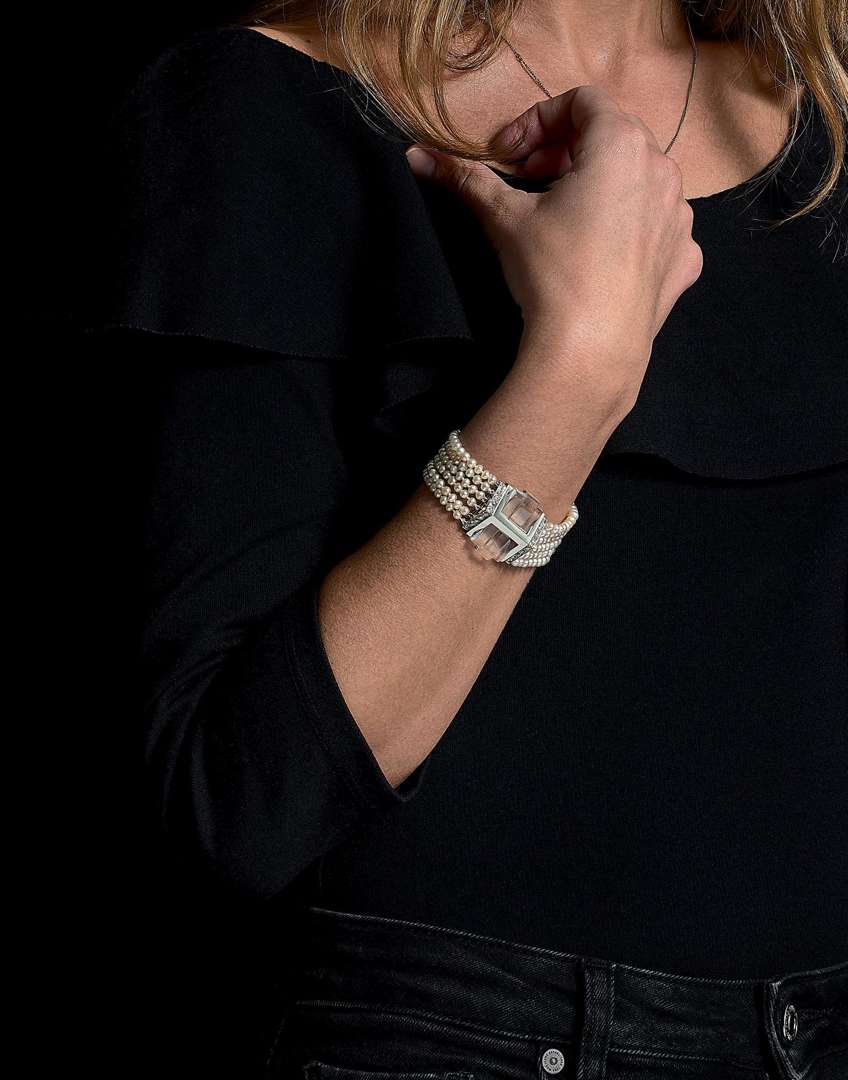
“Art Deco” bracelet
Fees include commission and taxes.
“Art Deco” bracelet
Strands of fine pearls; rock crystal
and diamond motifs;
18-carat gold (750) and platinum (950);
signed and hallmarked by Baudin (B.);
Length: approx. 17.2 cm – Weight: 38.4 g
A Boucheron bracelet, a symbol of the 1930s Geometric jewellery
of the Art Deco era
In the aftermath of the Great War, the world of fine art was undergoing a period of artistic transformation. We witnessed a simplification, or even a deconstruction, of forms, particularly with the Cubist movement.
These experiments extended to the world of jewellery. Art Deco jewellery broke free from the classical codes imposed by etiquette. The ornate excesses of Art Nouveau naturalism gave way to pure geometric forms with stylised motifs. This period also saw unprecedented combinations of gemstones never before used in fine jewellery: jade and onyx, turquoise and diamonds, or rubies and lapis lazuli.
Platinum was the metal of choice for the Art Deco movement; its whiteness, which never loses its lustre, along with its rigidity and strength, made it the ideal material for strictly geometric designs.
Typical of the Art Deco period, this bracelet combines fine pearls with sculptural, geometric forms crafted from rock crystal and diamonds set in a gold and platinum frame.
Louis Boucheron played an active role in the jewellery innovations of the Art Deco movement. He made a name for himself in particular at the 1931 Colonial Exhibition with jewellery inspired by African art.
The bracelets created by the House of Boucheron during this period demonstrate great modernity. Motifs featuring bridges and sloping sides, inspired by industrial architecture, were a recurring theme and were most often set with diamonds and sapphires. Boucheron took great care to ensure that the movement of the bracelet harmonised with that of the wrist.
Both supple, thanks to the fluidity of the fine beads, and static, due to the central motif and the solid rock crystal clasp, this bracelet in almost monochrome shades is an elegant testament to the aesthetic trends of the 1930s.
A Boucheron bracelet, a symbol of the 1930s Geometric jewellery
of the Art Deco era
In the aftermath of the Great War, the world of fine art was undergoing a period of artistic transformation. We witnessed a simplification, or even a deconstruction, of forms, particularly with the Cubist movement.
These experiments extended to the world of jewellery. Art Deco jewellery broke free from the classical codes imposed by etiquette. The ornate excesses of Art Nouveau naturalism gave way to pure geometric forms with stylised motifs. This period also saw unprecedented combinations of gemstones never before used in fine jewellery: jade and onyx, turquoise and diamonds, or rubies and lapis lazuli.
Platinum was the metal of choice for the Art Deco movement; its whiteness, which never loses its lustre, along with its rigidity and strength, made it the ideal material for strictly geometric designs.
Typical of the Art Deco period, this bracelet combines fine pearls with sculptural, geometric forms crafted from rock crystal and diamonds set in a gold and platinum frame.
Louis Boucheron played an active role in the jewellery innovations of the Art Deco movement. He made a name for himself in particular at the 1931 Colonial Exhibition with jewellery inspired by African art.
The bracelets created by the House of Boucheron during this period demonstrate great modernity. Motifs featuring bridges and sloping sides, inspired by industrial architecture, were a recurring theme and were most often set with diamonds and sapphires. Boucheron took great care to ensure that the movement of the bracelet harmonised with that of the wrist.
Both supple, thanks to the fluidity of the fine beads, and static, due to the central motif and the solid rock crystal clasp, this bracelet in almost monochrome shades is an elegant testament to the aesthetic trends of the 1930s.