
&w=3840&q=75)
&w=3840&q=75)
&w=3840&q=75)
&w=3840&q=75)
&w=3840&q=75)
&w=3840&q=75)
&w=3840&q=75)
&w=3840&q=75)


140
BERLIOZ Hector (1803-1869).
The item was sold for 2 504 €
Fees include commission and taxes.
BERLIOZ Hector (1803-1869).
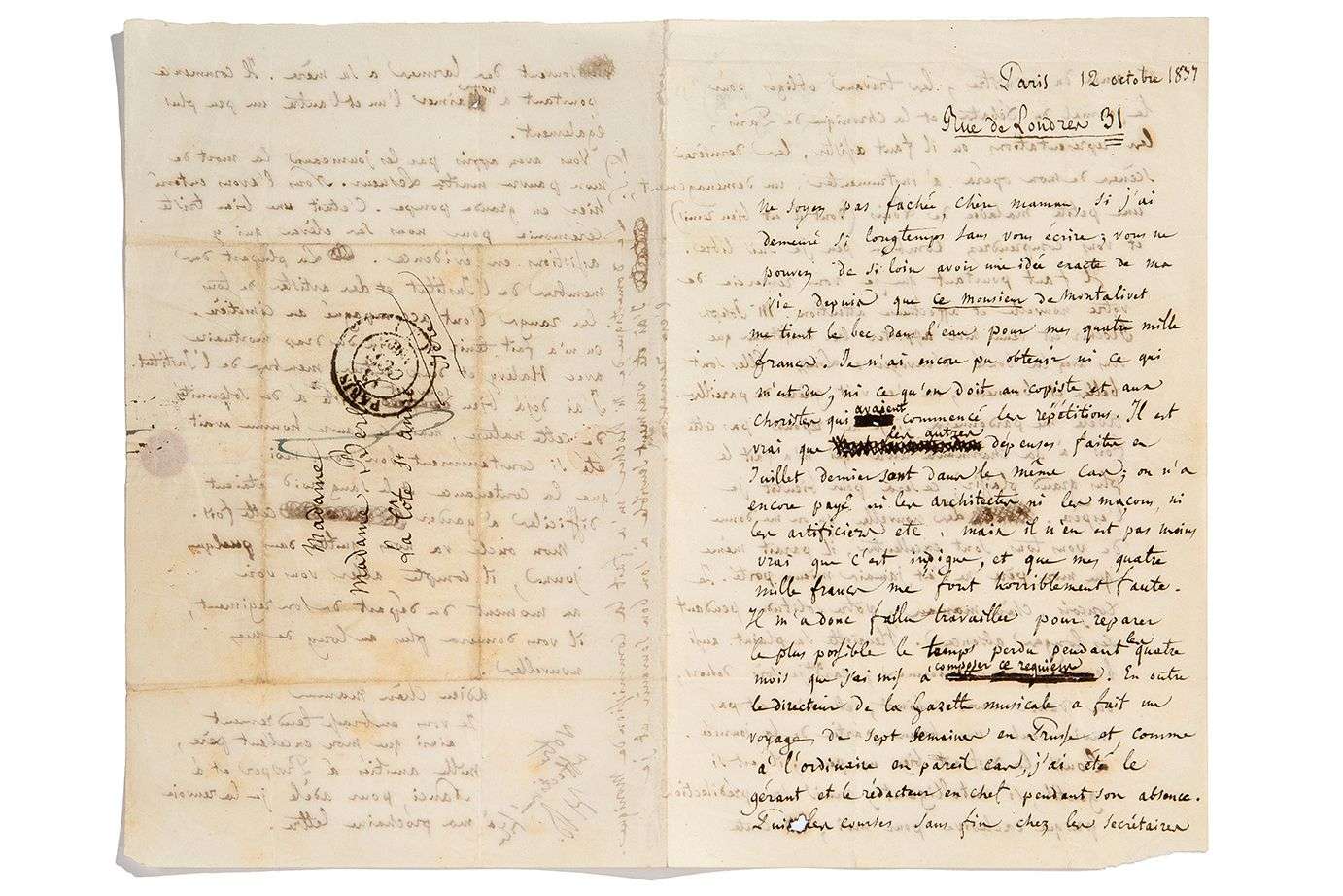
L.A.S. "H.B.", addressed to his mother, Mme Berlioz, at La Côte Saint-André. Paris, 12 October 1837. 3 pp. in-8. Scratches, corrections and additions.
About his Requiem (Grande Messe des Morts) and his opera Benvenuto Cellini:
Berlioz is waiting for a sum of four thousand francs owed by M. de Montalivet and has not been able to pay a copyist and his choristers "who had begun rehearsals". He adds 'It is true that the expenses incurred last July are in the same situation| the architects, the masons, the artificers, etc. have not yet been paid, but it is no less true that this is unworthy, and that my four thousand francs are horribly in default. So I had to work to make up as much as possible for the time lost during the four months it took me to compose this requiem. Berlioz is short of time: he held the role of manager and editor of the musical gazette, during the trip to Prussia of the director, Maurice Schlesinger (1798-1871), his musical columns in the Journal des débats and the Chronique de Paris, "endless errands among the secretaries and friends of the minister [of the Interior, Adrien de Gasparin, sponsor of the Requiem], the performances that must be attended, the last scenes of my opera to be instrumented [Benvenuto Cellini, Berlioz's famous opera on a libretto by Léon de Wailly and Auguste Barbier], a move, a little illness," etc. He mentions his father, Adèle, and his wife. He mentions his father, Adèle, Henriette, Prosper, Nanci, Monique, his son Louis "he is beginning to love both of us", etc. Berlioz mentions the death of his mentor, the composer Jean-François Lesueur (1760-1837), which had occurred 6 days earlier: "You have learned from the newspapers the death of my poor master Lesueur. We buried him yesterday with great pomp. It was a very sad ceremony [...]. Most of the members of the Institute and artists of all ranks accompanied him to the cemetery. I was made to hold a corner of the funeral sheet with Halèvy [...] ". Berlioz was overwhelmed: "this poor man had been so constantly good to me that composure and composure were difficult to maintain". Letter published in Hector Berlioz, Correspondance générale, II, p. 367, Flammarion, 1972.
L.A.S. "H.B.", addressed to his mother, Mme Berlioz, at La Côte Saint-André. Paris, 12 October 1837. 3 pp. in-8. Scratches, corrections and additions.
About his Requiem (Grande Messe des Morts) and his opera Benvenuto Cellini:
Berlioz is waiting for a sum of four thousand francs owed by M. de Montalivet and has not been able to pay a copyist and his choristers "who had begun rehearsals". He adds 'It is true that the expenses incurred last July are in the same situation| the architects, the masons, the artificers, etc. have not yet been paid, but it is no less true that this is unworthy, and that my four thousand francs are horribly in default. So I had to work to make up as much as possible for the time lost during the four months it took me to compose this requiem. Berlioz is short of time: he held the role of manager and editor of the musical gazette, during the trip to Prussia of the director, Maurice Schlesinger (1798-1871), his musical columns in the Journal des débats and the Chronique de Paris, "endless errands among the secretaries and friends of the minister [of the Interior, Adrien de Gasparin, sponsor of the Requiem], the performances that must be attended, the last scenes of my opera to be instrumented [Benvenuto Cellini, Berlioz's famous opera on a libretto by Léon de Wailly and Auguste Barbier], a move, a little illness," etc. He mentions his father, Adèle, and his wife. He mentions his father, Adèle, Henriette, Prosper, Nanci, Monique, his son Louis "he is beginning to love both of us", etc. Berlioz mentions the death of his mentor, the composer Jean-François Lesueur (1760-1837), which had occurred 6 days earlier: "You have learned from the newspapers the death of my poor master Lesueur. We buried him yesterday with great pomp. It was a very sad ceremony [...]. Most of the members of the Institute and artists of all ranks accompanied him to the cemetery. I was made to hold a corner of the funeral sheet with Halèvy [...] ". Berlioz was overwhelmed: "this poor man had been so constantly good to me that composure and composure were difficult to maintain". Letter published in Hector Berlioz, Correspondance générale, II, p. 367, Flammarion, 1972.