
&w=3840&q=75)
&w=3840&q=75)
&w=3840&q=75)
&w=3840&q=75)
&w=3840&q=75)
&w=3840&q=75)
&w=3840&q=75)
&w=3840&q=75)


85
HUGO Victor (1802-1885).
The item was sold for 1 581 €
Fees include commission and taxes.
HUGO Victor (1802-1885).
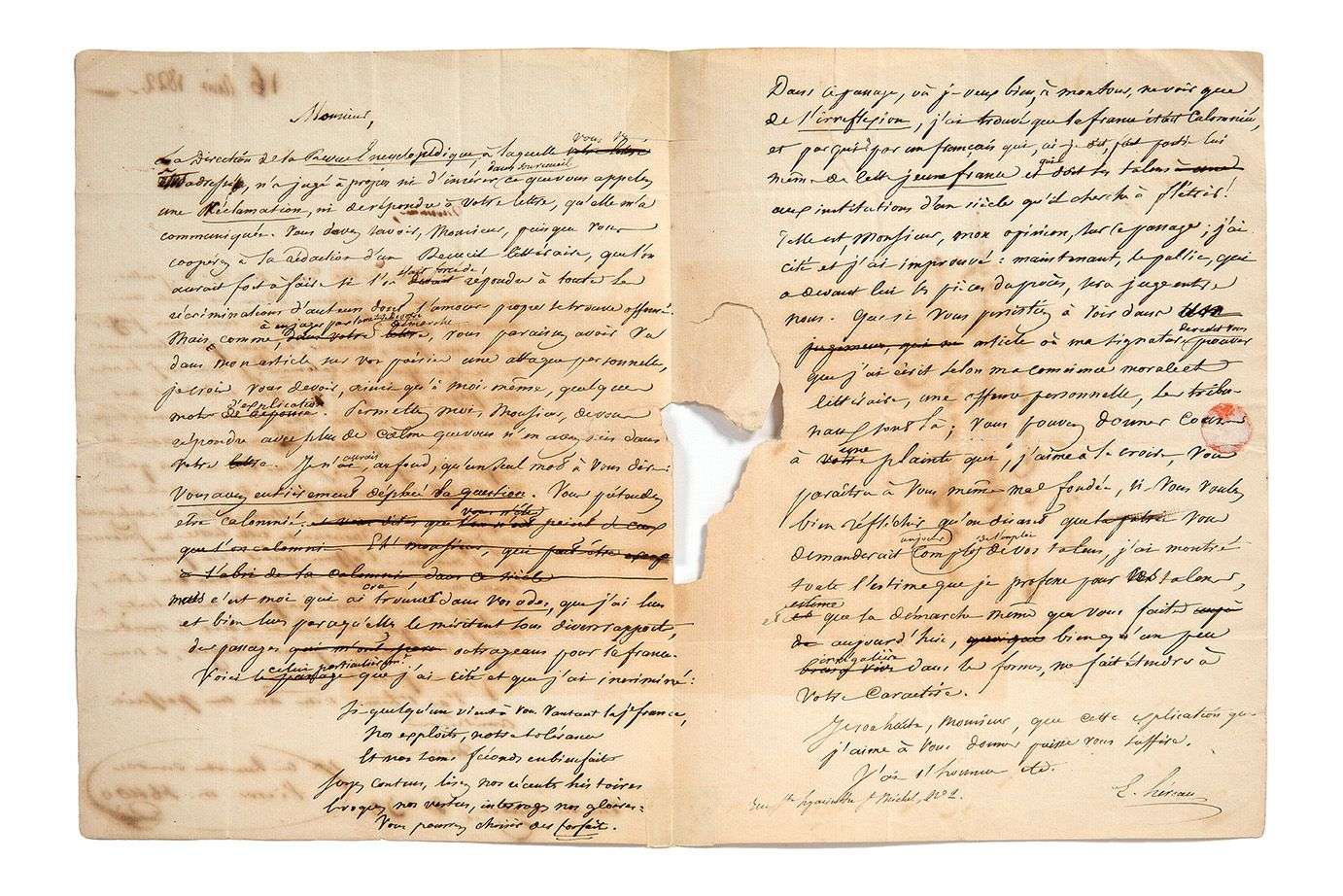
L.A.S. "Victor m. Hugo", Paris, August 16, 1822, addressed to Edme HEREAU, director of the Revue encyclopédique.
1 page in-4 (marginal tear due to the opening without affecting the text).
Polémique autour des Odes et poésies diverses Autograph letter signed " Victor m. Hugo " to the director of the Revue encyclopédique Edme Héreau with autograph apostille signed by him. Paris, August 16, 1822. One p. in-4, address on the back, marginal tear due to the opening without affecting the text. Rare letter concerning his first poetic collection: "I have just read in your n° of July an article which concerns me and in this article a formal accusation of calumny towards my country. I am not, sir, of the people who slander nor of the people who are slandered. I love and honor my country more than anyone else. If my verses were worth reading carefully, the editor would have found in them the very opposite of what he reproaches me for. I am willing to see nothing but thoughtlessness in this sentence of an article whose literary part is moreover full of indulgence, and I hope that the insertion of this letter will prove to me that he disavows the offense he has allowed himself against me. I don't know if, as he wants to say, my country will ask me for an account of my talents, but I know that I will ask everyone for an account of an outrage. No praise, if you wish, but no slander...". Edme Héreau wrote the draft of his answer on the two inside pages: "... You claim to be slandered, but it is I who thought to find in your Odes, which I read and read well because they deserve it in various respects, passages outrageous for France. Here is the one in particular that I quoted and that I incriminated: "If someone comes to you praising young France, Our exploits, our tolerance, And our times fertile in benefits Be content, read our recent histories, Evoke our virtues, question our glories: You will be able to choose some forfeits!" In this passage, where I am willing, in my turn, to see only thoughtlessness, I found that France was slandered, and by whom? by a Frenchman who, I said, is himself part of this young France and who owes his talents to the institutions of a century he seeks to wither! Such is, Sir, my opinion on this passage| I have quoted and I have imprecated: now the public, which has before it the pieces of the trial, will be the judge between us. If you persist in seeing in an article where my signature should prove to you that I have written according to my moral and literary conscience, a personal matter, the courts are there| you can give course to a complaint which, I like to believe, will appear to you to be ill-founded, if you will reflect that by saying that the fatherland would one day ask you for an account of the use of your talents, I have shown all the esteem that I have for these talents, which the very step that you are taking today, although a little irregular in form, makes me extend to your character...
L.A.S. "Victor m. Hugo", Paris, August 16, 1822, addressed to Edme HEREAU, director of the Revue encyclopédique.
1 page in-4 (marginal tear due to the opening without affecting the text).
Polémique autour des Odes et poésies diverses Autograph letter signed " Victor m. Hugo " to the director of the Revue encyclopédique Edme Héreau with autograph apostille signed by him. Paris, August 16, 1822. One p. in-4, address on the back, marginal tear due to the opening without affecting the text. Rare letter concerning his first poetic collection: "I have just read in your n° of July an article which concerns me and in this article a formal accusation of calumny towards my country. I am not, sir, of the people who slander nor of the people who are slandered. I love and honor my country more than anyone else. If my verses were worth reading carefully, the editor would have found in them the very opposite of what he reproaches me for. I am willing to see nothing but thoughtlessness in this sentence of an article whose literary part is moreover full of indulgence, and I hope that the insertion of this letter will prove to me that he disavows the offense he has allowed himself against me. I don't know if, as he wants to say, my country will ask me for an account of my talents, but I know that I will ask everyone for an account of an outrage. No praise, if you wish, but no slander...". Edme Héreau wrote the draft of his answer on the two inside pages: "... You claim to be slandered, but it is I who thought to find in your Odes, which I read and read well because they deserve it in various respects, passages outrageous for France. Here is the one in particular that I quoted and that I incriminated: "If someone comes to you praising young France, Our exploits, our tolerance, And our times fertile in benefits Be content, read our recent histories, Evoke our virtues, question our glories: You will be able to choose some forfeits!" In this passage, where I am willing, in my turn, to see only thoughtlessness, I found that France was slandered, and by whom? by a Frenchman who, I said, is himself part of this young France and who owes his talents to the institutions of a century he seeks to wither! Such is, Sir, my opinion on this passage| I have quoted and I have imprecated: now the public, which has before it the pieces of the trial, will be the judge between us. If you persist in seeing in an article where my signature should prove to you that I have written according to my moral and literary conscience, a personal matter, the courts are there| you can give course to a complaint which, I like to believe, will appear to you to be ill-founded, if you will reflect that by saying that the fatherland would one day ask you for an account of the use of your talents, I have shown all the esteem that I have for these talents, which the very step that you are taking today, although a little irregular in form, makes me extend to your character...