
&w=3840&q=75)
&w=3840&q=75)
&w=3840&q=75)
&w=3840&q=75)
&w=3840&q=75)
&w=3840&q=75)
&w=3840&q=75)
&w=3840&q=75)


54
BARBEY D'AUREVILLY Jules (1808-1889).
The item was sold for 3 120 €
Fees include commission and taxes.
BARBEY D'AUREVILLY Jules (1808-1889).
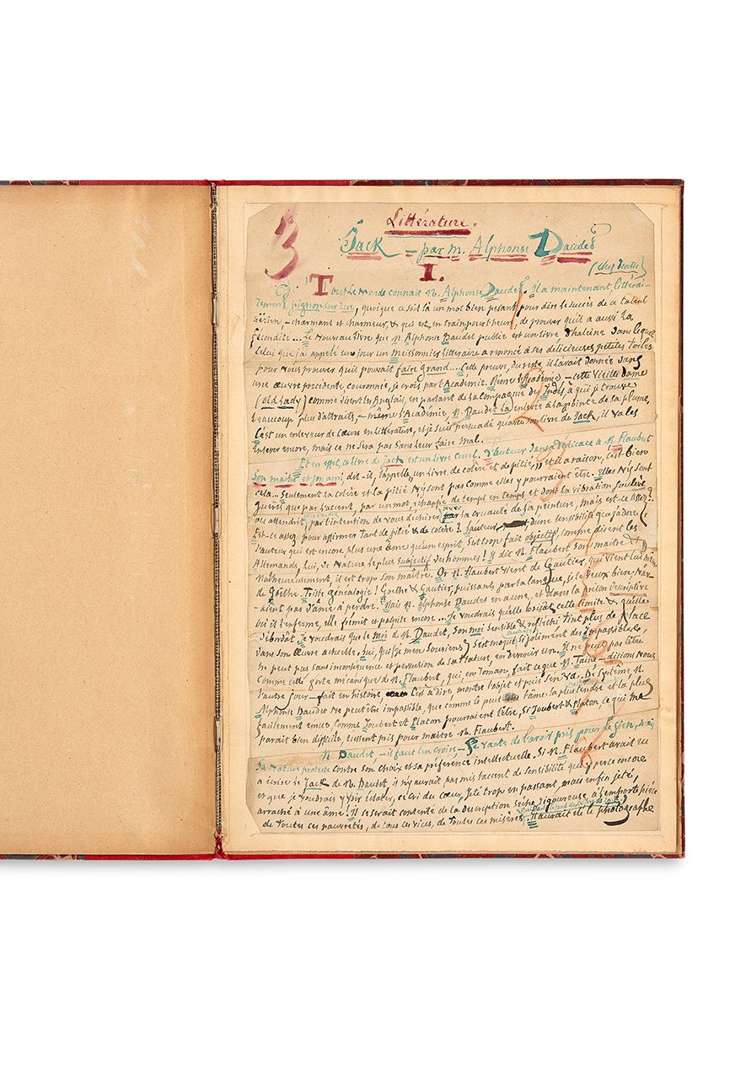
Autograph manuscript signed "J. Barbey d'Aurevilly", entitled "Jack by M. Alphonse DAUDET", [1876].
5 folio pages, cut out for printing and reassembled (marginal losses) on 5 sheets of buff paper, bound in red half-percaline.
INTERESTING CRITIQUE OF ALPHONSE DAUDET'S JACK (Dentu, 1876), AND VIGOUROUS ATTACK OF THE NATURALIST ROMAN.
The article was published in Le Constitutionnel of February 28, 1876, and collected in volume XVIII of Les œuvres et les Hommes : Le Roman contemporain (Lemerre, 1902)
The manuscript, superbly traced in black, green and red inks, was cut into 47 numbered strips in red pencil to speed up the composition| the small fragments 25, 26, 35, 37, 39 and 40 are missing. It presents some erasures and corrections
It presents some erasures and corrections "Everyone knows Mr. Alphonse Daudet. He has now, literarily, a foothold on the street, although this is a very heavy word to say the success of this airy talent, - charming and charming, and which is proving, for the time being, that it also has fertility. Jack is "a book of breath", and "a cruel book", that Daudet dedicated to Flaubert: "He says M. Flaubert his master and unfortunately, he is too much his master. Now M. Flaubert comes from Gautier, who himself comes from Goëthe. Sad genealogy! " Daudet has locked his soul "in the descriptive prison [...] I would like M. Daudet's self, his sensitive and reflective self, to have more space in his current work". He cannot become one of these Impassibles of whom he made fun: "his nature protests against his choice and his intellectual preference". But this "book of anger and pity" suffers from taking as models the "describers", and "the artist made to give us the noblest spectacles, the most aristocratic and ideal things, turned away from all this poetry to paint us the lowest realities. The little blue flame of the capricious and charming geniuses that he has in his mind, this man, of delicate fancy, walks it and makes it crawl on abject and repulsive subjects, under the pretext of contemporary mores to reproduce [...] The subject of Jack's novel is prosaic, common, yes, and even abject| and all the talent of the writer, shining in a crowd of details, saves neither its painful abasement, nor its worse vulgarity ". He went looking for his subject in the mire. His book is therefore the tragic story of the powerless, vain, envious bohemians of which this unfortunate modern and revolutionized world is teeming. In order to better understand their ignominy, M. Daudet used a word, much said in that world, he called them: the losers, ... and the bold use of this word, which appears, I believe for the first time in a book of style, will perhaps make its fortune. Jack is himself a loser, "and who misses since his birth, since he is the bastard of a maintained girl. Now it is this misfortune of birth which weighs on him and pushes him into all the miseries of his life... M. Daudet could have made a hero of him, because there are bastards who are heroes, who go up by dint of heart, will and energy this torrent of bastardy which drags Jack to the last misfortunes and to the most lamentable catastrophes. But Jack matters much less to the novelist than the environment in which he lives and succumbs. Jack for him is an opportunity to paint the losers| he is the scapegoat of the losers"| but "it is impossible for the disgusted imagination to be interested in this Jack, imbecile, sentimental and loser [...] Such is the defect of the armor of this novel. The uninteresting! "... Throughout the two volumes, "it is a heap of baseness, infamy, ridicule, platitudes, misery of all kinds ... ".
Autograph manuscript signed "J. Barbey d'Aurevilly", entitled "Jack by M. Alphonse DAUDET", [1876].
5 folio pages, cut out for printing and reassembled (marginal losses) on 5 sheets of buff paper, bound in red half-percaline.
INTERESTING CRITIQUE OF ALPHONSE DAUDET'S JACK (Dentu, 1876), AND VIGOUROUS ATTACK OF THE NATURALIST ROMAN.
The article was published in Le Constitutionnel of February 28, 1876, and collected in volume XVIII of Les œuvres et les Hommes : Le Roman contemporain (Lemerre, 1902)
The manuscript, superbly traced in black, green and red inks, was cut into 47 numbered strips in red pencil to speed up the composition| the small fragments 25, 26, 35, 37, 39 and 40 are missing. It presents some erasures and corrections
It presents some erasures and corrections "Everyone knows Mr. Alphonse Daudet. He has now, literarily, a foothold on the street, although this is a very heavy word to say the success of this airy talent, - charming and charming, and which is proving, for the time being, that it also has fertility. Jack is "a book of breath", and "a cruel book", that Daudet dedicated to Flaubert: "He says M. Flaubert his master and unfortunately, he is too much his master. Now M. Flaubert comes from Gautier, who himself comes from Goëthe. Sad genealogy! " Daudet has locked his soul "in the descriptive prison [...] I would like M. Daudet's self, his sensitive and reflective self, to have more space in his current work". He cannot become one of these Impassibles of whom he made fun: "his nature protests against his choice and his intellectual preference". But this "book of anger and pity" suffers from taking as models the "describers", and "the artist made to give us the noblest spectacles, the most aristocratic and ideal things, turned away from all this poetry to paint us the lowest realities. The little blue flame of the capricious and charming geniuses that he has in his mind, this man, of delicate fancy, walks it and makes it crawl on abject and repulsive subjects, under the pretext of contemporary mores to reproduce [...] The subject of Jack's novel is prosaic, common, yes, and even abject| and all the talent of the writer, shining in a crowd of details, saves neither its painful abasement, nor its worse vulgarity ". He went looking for his subject in the mire. His book is therefore the tragic story of the powerless, vain, envious bohemians of which this unfortunate modern and revolutionized world is teeming. In order to better understand their ignominy, M. Daudet used a word, much said in that world, he called them: the losers, ... and the bold use of this word, which appears, I believe for the first time in a book of style, will perhaps make its fortune. Jack is himself a loser, "and who misses since his birth, since he is the bastard of a maintained girl. Now it is this misfortune of birth which weighs on him and pushes him into all the miseries of his life... M. Daudet could have made a hero of him, because there are bastards who are heroes, who go up by dint of heart, will and energy this torrent of bastardy which drags Jack to the last misfortunes and to the most lamentable catastrophes. But Jack matters much less to the novelist than the environment in which he lives and succumbs. Jack for him is an opportunity to paint the losers| he is the scapegoat of the losers"| but "it is impossible for the disgusted imagination to be interested in this Jack, imbecile, sentimental and loser [...] Such is the defect of the armor of this novel. The uninteresting! "... Throughout the two volumes, "it is a heap of baseness, infamy, ridicule, platitudes, misery of all kinds ... ".