
&w=3840&q=75)
&w=3840&q=75)
&w=3840&q=75)
&w=3840&q=75)
&w=3840&q=75)
&w=3840&q=75)
&w=3840&q=75)
&w=3840&q=75)


19
BARTOLOMÉ ESTEBAN MURILLO SÉVILLE, 1617 - 1682
The item was sold for 641 600 €
Fees include commission and taxes.
BARTOLOMÉ ESTEBAN MURILLO SÉVILLE, 1617 - 1682
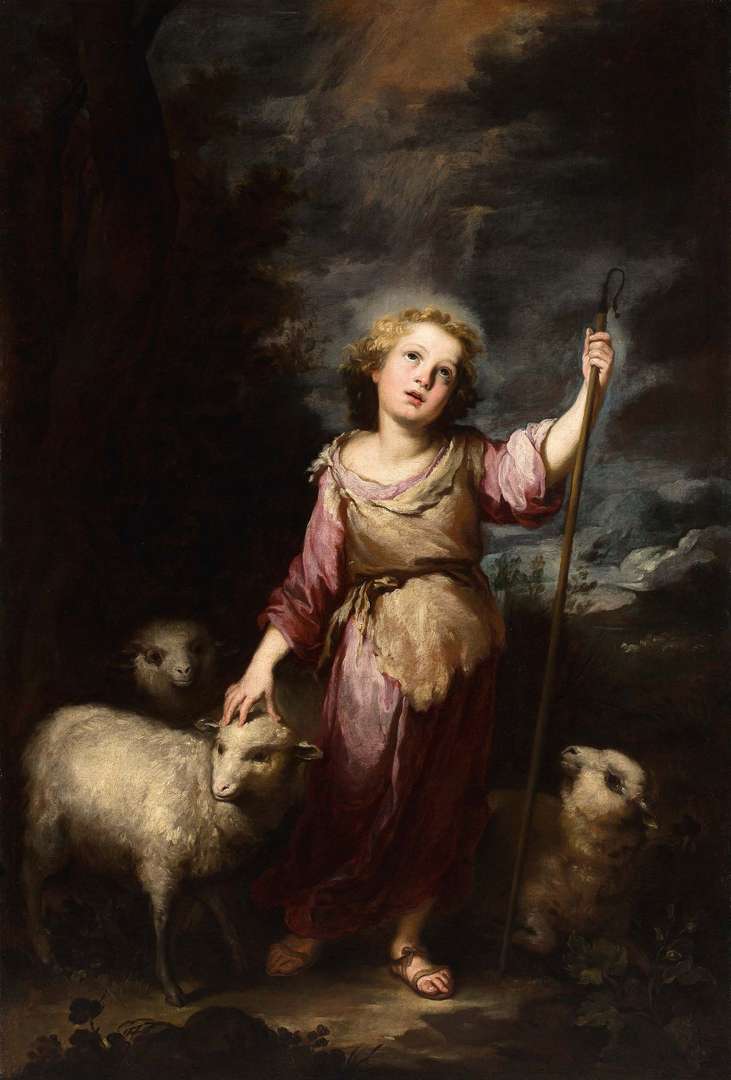
The Good Shepherd
Oil on canvas
65 x 44 1/8 in.
Because of its stylistic characteristics, this work can be considered to be by Bartolomé Estaban Murillo, a work of which he made several versions at the request of the Sevillian public of his time, due to the beauty of the exe - cution. This subject is usually always paired with a St. John the Baptist child, although due to historical circumstances they have not always been preserved together, as is the case with those in the George Lane Collection at Asthon Wold, Peterborough, England, and its counterpart, now in the National Gallery in London (Fig. 1). In this Child Jesus the Good Shepherd, Murillo’s technique is perfectly identifiable in the compo - sition, the drawing, the coloring, and above all in the expressiveness with which the artist has managed to capture the gentle and tender figure of the Child who raises his eyes to heaven. With emotion, he expresses his gratitude for having been able to recover a lost sheep to reintegrate it into his flock. Naturally, the sheep is the sym - bol of the soul that has strayed from Christian doctrine and gone astray, which motivates the good shepherd to seek it out and bring it back into the fold of faith. Murillo’s transposition of the figure of Christ the Good Shepherd into Sevillian painting, in the guise of a child and not an adult, is important: the painter uses a pictorial effect that intensifies the love and tenderness that he manifests as the guardian and protector of souls. One notices in this work the sense of childlike beauty, captured with intense physical and spiri - tual splendor, in which the beautiful facial features of the head stand out, haloed by a golden glow, forming a model that seduces the viewer and conveys to him the security and confidence that his soul will never be in danger of being lost in hell, for he will always offer him the security of his protection and shelter. This painting is striking for its harmonious and soft coloring, thanks to which Murillo first resolves the modesty of the Child’s clothing, which consists of a simple purple tunic. The humble condition of the Good Shepherd is reinforced in the painting by the appearance of simple sandals that leave his small feet uncovered. Other interesting details are visible in this work, such as the good treatment of the texture of the white wool of the sheepskins, on which the intense light falls and makes their qualities clearly tactile. The figure of Jesus is supported by a soft and idyllic landscape, covered on the right by dense thickets and copses that create an area of semidarkness and contrast with the bright sky that opens on the right, where we can see the descrip - tion of the flock of sheep that the Good Shepherd abandoned to go and look for the one who got lost. In the upper part, golden clouds appear, alluding to the celestial glory and therefore to the sky with which Jesus communicates. Given its stylistic characteristics, this work can be dated to around 1660-1665, a period in which Murillo reached his full artistic maturity. The original provenance of this painting is unknown, but it may well be the painting that formed a pair with a Child Saint John the Baptist placed on the ephemeral altar (Fig. 2) erected in Seville in 1665 for the festivities celebrating the inauguration of the church of Santa María de la Blanca. The religious theme of the good shepherd tending his sheep is found in the Gospel of Luke (Luke 15:4-7), where Christ, addressing the Scribes and Pharisees, explains that if a shepherd with a hundred sheep loses one of them, he leaves the other ninety-nine and goes to look for the one that has strayed. The first artistic interpretations of this passage appear in early Christian art, in the paintings of the catacombs, in the reliefs of sarcophagi and in mosaics. Later, in the Middle Ages and the Renaissance, it disappears to be recovered in Spain, especially in Seville, where it is brilliantly interpreted by Murillo. Through this scene, the Church clearly wanted to remind us that Christ is still looking for the souls of those who have turned away from him, abandoning the faith. There is some known information about the pro - venance of this painting, the earliest of which is that it was part of a private collection in France for which it was acquired in 1764 from a daughter of Monsieur Goupil, known as Madame Duval. There are references to the fact that the last owners and their descendants have always considered the painting to be an original by Murillo. Enrique Valdivieso González, professor emeritus of the University of Seville and author of the catalog raisonné of Bartolomé Estaban Murillo (Madrid, 2010)
The Good Shepherd
Oil on canvas
65 x 44 1/8 in.
Because of its stylistic characteristics, this work can be considered to be by Bartolomé Estaban Murillo, a work of which he made several versions at the request of the Sevillian public of his time, due to the beauty of the exe - cution. This subject is usually always paired with a St. John the Baptist child, although due to historical circumstances they have not always been preserved together, as is the case with those in the George Lane Collection at Asthon Wold, Peterborough, England, and its counterpart, now in the National Gallery in London (Fig. 1). In this Child Jesus the Good Shepherd, Murillo’s technique is perfectly identifiable in the compo - sition, the drawing, the coloring, and above all in the expressiveness with which the artist has managed to capture the gentle and tender figure of the Child who raises his eyes to heaven. With emotion, he expresses his gratitude for having been able to recover a lost sheep to reintegrate it into his flock. Naturally, the sheep is the sym - bol of the soul that has strayed from Christian doctrine and gone astray, which motivates the good shepherd to seek it out and bring it back into the fold of faith. Murillo’s transposition of the figure of Christ the Good Shepherd into Sevillian painting, in the guise of a child and not an adult, is important: the painter uses a pictorial effect that intensifies the love and tenderness that he manifests as the guardian and protector of souls. One notices in this work the sense of childlike beauty, captured with intense physical and spiri - tual splendor, in which the beautiful facial features of the head stand out, haloed by a golden glow, forming a model that seduces the viewer and conveys to him the security and confidence that his soul will never be in danger of being lost in hell, for he will always offer him the security of his protection and shelter. This painting is striking for its harmonious and soft coloring, thanks to which Murillo first resolves the modesty of the Child’s clothing, which consists of a simple purple tunic. The humble condition of the Good Shepherd is reinforced in the painting by the appearance of simple sandals that leave his small feet uncovered. Other interesting details are visible in this work, such as the good treatment of the texture of the white wool of the sheepskins, on which the intense light falls and makes their qualities clearly tactile. The figure of Jesus is supported by a soft and idyllic landscape, covered on the right by dense thickets and copses that create an area of semidarkness and contrast with the bright sky that opens on the right, where we can see the descrip - tion of the flock of sheep that the Good Shepherd abandoned to go and look for the one who got lost. In the upper part, golden clouds appear, alluding to the celestial glory and therefore to the sky with which Jesus communicates. Given its stylistic characteristics, this work can be dated to around 1660-1665, a period in which Murillo reached his full artistic maturity. The original provenance of this painting is unknown, but it may well be the painting that formed a pair with a Child Saint John the Baptist placed on the ephemeral altar (Fig. 2) erected in Seville in 1665 for the festivities celebrating the inauguration of the church of Santa María de la Blanca. The religious theme of the good shepherd tending his sheep is found in the Gospel of Luke (Luke 15:4-7), where Christ, addressing the Scribes and Pharisees, explains that if a shepherd with a hundred sheep loses one of them, he leaves the other ninety-nine and goes to look for the one that has strayed. The first artistic interpretations of this passage appear in early Christian art, in the paintings of the catacombs, in the reliefs of sarcophagi and in mosaics. Later, in the Middle Ages and the Renaissance, it disappears to be recovered in Spain, especially in Seville, where it is brilliantly interpreted by Murillo. Through this scene, the Church clearly wanted to remind us that Christ is still looking for the souls of those who have turned away from him, abandoning the faith. There is some known information about the pro - venance of this painting, the earliest of which is that it was part of a private collection in France for which it was acquired in 1764 from a daughter of Monsieur Goupil, known as Madame Duval. There are references to the fact that the last owners and their descendants have always considered the painting to be an original by Murillo. Enrique Valdivieso González, professor emeritus of the University of Seville and author of the catalog raisonné of Bartolomé Estaban Murillo (Madrid, 2010)