
&w=3840&q=75)
&w=3840&q=75)
&w=3840&q=75)
&w=3840&q=75)
&w=3840&q=75)
&w=3840&q=75)


142
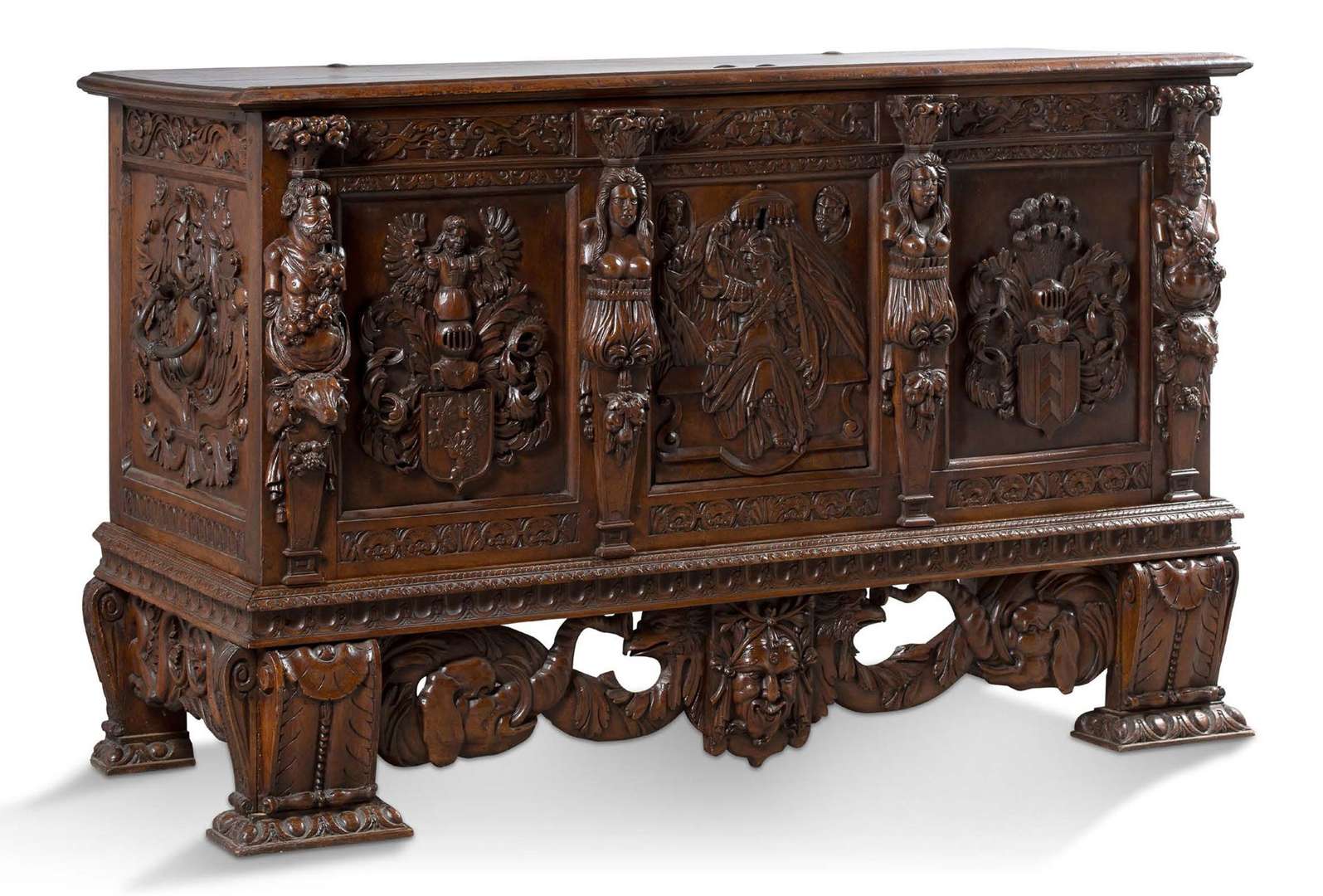
RARE COFFRE DE MARIAGE NEUCHÂTELOIS en noyer richement sculpté. La façade
The item was sold for 45 500 €
Fees include commission and taxes.
RARE NEUCHÂTELOIS WEDDING CHEST in richly carved walnut. The front is decorated with three panels framed by four columns of terms decorated with two female and two male figures surmounting deer heads. The decoration of the front panels presents the coat of arms of the de Watteville family on the left panel and of the Neuchâtel family on the right. The central panel is an allegory of Justice holding the sword and the scales, she stands under a canopy over the lock entrance of the cabinet, framed by two faces in medallions, one female on the left, the other male on the right. The chest is framed with friezes decorated with foliage and dragons on the front and side panels decorated with chimeras and foliage. The chest rests on a large and imposing base decorated with interlacing friezes and offers a base with openwork decoration of elephants between which sits a grotesque man's face. There is a lock under the central panel and two large wrought iron handles on the side panels. In the chest, hinges joining the back and the flap of the piece of furniture are chiseled. The flap of the chest opens on a space including another small chest on the left side.Switzerland, Neuchâtel, end of the 16th, beginning of the 17th century
Height : 106 cm - Width : 168 cm Depth : 64,5 cm (good general condition, no visible missing parts, scratches, traces of use)
We have to link this piece of furniture with the Bahut d'Elisabeth de Neuchâtel (fig.), a very rare piece of Swiss historical furniture whose decorations and dimensions (identical) are in perfect harmony with the chest we are presenting. Designed at the beginning of the 17th century, shortly before the marriage of Elisabeth de Neuchâtel to Pierre de Wallier, lord of Cressier and Chandon, this piece of furniture is currently preserved by the descendants of the first owner, Elisabeth de Neuchâtel, the de Techtermann de Bionnens family. The purpose of this chest was to contain the trousseau of the second daughter of Béat-Jacob de Neuchâtel, Baron of Gorgier, and Anne de Watteville. The coats of arms on the trunk of Elisabeth de Neuchâtel and the one we are presenting, Watteville and Neuchâtel, could lead us to consider our trunk as either a counterpart to the trunk of Elisabeth de Neuchâtel, or its predecessor intended for Elisabeth's parents: Beat Jacob de Neuchâtel, lord of Gorgier and husband in 1592 of Anne de Watteville.
The iconographic repertoire used on our chest is reminiscent of that of Hugues Sambin whose work "OEuvre de la diversité des termes" published in 1572 exposes numerous figures of analogous terms. It is this iconographic proximity that makes Olivier Clottu assume a Burgundian origin in the Comtoise region, which leads him to believe that Sambin or his heirs in the Dijon workshops were the creators.
COMPARATIVE BIBLIOGRAPHY
- Max de Diesbach, Le bahut d'Elisabeth de Neuchâtel in Fribourg artistique à travers les âges, 1893 (illustration plate X)
- Olivier Clottu, Le coffre de mariage armorié neuchâtelois in Archives héraldiques suisses, 1984. Pages 66 and 67.
- Musée Neuchâtelois, recueil d'histoire nationale et d'archéologie, 1903. Pages 189 to 192.
Height : 106 cm - Width : 168 cm Depth : 64,5 cm (good general condition, no visible missing parts, scratches, traces of use)
We have to link this piece of furniture with the Bahut d'Elisabeth de Neuchâtel (fig.), a very rare piece of Swiss historical furniture whose decorations and dimensions (identical) are in perfect harmony with the chest we are presenting. Designed at the beginning of the 17th century, shortly before the marriage of Elisabeth de Neuchâtel to Pierre de Wallier, lord of Cressier and Chandon, this piece of furniture is currently preserved by the descendants of the first owner, Elisabeth de Neuchâtel, the de Techtermann de Bionnens family. The purpose of this chest was to contain the trousseau of the second daughter of Béat-Jacob de Neuchâtel, Baron of Gorgier, and Anne de Watteville. The coats of arms on the trunk of Elisabeth de Neuchâtel and the one we are presenting, Watteville and Neuchâtel, could lead us to consider our trunk as either a counterpart to the trunk of Elisabeth de Neuchâtel, or its predecessor intended for Elisabeth's parents: Beat Jacob de Neuchâtel, lord of Gorgier and husband in 1592 of Anne de Watteville.
The iconographic repertoire used on our chest is reminiscent of that of Hugues Sambin whose work "OEuvre de la diversité des termes" published in 1572 exposes numerous figures of analogous terms. It is this iconographic proximity that makes Olivier Clottu assume a Burgundian origin in the Comtoise region, which leads him to believe that Sambin or his heirs in the Dijon workshops were the creators.
COMPARATIVE BIBLIOGRAPHY
- Max de Diesbach, Le bahut d'Elisabeth de Neuchâtel in Fribourg artistique à travers les âges, 1893 (illustration plate X)
- Olivier Clottu, Le coffre de mariage armorié neuchâtelois in Archives héraldiques suisses, 1984. Pages 66 and 67.
- Musée Neuchâtelois, recueil d'histoire nationale et d'archéologie, 1903. Pages 189 to 192.