
&w=3840&q=75)
&w=3840&q=75)
&w=3840&q=75)
&w=3840&q=75)
&w=3840&q=75)
&w=3840&q=75)
&w=3840&q=75)
&w=3840&q=75)


346
CHINE FIN DE LA PÉRIODE MING - DÉBUT DE LA PÉRIODE QING
The item was sold for 20 800 €
Fees include commission and taxes.
CHINE FIN DE LA PÉRIODE MING - DÉBUT DE LA PÉRIODE QING
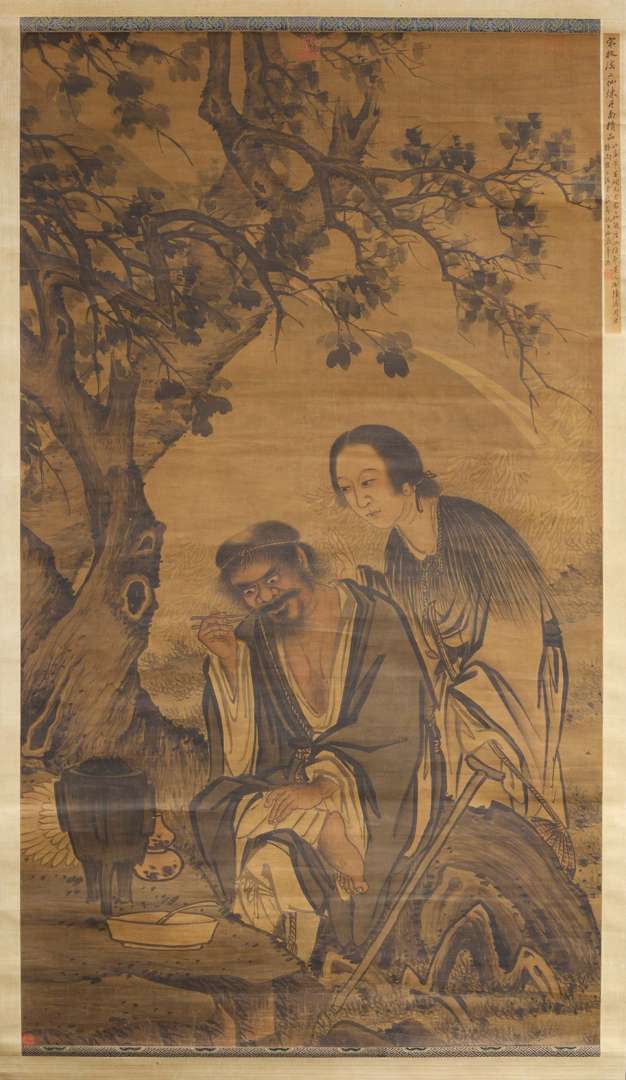
Large ink painting on silk, mounted in a vertical scroll, representing two of the eight
Taoist Immortals, Li Tieguai, also known as Li the Limping One, and He Xiangu, the former seated on a tree trunk, his cane at his side, preparing cinnabar, a piece of which he looks at closely, while the latter, standing behind him, observes what he is doing.
Unsigned, with stamps. A late collophon, probably from the nineteenth century, associated with the painting, in the upper right corner, and signed
Duan Fang, states that it was painted by Muxi (Muqi, a thirteenth-century Buddhist painter and monk). This collophon describes the scene and praises the technique.
Dim. 158 x 92 cm
N.B.
This painting has also been attributed to the painter Yan Hui, active in the late Song and early Yuan periods. It is a fact that one of the artist's favorite themes was the Taoist Immortals which he treated in a style quite similar to our painting.
However, comparing it with some of the few known paintings of the artist, most of which are preserved in Japan, a later date seems more likely.
N.B.
Export authorization passport issued by the Guimet Museum.
Large ink painting on silk, mounted in a vertical scroll, representing two of the eight
Taoist Immortals, Li Tieguai, also known as Li the Limping One, and He Xiangu, the former seated on a tree trunk, his cane at his side, preparing cinnabar, a piece of which he looks at closely, while the latter, standing behind him, observes what he is doing.
Unsigned, with stamps. A late collophon, probably from the nineteenth century, associated with the painting, in the upper right corner, and signed
Duan Fang, states that it was painted by Muxi (Muqi, a thirteenth-century Buddhist painter and monk). This collophon describes the scene and praises the technique.
Dim. 158 x 92 cm
N.B.
This painting has also been attributed to the painter Yan Hui, active in the late Song and early Yuan periods. It is a fact that one of the artist's favorite themes was the Taoist Immortals which he treated in a style quite similar to our painting.
However, comparing it with some of the few known paintings of the artist, most of which are preserved in Japan, a later date seems more likely.
N.B.
Export authorization passport issued by the Guimet Museum.