
&w=3840&q=75)
&w=3840&q=75)
&w=3840&q=75)
&w=3840&q=75)
&w=3840&q=75)
&w=3840&q=75)
&w=3840&q=75)
&w=3840&q=75)


QUENEAU Raymond.
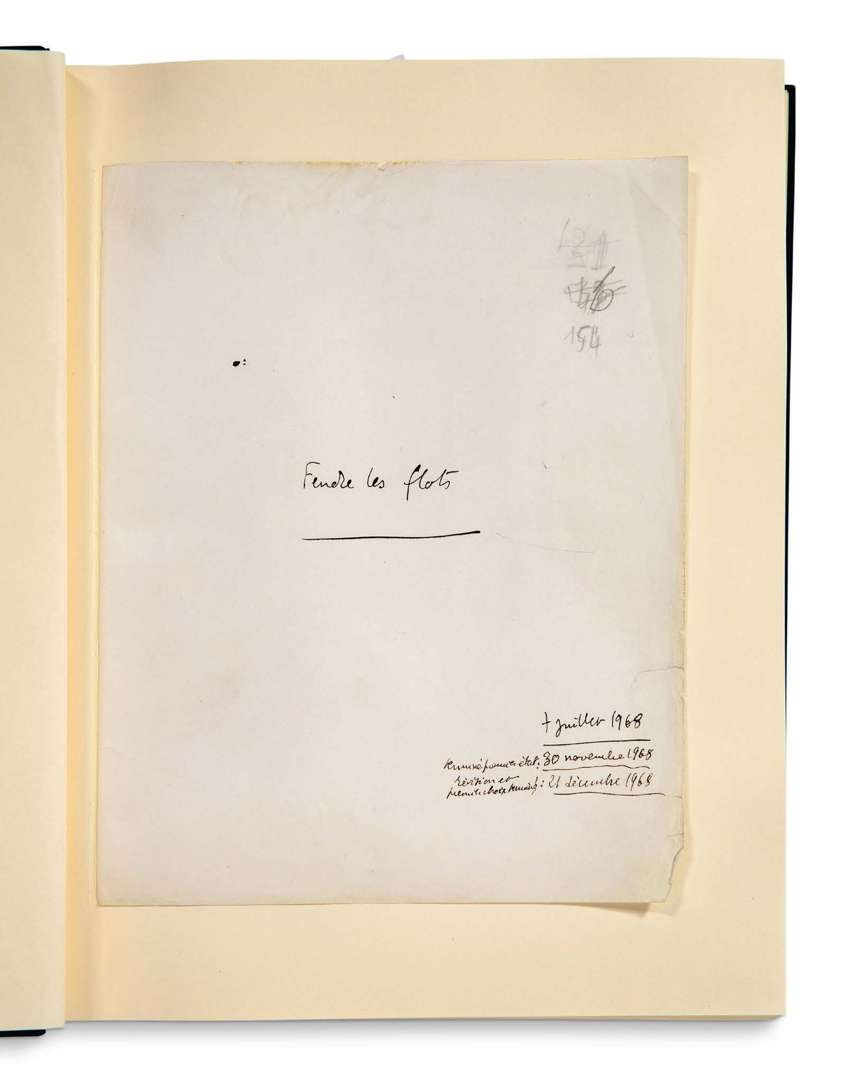
Autograph manuscript, Fendre les flots, 1968| title and 155 pages in-4 (21 x 27 cm) mounted on tabs on strong white wove paper, bound in an in-4 volume of midnight blue half-maroquin with corners, boards of paper with navy blue stamp with stripes, spine with title in large gilt letters, lining and endpapers of paper with navy blue stamp with slanting stripes, lined case (Loutrel, 2003).
Complete and unique manuscript of the poetic collection Fendre les flots.
Fendre les flots was published in May 1969 by Gallimard in the collection
Blanche, ending the trilogy inaugurated in 1967 with Courir les rues.
In the prayer of insertion, Queneau outlines the theme of Fendre les flots where his own life is conceived as a navigation: "Life is a navigation, as we know since Homer. The author watches a child set sail in a maritime city, following him through the winds and tides, and thus complements Oak and Dog as well as following up Running the Streets and Beating the Country. The first part of the collection is less autobiographical than the second| between the two there is an interlude of sonnets. As much as a return to his origins and the waves of his native city, this collection is also, as Claude Debon noted, the beginning of a spiritual quest. Let us quote the short poem that closes the collection, Recueillement, entitled in this manuscript Ce n'est pas fini (It is not finished): "I will write the word 'end' as if I had arrived at the harbour| this end is nothing other than a restart. I will not leave my poems to their fate, I will collect them in a well-ordered way"
The manuscript is dated at the bottom of the title page: "July 7, 1968 / Reworked in its first state: November 30, 1968 / Revision and first choice completed: December 21, 1968".
This working manuscript is complete with all 154 poems in the collection| it is written in black ink on the front of sheets of watermarked white wove paper
L&J&Cie.
After the title page, it is paginated in red in the upper corner from 1 to 154 (2 pages are numbered 134). All the poems follow in the order of the printed collection| but a first pagination in black shows that the order of the collection has been changed.
It gives the final state of the poems, with many variants, crossed-out lines and multiple corrections. Most of the poems are dated by Queneau.
This fascinating manuscript sometimes reveals two very different versions of the same poem. For example, for the poem that opens the collection, Le ru initial, first titled Sort du ru, and dated November 13, 1968, the manuscript offers a first version that was entirely crossed out, before the clean-up was corrected again. At the bottom of the page, this note has been crossed out: "Parallel and antinomy between the [scientific] cycle of water and the ru that does not return / perhaps fable The ru that returns and the ru that does not return / use the word source". This is also true of L'iode natif, a first version of which is crossed out with the words "to be redone entirely| from kelp-violet", or of Vigie urbaine| or of Les îles fortunées: "The navigation of life with its alarming departure / its flat calms its storms its shipwrecks and sometimes / its fortunate islands / its arrival". We can also see that in Le Vieil Homme et l'Enfant, the text was first written in the first person: "Je viens d'ailleurs irai-je ailleurs", replaced by "Il vient d'ailleurs où ira-t-il"...
Œuvres complètes, Bibliothèque de la Pléiade, tome I, edition established by
Claude Debon, 1989 (p. 527-607, and notice p. 1409-1413).
Autograph manuscript, Fendre les flots, 1968| title and 155 pages in-4 (21 x 27 cm) mounted on tabs on strong white wove paper, bound in an in-4 volume of midnight blue half-maroquin with corners, boards of paper with navy blue stamp with stripes, spine with title in large gilt letters, lining and endpapers of paper with navy blue stamp with slanting stripes, lined case (Loutrel, 2003).
Complete and unique manuscript of the poetic collection Fendre les flots.
Fendre les flots was published in May 1969 by Gallimard in the collection
Blanche, ending the trilogy inaugurated in 1967 with Courir les rues.
In the prayer of insertion, Queneau outlines the theme of Fendre les flots where his own life is conceived as a navigation: "Life is a navigation, as we know since Homer. The author watches a child set sail in a maritime city, following him through the winds and tides, and thus complements Oak and Dog as well as following up Running the Streets and Beating the Country. The first part of the collection is less autobiographical than the second| between the two there is an interlude of sonnets. As much as a return to his origins and the waves of his native city, this collection is also, as Claude Debon noted, the beginning of a spiritual quest. Let us quote the short poem that closes the collection, Recueillement, entitled in this manuscript Ce n'est pas fini (It is not finished): "I will write the word 'end' as if I had arrived at the harbour| this end is nothing other than a restart. I will not leave my poems to their fate, I will collect them in a well-ordered way"
The manuscript is dated at the bottom of the title page: "July 7, 1968 / Reworked in its first state: November 30, 1968 / Revision and first choice completed: December 21, 1968".
This working manuscript is complete with all 154 poems in the collection| it is written in black ink on the front of sheets of watermarked white wove paper
L&J&Cie.
After the title page, it is paginated in red in the upper corner from 1 to 154 (2 pages are numbered 134). All the poems follow in the order of the printed collection| but a first pagination in black shows that the order of the collection has been changed.
It gives the final state of the poems, with many variants, crossed-out lines and multiple corrections. Most of the poems are dated by Queneau.
This fascinating manuscript sometimes reveals two very different versions of the same poem. For example, for the poem that opens the collection, Le ru initial, first titled Sort du ru, and dated November 13, 1968, the manuscript offers a first version that was entirely crossed out, before the clean-up was corrected again. At the bottom of the page, this note has been crossed out: "Parallel and antinomy between the [scientific] cycle of water and the ru that does not return / perhaps fable The ru that returns and the ru that does not return / use the word source". This is also true of L'iode natif, a first version of which is crossed out with the words "to be redone entirely| from kelp-violet", or of Vigie urbaine| or of Les îles fortunées: "The navigation of life with its alarming departure / its flat calms its storms its shipwrecks and sometimes / its fortunate islands / its arrival". We can also see that in Le Vieil Homme et l'Enfant, the text was first written in the first person: "Je viens d'ailleurs irai-je ailleurs", replaced by "Il vient d'ailleurs où ira-t-il"...
Œuvres complètes, Bibliothèque de la Pléiade, tome I, edition established by
Claude Debon, 1989 (p. 527-607, and notice p. 1409-1413).