
&w=3840&q=75)
&w=3840&q=75)
&w=3840&q=75)
&w=3840&q=75)
&w=3840&q=75)
&w=3840&q=75)
&w=3840&q=75)
&w=3840&q=75)

QUENEAU Raymond.
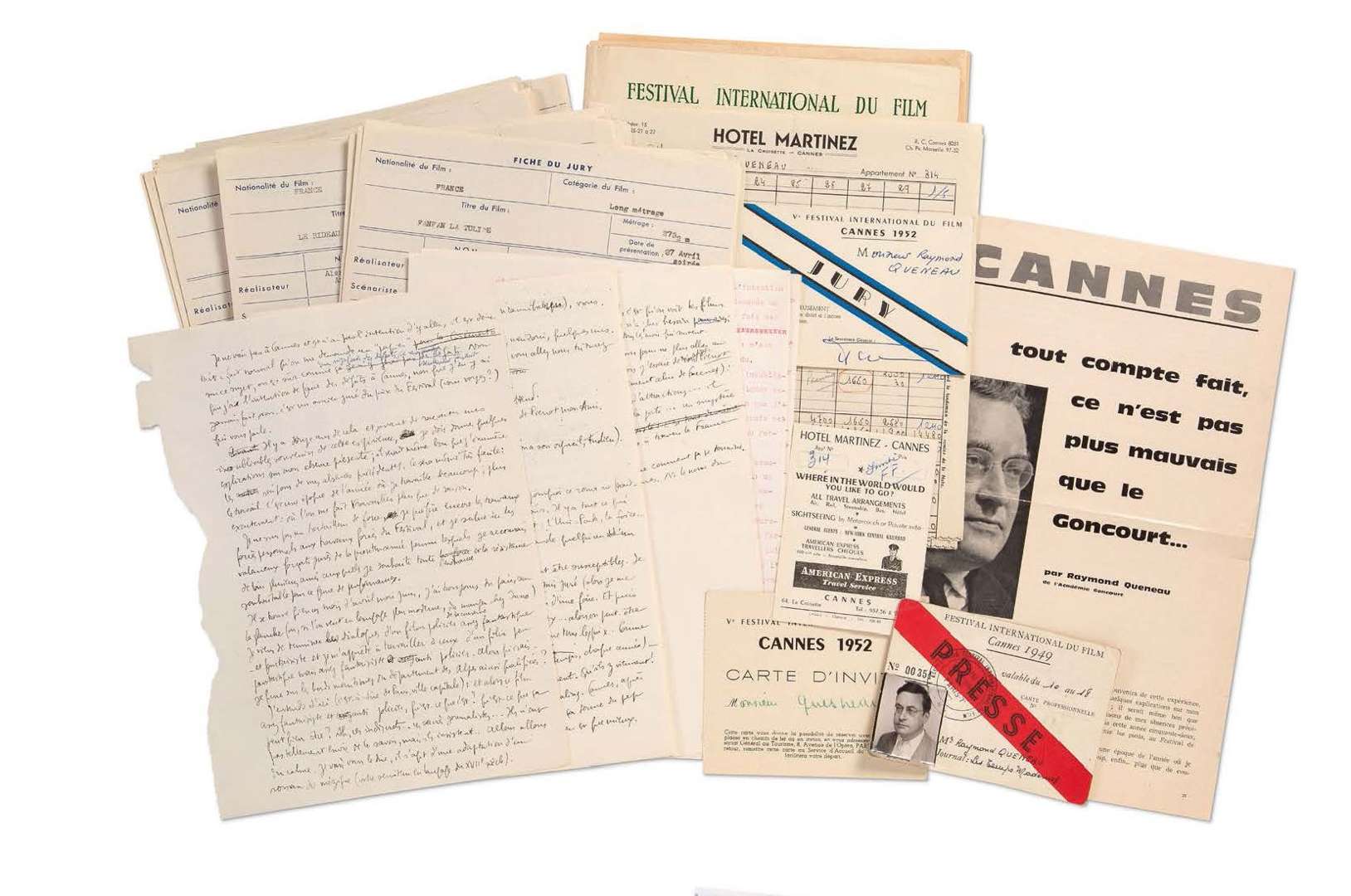
DOSSIER on the 1952 Cannes Film Festival.
Interesting set on his work as a juror at Cannes.
Queneau was a member of the Cannes Film Festival jury in 1952, presided over by
Maurice Genevoix.
* 90 film prints with autograph annotations by Queneau (1 p.
in-4 partly printed each), giving his appreciation of each film seen.
On Two Pennies of Hope by Roberto Castellani, which won the Palme d'Or ex-aequo with Othello by Orson Welles: "Enfi n! Intelligent, lively, human cinema. Two or three passages have greatness and it is not pretentious"| as for Othello: "number one". An American in Paris: "Excellent music-hall film", then he adds: "on reflection, it's even better than that, it's an event in the history of dance in cinema". He is severe with Fanfan la Tulipe: "It could have been a pleasant film, but the dialogue spoils everything"| as for Gérard Philipe: "not good, this time". Viva Zapata by Elia Kazan: "The beginning and the end are admirable. The middle is weak. Umberto D by Vittorio de Sica: "Excellent. A little long. A little thin too (the subject). Still, very good cinema. Youssef Chahine's Call of the Nile: "
Sometimes it's more concise: "Zero", or "no! no! no!" Etc.
* 5 pages of autograph notes on the jury's deliberations.
* Autograph manuscript, [1964] (3 pages in-4). "I am not going to Cannes and I have no intention of going there"... Twelve years later, he comes back to this experience: "When I was a juror, I didn't find it to be a fair (or so little), but a fair where you deal like in fairs.
Like in Lyon, in Milan, that's what it's made for: the trade that it works. And then there is also art. Orson Welles got the prize. There's still plenty to be proud of. There is good in all of this. The typescript is attached, as well as an excerpt from La Cinématographie française of May 1964, where this text appeared.
* Various documents: press card, jury member card, hotel notes, annotated program, festival regulations...
DOSSIER on the 1952 Cannes Film Festival.
Interesting set on his work as a juror at Cannes.
Queneau was a member of the Cannes Film Festival jury in 1952, presided over by
Maurice Genevoix.
* 90 film prints with autograph annotations by Queneau (1 p.
in-4 partly printed each), giving his appreciation of each film seen.
On Two Pennies of Hope by Roberto Castellani, which won the Palme d'Or ex-aequo with Othello by Orson Welles: "Enfi n! Intelligent, lively, human cinema. Two or three passages have greatness and it is not pretentious"| as for Othello: "number one". An American in Paris: "Excellent music-hall film", then he adds: "on reflection, it's even better than that, it's an event in the history of dance in cinema". He is severe with Fanfan la Tulipe: "It could have been a pleasant film, but the dialogue spoils everything"| as for Gérard Philipe: "not good, this time". Viva Zapata by Elia Kazan: "The beginning and the end are admirable. The middle is weak. Umberto D by Vittorio de Sica: "Excellent. A little long. A little thin too (the subject). Still, very good cinema. Youssef Chahine's Call of the Nile: "
Sometimes it's more concise: "Zero", or "no! no! no!" Etc.
* 5 pages of autograph notes on the jury's deliberations.
* Autograph manuscript, [1964] (3 pages in-4). "I am not going to Cannes and I have no intention of going there"... Twelve years later, he comes back to this experience: "When I was a juror, I didn't find it to be a fair (or so little), but a fair where you deal like in fairs.
Like in Lyon, in Milan, that's what it's made for: the trade that it works. And then there is also art. Orson Welles got the prize. There's still plenty to be proud of. There is good in all of this. The typescript is attached, as well as an excerpt from La Cinématographie française of May 1964, where this text appeared.
* Various documents: press card, jury member card, hotel notes, annotated program, festival regulations...