
&w=3840&q=75)
&w=3840&q=75)
&w=3840&q=75)
&w=3840&q=75)
&w=3840&q=75)
&w=3840&q=75)
&w=3840&q=75)
&w=3840&q=75)

QUENEAU Raymond.
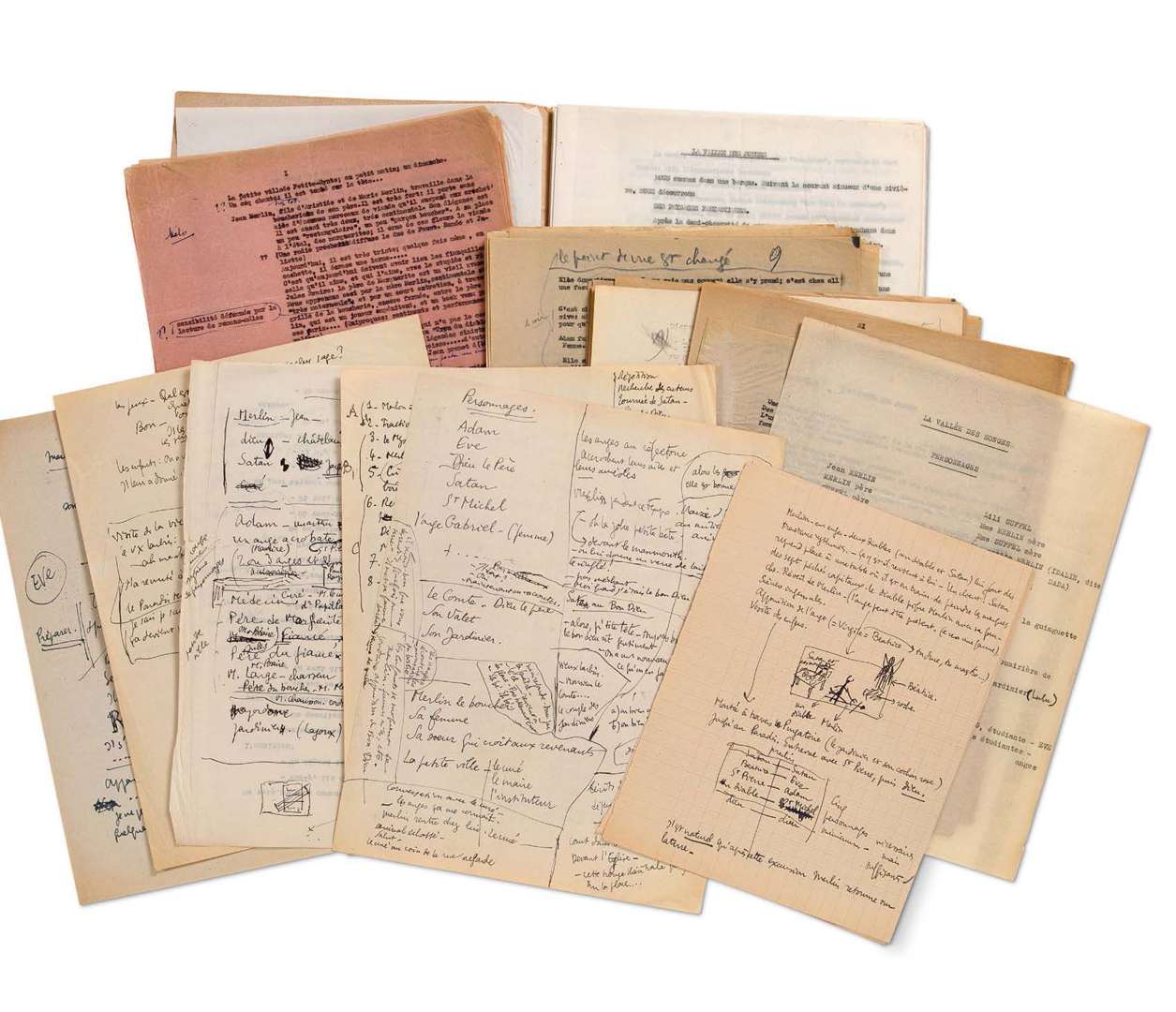
AUTOGRAPHIC MANUSCRIPT and 2 CORRECTED TAPS, La Vallée des songes, [ca. 1950?]
Unpublished script, a marvelous and mythological tale.
The file includes: an autograph manuscript of notes and plans, sequence of scenes, dialogue, etc. (9 pages in-4)| the synopsis, complete typescript (10 pages in-4). (9 pages in-4)| the synopsis, complete typescript (10 p. in-4 on pink linen paper), with autograph corrections and additions, and by another hand| the typescript of various states of the scenario, extensively corrected by Queneau and another hand (45 p.
in-4)| another typescript of the scenario with numerous sticky notes (15 p. in-4)| the typescript of the complete scenario (39 p. in-4).
On their wedding day, Merlin and Lili are walking in the park of Touary Castle. Merlin, having fallen into the river, finds himself, like
Dante, travelling through Hell, Purgatory and Paradise, which are presented as changing theatrical settings where God, Satan, Adam and Eve re-enact the scene of original sin: a fairground stall, a no-man's-land, a provincial railway station. A drawing represents the apparition of the Angel. During an "intermission", these characters become "student actors" again, while God the father takes on the appearance of the count who owns the castle. One of the students meets Lili, to whom he offers to play the roles of Adam and Eve with him. They arrive at the "Paradou", a marvellous garden where they re-enact the scene with the apple. Merlin, for his part, is enlisted in the troupe to replace Adam and also rehearses the temptation scene with another Eve. An apocalyptic storm breaks out, and Prinçatout, a groomsman in the wedding party, falls victim to the trap of the "robot women", creatures of the "good god-count" who has gone mad. At the end, the theatre company leaves. The newlyweds wake up from their dream, recognize themselves as the new Adam and Eve and watch the troupe leave with the sign: "Paradise Lost".
This ambitious work, mixing reality and representation, was the subject of a great deal of work, as evidenced by the deleted or discarded scenes (a fakir offers to replace God when he goes for a drink at the bar or when he has a date, God the father holding an imaginary dog on a leash), the added lines, the avenues to be explored, the suggested variants...
AUTOGRAPHIC MANUSCRIPT and 2 CORRECTED TAPS, La Vallée des songes, [ca. 1950?]
Unpublished script, a marvelous and mythological tale.
The file includes: an autograph manuscript of notes and plans, sequence of scenes, dialogue, etc. (9 pages in-4)| the synopsis, complete typescript (10 pages in-4). (9 pages in-4)| the synopsis, complete typescript (10 p. in-4 on pink linen paper), with autograph corrections and additions, and by another hand| the typescript of various states of the scenario, extensively corrected by Queneau and another hand (45 p.
in-4)| another typescript of the scenario with numerous sticky notes (15 p. in-4)| the typescript of the complete scenario (39 p. in-4).
On their wedding day, Merlin and Lili are walking in the park of Touary Castle. Merlin, having fallen into the river, finds himself, like
Dante, travelling through Hell, Purgatory and Paradise, which are presented as changing theatrical settings where God, Satan, Adam and Eve re-enact the scene of original sin: a fairground stall, a no-man's-land, a provincial railway station. A drawing represents the apparition of the Angel. During an "intermission", these characters become "student actors" again, while God the father takes on the appearance of the count who owns the castle. One of the students meets Lili, to whom he offers to play the roles of Adam and Eve with him. They arrive at the "Paradou", a marvellous garden where they re-enact the scene with the apple. Merlin, for his part, is enlisted in the troupe to replace Adam and also rehearses the temptation scene with another Eve. An apocalyptic storm breaks out, and Prinçatout, a groomsman in the wedding party, falls victim to the trap of the "robot women", creatures of the "good god-count" who has gone mad. At the end, the theatre company leaves. The newlyweds wake up from their dream, recognize themselves as the new Adam and Eve and watch the troupe leave with the sign: "Paradise Lost".
This ambitious work, mixing reality and representation, was the subject of a great deal of work, as evidenced by the deleted or discarded scenes (a fakir offers to replace God when he goes for a drink at the bar or when he has a date, God the father holding an imaginary dog on a leash), the added lines, the avenues to be explored, the suggested variants...