
&w=3840&q=75)
&w=3840&q=75)
&w=3840&q=75)
&w=3840&q=75)
&w=3840&q=75)
&w=3840&q=75)
&w=3840&q=75)
&w=3840&q=75)


138
ZOLA Émile (1840-1902).
The item was sold for 1 252 €
Fees include commission and taxes.
ZOLA Émile (1840-1902).
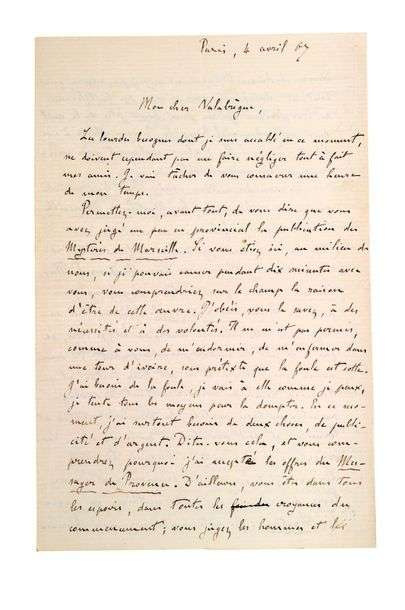
L.A.S. "Emile Zola", Paris April 4, 1867, to Antony VALABRÈGUE| 4 pages in-8 filled with a small, tight handwriting.
Beautiful and long letter at the beginning of his literary career.
[Zola began on March 2 to publish in serial form in Le Messager de Provence his first novel, Les Mystères de Marseille. Antony
VALABRÈGUE (1844-1900), who was to become a poet and art critic, was the friend and fellow student at Aix-en-Provence of Zola and Cézanne, who painted his portrait]. "The heavy tasks with which I am burdened at the moment should not, however, make me neglect my friends altogether. He reproaches his friend for having "judged the publication of the Mysteries of
Marseille a little provincially. [...] I obey, as you know, necessities and wills.
I am not allowed, as you are, to fall asleep, to shut myself up in an ivory tower, on the pretext that the crowd is stupid. I need the crowd, I go to it as I can, I try all means to tame it. At the moment, I need two things above all: publicity and money. Tell yourself that, and you will understand why I accepted the offers of the Messager de Provence. Besides, you are in all the hopes, in all the beliefs of the beginning, you judge men and works absolutely, you do not yet see that everything is relative, and you do not have the tolerances of experience. I do not wish to cast darkness into your beautiful and limpid sky. I am waiting for you at your beginnings, at your struggles| only then will you understand my conduct well. [...] I know what I am doing.
At the moment, I am working on three novels: Les Mystères, a short story for L'Illustration, and a major psychological study for the Revue du
XIXe siècle [Un mariage d'amour]. I am very satisfied with this last work| it is, I believe, the best I have done so far. I even fear that the pace will be too strong, and that Houssaye will back out at the last moment. The work will be published in three parts| the first part is finished and should appear in May. You see that I am going quickly. Last month I wrote this first part - a third of the volume - and a hundred pages of the Mysteries. I'm bent over my desk from morning to night. This year I shall publish four or five volumes.
Give me an income, and I undertake to go right away to shut myself up with you and wallow in the sun in the grass.
He left Le Figaro, where he will only publish "flying articles, and, profession for profession, I prefer to write long stories, which remain. I also had to give up the idea of doing a Salon. It is possible, however, that I will launch some brochure on my friends the painters. [...]
I work a lot, taking care of some works and abandoning others, trying to make my hole with a lot of digging. You will know one day that it is difficult to dig such a hole".
He envisages Valabrègue's future career as a poet, but it is "a path so different from the one I have taken, that it is difficult for me not to make some restrictions. My position has imposed struggle on me, militant work is for me the great means, the only one I can advise. Your wealth, your instincts give you leisure, you linger on cheerfully. All roads are good: follow yours"...
He ends by giving news of their painter friends: "Paul [CÉZANNE] is refused, Guillemet is refused, all are refused| the jury, irritated by my Salon, has thrown out all those who walk in the new way"...
L.A.S. "Emile Zola", Paris April 4, 1867, to Antony VALABRÈGUE| 4 pages in-8 filled with a small, tight handwriting.
Beautiful and long letter at the beginning of his literary career.
[Zola began on March 2 to publish in serial form in Le Messager de Provence his first novel, Les Mystères de Marseille. Antony
VALABRÈGUE (1844-1900), who was to become a poet and art critic, was the friend and fellow student at Aix-en-Provence of Zola and Cézanne, who painted his portrait]. "The heavy tasks with which I am burdened at the moment should not, however, make me neglect my friends altogether. He reproaches his friend for having "judged the publication of the Mysteries of
Marseille a little provincially. [...] I obey, as you know, necessities and wills.
I am not allowed, as you are, to fall asleep, to shut myself up in an ivory tower, on the pretext that the crowd is stupid. I need the crowd, I go to it as I can, I try all means to tame it. At the moment, I need two things above all: publicity and money. Tell yourself that, and you will understand why I accepted the offers of the Messager de Provence. Besides, you are in all the hopes, in all the beliefs of the beginning, you judge men and works absolutely, you do not yet see that everything is relative, and you do not have the tolerances of experience. I do not wish to cast darkness into your beautiful and limpid sky. I am waiting for you at your beginnings, at your struggles| only then will you understand my conduct well. [...] I know what I am doing.
At the moment, I am working on three novels: Les Mystères, a short story for L'Illustration, and a major psychological study for the Revue du
XIXe siècle [Un mariage d'amour]. I am very satisfied with this last work| it is, I believe, the best I have done so far. I even fear that the pace will be too strong, and that Houssaye will back out at the last moment. The work will be published in three parts| the first part is finished and should appear in May. You see that I am going quickly. Last month I wrote this first part - a third of the volume - and a hundred pages of the Mysteries. I'm bent over my desk from morning to night. This year I shall publish four or five volumes.
Give me an income, and I undertake to go right away to shut myself up with you and wallow in the sun in the grass.
He left Le Figaro, where he will only publish "flying articles, and, profession for profession, I prefer to write long stories, which remain. I also had to give up the idea of doing a Salon. It is possible, however, that I will launch some brochure on my friends the painters. [...]
I work a lot, taking care of some works and abandoning others, trying to make my hole with a lot of digging. You will know one day that it is difficult to dig such a hole".
He envisages Valabrègue's future career as a poet, but it is "a path so different from the one I have taken, that it is difficult for me not to make some restrictions. My position has imposed struggle on me, militant work is for me the great means, the only one I can advise. Your wealth, your instincts give you leisure, you linger on cheerfully. All roads are good: follow yours"...
He ends by giving news of their painter friends: "Paul [CÉZANNE] is refused, Guillemet is refused, all are refused| the jury, irritated by my Salon, has thrown out all those who walk in the new way"...