
&w=3840&q=75)
&w=3840&q=75)
&w=3840&q=75)
&w=3840&q=75)
&w=3840&q=75)
&w=3840&q=75)
&w=3840&q=75)
&w=3840&q=75)


128
SARTRE Jean-Paul (1905-1980).
The item was sold for 11 700 €
Fees include commission and taxes.
SARTRE Jean-Paul (1905-1980).
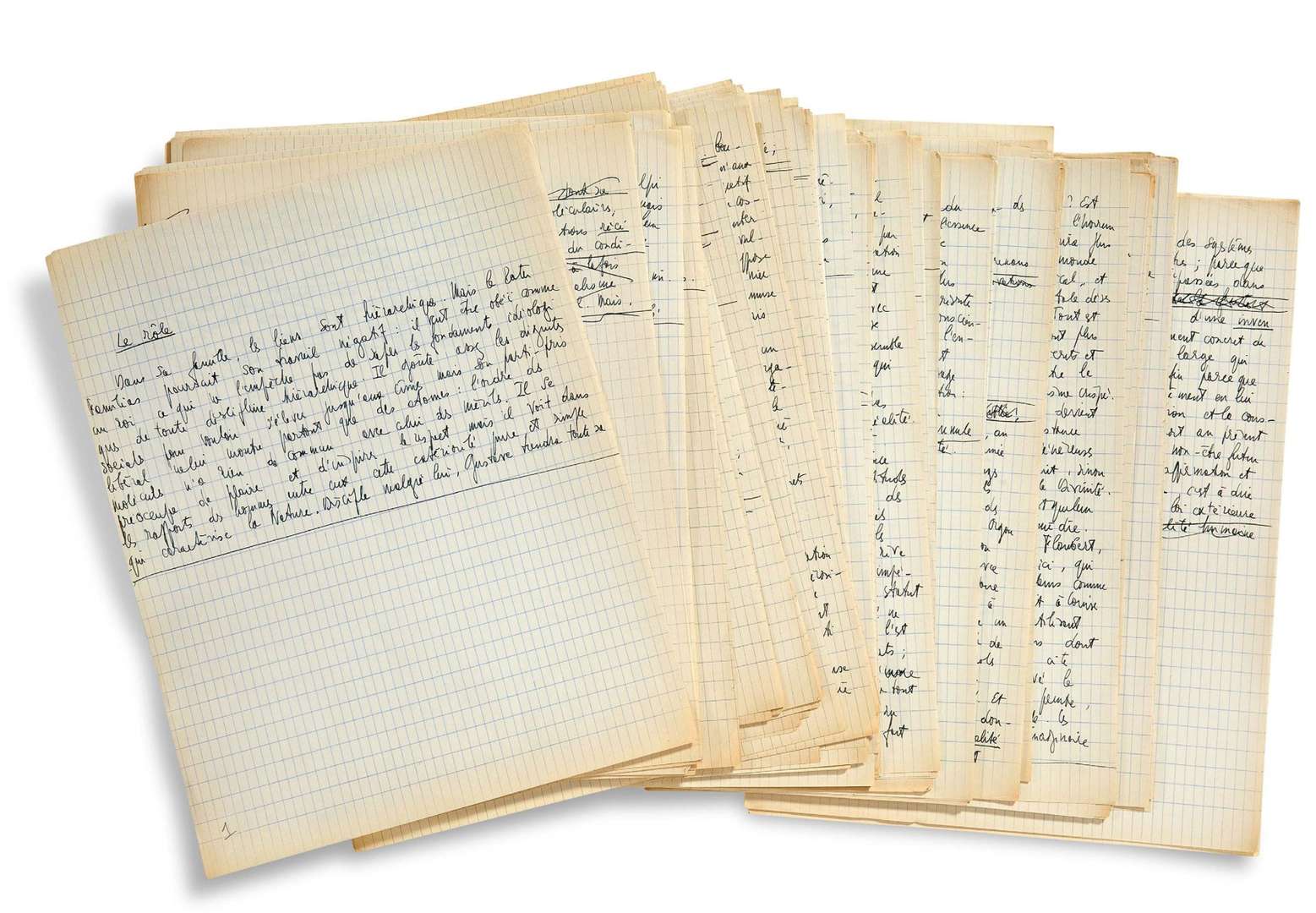
Autograph MANUSCRIPT for The Family Idiot, [1965]| 126 leaves in-4 (27 x 21 cm) of squared paper written on the front (small defects to a few leaves).
Important manuscript for the second part of Sartre's "Flaubert".
Sartre's monumental work on Gustave FLAUBERT, which occupied
Sartre for some twenty years, has been published, under the title L'Idiot de la famille. Gustave Flaubert de 1821 à 1857, in three large volumes published by
Gallimard in 1971 and 1972, and remained unfinished.
Written in blue-black ink on the front of sheets of graph paper, this manuscript offers a first unpublished version of an important fragment of the first draft of 1965: a complete chapter entitled Le rôle (p. 1-107), followed by the beginning of another chapter: Théâtre et littérature (p. 107-126| the pagination, in pencil, is not Sartre's). This fully redacted version, however, contains important corrections, following Sartre's usual system of going to the page after an unsatisfactory and crossed-out passage, where one can thus follow the invention of the text in its writing flow. There are, however, important passages that have been crossed out.
This manuscript is attached to the second part of the work: "Flaubert as he is made", subtitled: "What is beauty, if not the impossible?", a part that will be entitled in the last version of 1971: "Personalisation", the first book taking up the subtitle "What is beauty, if not the impossible? ""
These pages are of major interest for the understanding of the genesis of The Family Idiot, because this piece is long, whereas the manuscripts were often dismembered to constitute the later version. One will appreciate the tightened style, often more lively, more cheerful than in the final version. It is in fact a very stylistically elaborate version, an exercise in rewriting, with abrupt analyses and bravura pieces, which will be softened in the final version.
This part reveals in a complex way Sartre's themes of the relationship to others, of language, of the actor and of the "role".
In this 1965 version, the themes are more condensed and synthetic than they will be in the final version.
The role begins thus: "
But the Pater Familias continues his negative work: he wants to be obeyed like a king, which does not prevent him from undermining the ideological foundations of all hierarchical discipline. He likes social dignities enough to want to rise to the heights, but his liberal bias shows him only atoms everywhere: the order of molecules has nothing in common with that of merits...
In these pages, Sartre is keen to bring out the feudal link that Flaubert claimed to have with his fellow creatures and which gradually draws the pessimism of human relations. The cause of this is the father's ideology: "a Flaubert is a mountain climber, he constantly crosses new social strata but without staying in them| if he frequents his peers, it is to find their weak point and rise above them| when he declares that a man is his equal, it is a way of expressing the contempt that this future inferior inspires in him. [...] and then his love of feudalism turns him away forever from reciprocal relations: lords and vassals, as much as one likes, but no equals" (pp. 5-6).
Sartre clearly highlights the Flaubertian mechanism that will govern this intuition of the absence of links between men and between things: "The reason for this attitude hardly needs to be mentioned: it is the paternal Refusal which, by discovering him to himself as a universal object, has initiated a kind of chain disintegration and "reification" of the human environment. Flaubert experiences social life as a kind of solitude in common, as a swarming of separations. But this distance which made him suffer so much when he felt it in the presence of the father, he never complains about it when he rediscovers it in front of others. It is the same cut| but it does not bleed. He does not recognize his personal status in it, and holds it rather as a character of our condition, as a state of human relations, in short, as the necessity which is common to us all of living in the same inert environment of exteriority. He sees no harm in the principle of inertia governing his relations with others| he even sees in it the only conceivable reciprocity: a reciprocity of indifference" (p. 11).
From this point on, the distance between the private and the public is established, of which the stage will be the means of revelation: "the impassable distance that separates man from man is made into this orchestra pit that separates the stage from the audience. We see the whole process: antagonism and reification determine the cut" (p. 19). Flaubert knows no intermediate zone between his solitude and his life.
Autograph MANUSCRIPT for The Family Idiot, [1965]| 126 leaves in-4 (27 x 21 cm) of squared paper written on the front (small defects to a few leaves).
Important manuscript for the second part of Sartre's "Flaubert".
Sartre's monumental work on Gustave FLAUBERT, which occupied
Sartre for some twenty years, has been published, under the title L'Idiot de la famille. Gustave Flaubert de 1821 à 1857, in three large volumes published by
Gallimard in 1971 and 1972, and remained unfinished.
Written in blue-black ink on the front of sheets of graph paper, this manuscript offers a first unpublished version of an important fragment of the first draft of 1965: a complete chapter entitled Le rôle (p. 1-107), followed by the beginning of another chapter: Théâtre et littérature (p. 107-126| the pagination, in pencil, is not Sartre's). This fully redacted version, however, contains important corrections, following Sartre's usual system of going to the page after an unsatisfactory and crossed-out passage, where one can thus follow the invention of the text in its writing flow. There are, however, important passages that have been crossed out.
This manuscript is attached to the second part of the work: "Flaubert as he is made", subtitled: "What is beauty, if not the impossible?", a part that will be entitled in the last version of 1971: "Personalisation", the first book taking up the subtitle "What is beauty, if not the impossible? ""
These pages are of major interest for the understanding of the genesis of The Family Idiot, because this piece is long, whereas the manuscripts were often dismembered to constitute the later version. One will appreciate the tightened style, often more lively, more cheerful than in the final version. It is in fact a very stylistically elaborate version, an exercise in rewriting, with abrupt analyses and bravura pieces, which will be softened in the final version.
This part reveals in a complex way Sartre's themes of the relationship to others, of language, of the actor and of the "role".
In this 1965 version, the themes are more condensed and synthetic than they will be in the final version.
The role begins thus: "
But the Pater Familias continues his negative work: he wants to be obeyed like a king, which does not prevent him from undermining the ideological foundations of all hierarchical discipline. He likes social dignities enough to want to rise to the heights, but his liberal bias shows him only atoms everywhere: the order of molecules has nothing in common with that of merits...
In these pages, Sartre is keen to bring out the feudal link that Flaubert claimed to have with his fellow creatures and which gradually draws the pessimism of human relations. The cause of this is the father's ideology: "a Flaubert is a mountain climber, he constantly crosses new social strata but without staying in them| if he frequents his peers, it is to find their weak point and rise above them| when he declares that a man is his equal, it is a way of expressing the contempt that this future inferior inspires in him. [...] and then his love of feudalism turns him away forever from reciprocal relations: lords and vassals, as much as one likes, but no equals" (pp. 5-6).
Sartre clearly highlights the Flaubertian mechanism that will govern this intuition of the absence of links between men and between things: "The reason for this attitude hardly needs to be mentioned: it is the paternal Refusal which, by discovering him to himself as a universal object, has initiated a kind of chain disintegration and "reification" of the human environment. Flaubert experiences social life as a kind of solitude in common, as a swarming of separations. But this distance which made him suffer so much when he felt it in the presence of the father, he never complains about it when he rediscovers it in front of others. It is the same cut| but it does not bleed. He does not recognize his personal status in it, and holds it rather as a character of our condition, as a state of human relations, in short, as the necessity which is common to us all of living in the same inert environment of exteriority. He sees no harm in the principle of inertia governing his relations with others| he even sees in it the only conceivable reciprocity: a reciprocity of indifference" (p. 11).
From this point on, the distance between the private and the public is established, of which the stage will be the means of revelation: "the impassable distance that separates man from man is made into this orchestra pit that separates the stage from the audience. We see the whole process: antagonism and reification determine the cut" (p. 19). Flaubert knows no intermediate zone between his solitude and his life.