
&w=3840&q=75)
&w=3840&q=75)
&w=3840&q=75)
&w=3840&q=75)
&w=3840&q=75)
&w=3840&q=75)
&w=3840&q=75)
&w=3840&q=75)

125
SARTRE Jean-Paul (1905-1980).
The item was sold for 5 200 €
Fees include commission and taxes.
SARTRE Jean-Paul (1905-1980).
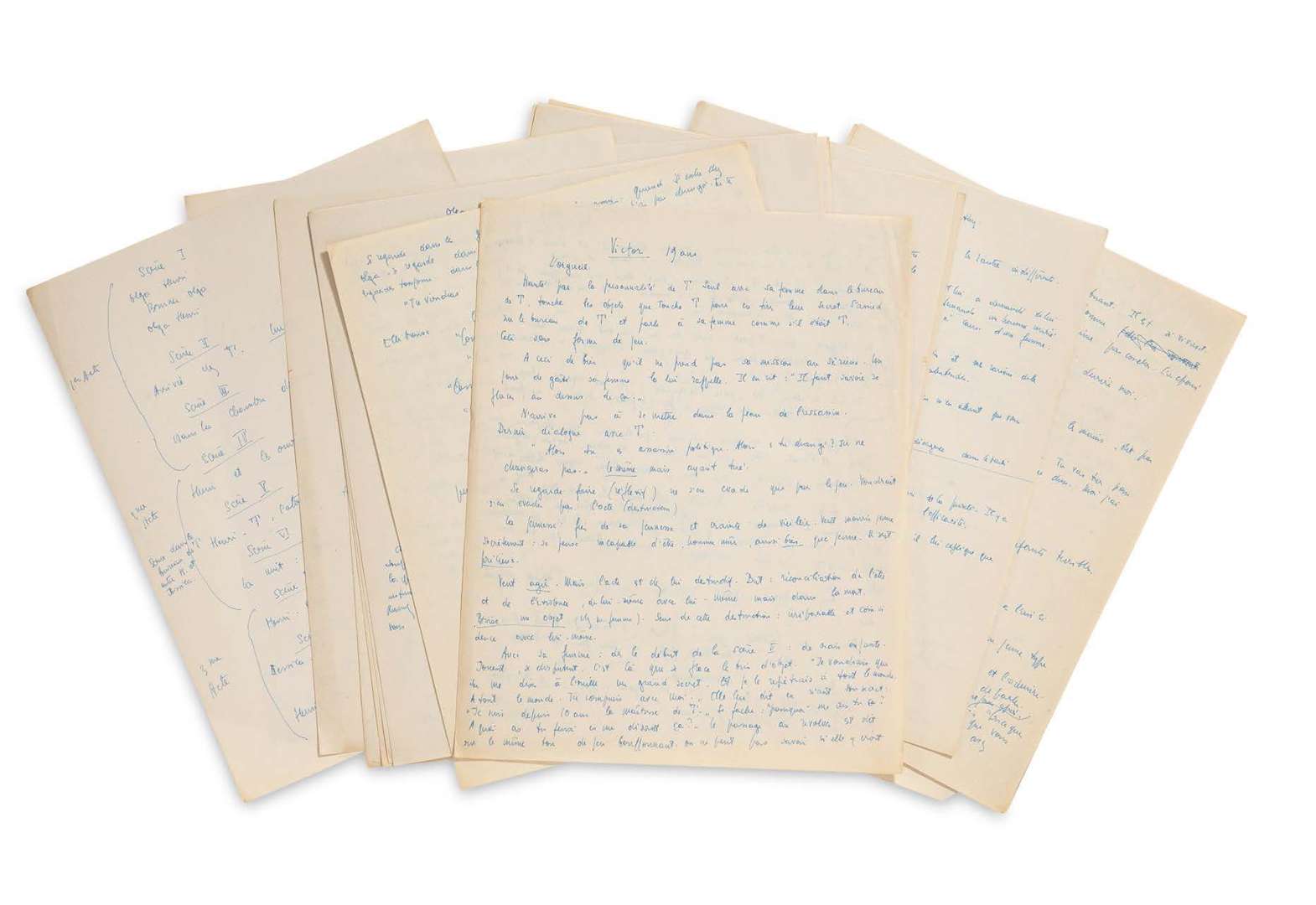
autograph manuscript for Les Mains sales| 28 pages on 23 ff. in-4 (27 x 21 cm).
Interesting file on the genesis of the play Les Mains sales.
"Sartre had the idea for Les Mains sales during the Christmas holidays of 1947 and wrote his text in a few months" (Sandra Teroni). The present manuscript dates from this period, in blue ink on cream-coloured vellum pages, with a few passages crossed out and additions. The play premiered on April 2, 1948 at the Théâtre Antoine, directed by Simone Berriau, with André Luguet, François Périer, Paula Dehelly and Marie Olivier in the main roles.
The idea for the play originated in the midst of the crisis of the Marxist ideal, in the context of the Cold War. By setting the drama within a "proletarian" party, Sartre wanted to bring to the stage a debate about the crucial notions of ideals, action and freedom, and to raise the question of the right of the revolutionary to "get his hands dirty".
Unknown to the editors of the Théâtre complet in the Bibliothèque de la Pléiade, this manuscript provides unpublished information on the genesis of the play, the final manuscript of which was given by Sartre to Jean Cocteau (now kept at the Bibliothèque historique de la Ville de Paris).
In these preparatory notes, Sartre drew up detailed cards on the main characters (some of whom would change their names): Victor (who would become Hugo), Hoederer, Jessica, Olga, Trotzky (who would become Karsky), on their motivations, and on the themes addressed. Thus: "Victor, 19 years old.
Pride. Haunted by the personality of T[rotzky]. Alone with his wife in T's office, touches the objects that T touches in order to extract their secret.
[...] The good thing is that he does not take his mission seriously. [...] Can't get into the assassin's skin. [...] Looks at himself (reflective) and only escapes by playing. Would like to escape by acting (destructive).
Youth: Proud of his youth and afraid of growing old. Wants to die young secretly: thinks himself incapable of being, a mature man, as well as young. Feels precious. Wants to act. But action is destructive for him. Goal: reconciliation of being and existence, of himself with himself but in death. [...] His relationship with the party: of course believes in the ultimate goal of the party. But above all need for discipline. The objective: to get rid of subjectivity"... Etc.
A plan of the play shows that, at first, it was structured in 3 acts, each containing 3 scenes (the final version having 7 tableaux containing from 1 to 6 scenes): Hugo-Victor is called Henri. About fifteen pages present outlines and then sketches of several scenes: there are the beginnings of dialogues to be developed, stage directions, reflections that will feed the lines. We witness the birth of the plot and the internal articulations of the action: "Scene III. 1) The waiting with the bodyguards. They leave. 2) Trotzky's arrival. 3) Jessica's argument and conciliation".
Psychological indications or reminders of facts prepare future lines: "pretends to be offended", "he wants to be moral. She is acting in bad faith", they "feel very weak, very small"... And so on.
autograph manuscript for Les Mains sales| 28 pages on 23 ff. in-4 (27 x 21 cm).
Interesting file on the genesis of the play Les Mains sales.
"Sartre had the idea for Les Mains sales during the Christmas holidays of 1947 and wrote his text in a few months" (Sandra Teroni). The present manuscript dates from this period, in blue ink on cream-coloured vellum pages, with a few passages crossed out and additions. The play premiered on April 2, 1948 at the Théâtre Antoine, directed by Simone Berriau, with André Luguet, François Périer, Paula Dehelly and Marie Olivier in the main roles.
The idea for the play originated in the midst of the crisis of the Marxist ideal, in the context of the Cold War. By setting the drama within a "proletarian" party, Sartre wanted to bring to the stage a debate about the crucial notions of ideals, action and freedom, and to raise the question of the right of the revolutionary to "get his hands dirty".
Unknown to the editors of the Théâtre complet in the Bibliothèque de la Pléiade, this manuscript provides unpublished information on the genesis of the play, the final manuscript of which was given by Sartre to Jean Cocteau (now kept at the Bibliothèque historique de la Ville de Paris).
In these preparatory notes, Sartre drew up detailed cards on the main characters (some of whom would change their names): Victor (who would become Hugo), Hoederer, Jessica, Olga, Trotzky (who would become Karsky), on their motivations, and on the themes addressed. Thus: "Victor, 19 years old.
Pride. Haunted by the personality of T[rotzky]. Alone with his wife in T's office, touches the objects that T touches in order to extract their secret.
[...] The good thing is that he does not take his mission seriously. [...] Can't get into the assassin's skin. [...] Looks at himself (reflective) and only escapes by playing. Would like to escape by acting (destructive).
Youth: Proud of his youth and afraid of growing old. Wants to die young secretly: thinks himself incapable of being, a mature man, as well as young. Feels precious. Wants to act. But action is destructive for him. Goal: reconciliation of being and existence, of himself with himself but in death. [...] His relationship with the party: of course believes in the ultimate goal of the party. But above all need for discipline. The objective: to get rid of subjectivity"... Etc.
A plan of the play shows that, at first, it was structured in 3 acts, each containing 3 scenes (the final version having 7 tableaux containing from 1 to 6 scenes): Hugo-Victor is called Henri. About fifteen pages present outlines and then sketches of several scenes: there are the beginnings of dialogues to be developed, stage directions, reflections that will feed the lines. We witness the birth of the plot and the internal articulations of the action: "Scene III. 1) The waiting with the bodyguards. They leave. 2) Trotzky's arrival. 3) Jessica's argument and conciliation".
Psychological indications or reminders of facts prepare future lines: "pretends to be offended", "he wants to be moral. She is acting in bad faith", they "feel very weak, very small"... And so on.