
&w=3840&q=75)
&w=3840&q=75)
&w=3840&q=75)
&w=3840&q=75)
&w=3840&q=75)
&w=3840&q=75)
&w=3840&q=75)
&w=3840&q=75)

124
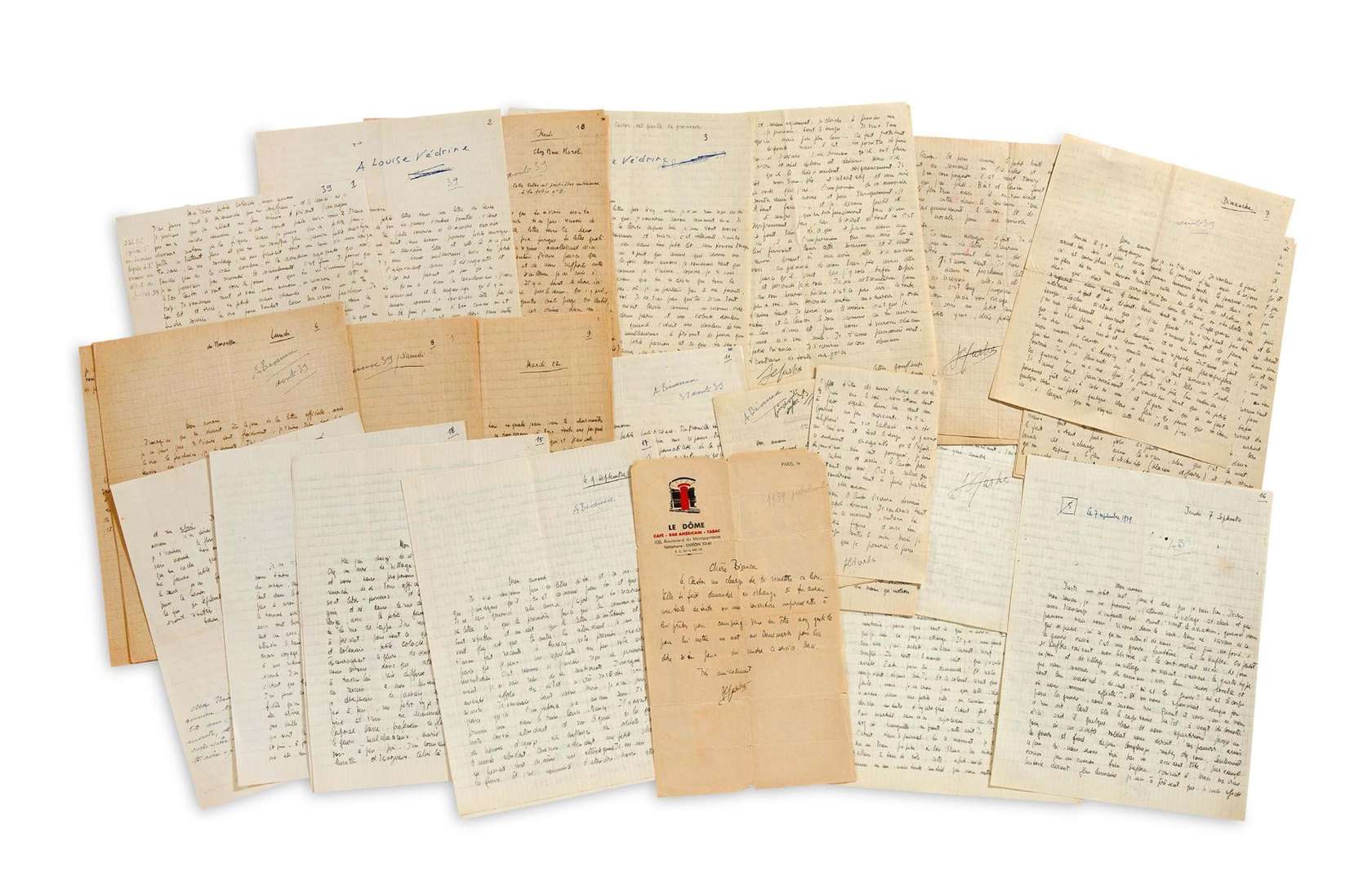
SARTRE Jean-Paul (1905-1980).
The item was sold for 15 600 €
Fees include commission and taxes.
SARTRE Jean-Paul (1905-1980).
20 L.A.S. "J.P. Sartre", July-September 1939, to Bianca
BIENFELD| 59 pages in4 and 13 pages in8 (one incomplete from the end).
Beautiful love letter, partly unpublished, to a young girl.
[Bianca BIENENFELD (1921-2011), daughter of Polish Jews who arrived in Paris in 1922, was Simone de Beauvoir's student at the Lycée Molière. She met
Sartre in 1938 and the affair that was then established lasted until February 1940.
A carnal affair was also established between Bianca [known under the pseudonym of Louise Védrine in Simone de Beauvoir's Memoirs] and Simone de Beauvoir. This triangular configuration explains why this correspondence was in the possession of Simone de Beauvoir, Sartre insisting that Bianca entrust these letters to Simone... These are the only ones that have survived, Bianca having burned all the others.
Bianca Lamblin, who became Bianca Lamblin in 1941, recounted in Mémoires d'une jeune fille dérangée (Balland, 1993) her relationship with Sartre and her friendship with Beauvoir, with whom she renewed contact after the war]. Thirteen of these letters were published in Lettres au Castor et à quelques autres (Gallimard, 1983, with some cuts and edits), the last five are unpublished. Most are dated in the hand of
Simone de Beauvoir and bear the name Bianca, crossed out and replaced by Louise Védrine].
In these tender and warm letters, Sartre addresses his "dear little Polack", his "love", his "dear little flame", his "little wonder", and always ends by kissing her passionately, affirming that he loves her with all his strength, that he is passionately attached to her, that he is thinking of her little body that he is holding tightly against his own...
In July 1939, Bianca is hospitalized for an operation on a cyst and Sartre spends a traditional family holiday in Saint-Fargeau, not far from Colette's house in Saint-Sauveur. He sympathises with the suffering of his young friend, he would like to be by her side, to hold her hand, he is sorry to know that she is unhappy and sad, he is haunted by her pale little face...
He gives details of his days, "everyone is bored"| of his relationship with his father-in-law "boring and my mother a slave to boring". He is bored "to the point of sentimentality", wanders from café to café, works on his novel by asking Bianca what she thinks of it [he sends chapters to Beauvoir of what will become The Age of Reason]...
For her part, Simone de Beauvoir has left to join her lover, Jacques-Laurent BOST, in Amiens where he is doing his military service, but she has pretended to go to the home of a friend, Mme Morel, near Angers. Sartre does not want to comment on this departure and urges Bianca not to torture herself: "our future is your future| there is no difference [...] the Beaver lives in a world where you are present everywhere at once [...] above all, my love, do not take what she does for a lack of tenderness. I know, more than you can know, how much the Beaver loves you"... ... "if you are a little sore in your love for Simone, think that I love you passionately in the meantime"...
In August, Sartre spends a few days with Bianca, convalescing in La Clusaz near Annecy, then joins Simone in the South of France. His letters from Marseille are full of detailed notes and descriptions of this stay, during which he met Paul Nizan and his family for the last time [Nizan was killed at Dunkirk on 23 May 1940]. He talks about his walks and evenings in Marseille, "it was all poetic and we talked about philosophical truth and we became existential and I looked at a luminous advertisement on the other sidewalk and I perceived it as existential"| about his long conversations with Simone, for example about the value of the psychoanalytic-marxist-historical explanations that can be given of someone's life: "basically, one is thrown into the world, into a situation that is by nature irrational, for example the sexual situation with this connection of sexual pleasure and childbirth and, whatever you do - abstention, abortion or on the contrary childbirth - you can only cover for a moment the irrationality of the situation but not lift it because it defines your being-in-the-world [....] we then agreed that you should be challenged by your rationalism because you have the optimistic tendency to believe that there are rational conducts in front of irrational objects that can therefore - without suppressing the irrationality of the object - purge you, subjectively, of all irrationality. Instead, it is the being-in-the-world that is irrational, that is to say, an original relation of you to the object from which your you and the object come concurrently"...
With the little Bost who joined them on leave, they went to Martigues before leaving for Juan-les-Pins in the company of Mme
Morel and her friends about whom Sar
20 L.A.S. "J.P. Sartre", July-September 1939, to Bianca
BIENFELD| 59 pages in4 and 13 pages in8 (one incomplete from the end).
Beautiful love letter, partly unpublished, to a young girl.
[Bianca BIENENFELD (1921-2011), daughter of Polish Jews who arrived in Paris in 1922, was Simone de Beauvoir's student at the Lycée Molière. She met
Sartre in 1938 and the affair that was then established lasted until February 1940.
A carnal affair was also established between Bianca [known under the pseudonym of Louise Védrine in Simone de Beauvoir's Memoirs] and Simone de Beauvoir. This triangular configuration explains why this correspondence was in the possession of Simone de Beauvoir, Sartre insisting that Bianca entrust these letters to Simone... These are the only ones that have survived, Bianca having burned all the others.
Bianca Lamblin, who became Bianca Lamblin in 1941, recounted in Mémoires d'une jeune fille dérangée (Balland, 1993) her relationship with Sartre and her friendship with Beauvoir, with whom she renewed contact after the war]. Thirteen of these letters were published in Lettres au Castor et à quelques autres (Gallimard, 1983, with some cuts and edits), the last five are unpublished. Most are dated in the hand of
Simone de Beauvoir and bear the name Bianca, crossed out and replaced by Louise Védrine].
In these tender and warm letters, Sartre addresses his "dear little Polack", his "love", his "dear little flame", his "little wonder", and always ends by kissing her passionately, affirming that he loves her with all his strength, that he is passionately attached to her, that he is thinking of her little body that he is holding tightly against his own...
In July 1939, Bianca is hospitalized for an operation on a cyst and Sartre spends a traditional family holiday in Saint-Fargeau, not far from Colette's house in Saint-Sauveur. He sympathises with the suffering of his young friend, he would like to be by her side, to hold her hand, he is sorry to know that she is unhappy and sad, he is haunted by her pale little face...
He gives details of his days, "everyone is bored"| of his relationship with his father-in-law "boring and my mother a slave to boring". He is bored "to the point of sentimentality", wanders from café to café, works on his novel by asking Bianca what she thinks of it [he sends chapters to Beauvoir of what will become The Age of Reason]...
For her part, Simone de Beauvoir has left to join her lover, Jacques-Laurent BOST, in Amiens where he is doing his military service, but she has pretended to go to the home of a friend, Mme Morel, near Angers. Sartre does not want to comment on this departure and urges Bianca not to torture herself: "our future is your future| there is no difference [...] the Beaver lives in a world where you are present everywhere at once [...] above all, my love, do not take what she does for a lack of tenderness. I know, more than you can know, how much the Beaver loves you"... ... "if you are a little sore in your love for Simone, think that I love you passionately in the meantime"...
In August, Sartre spends a few days with Bianca, convalescing in La Clusaz near Annecy, then joins Simone in the South of France. His letters from Marseille are full of detailed notes and descriptions of this stay, during which he met Paul Nizan and his family for the last time [Nizan was killed at Dunkirk on 23 May 1940]. He talks about his walks and evenings in Marseille, "it was all poetic and we talked about philosophical truth and we became existential and I looked at a luminous advertisement on the other sidewalk and I perceived it as existential"| about his long conversations with Simone, for example about the value of the psychoanalytic-marxist-historical explanations that can be given of someone's life: "basically, one is thrown into the world, into a situation that is by nature irrational, for example the sexual situation with this connection of sexual pleasure and childbirth and, whatever you do - abstention, abortion or on the contrary childbirth - you can only cover for a moment the irrationality of the situation but not lift it because it defines your being-in-the-world [....] we then agreed that you should be challenged by your rationalism because you have the optimistic tendency to believe that there are rational conducts in front of irrational objects that can therefore - without suppressing the irrationality of the object - purge you, subjectively, of all irrationality. Instead, it is the being-in-the-world that is irrational, that is to say, an original relation of you to the object from which your you and the object come concurrently"...
With the little Bost who joined them on leave, they went to Martigues before leaving for Juan-les-Pins in the company of Mme
Morel and her friends about whom Sar