
&w=3840&q=75)
&w=3840&q=75)
&w=3840&q=75)
&w=3840&q=75)
&w=3840&q=75)
&w=3840&q=75)
&w=3840&q=75)
&w=3840&q=75)

116
PROUST Marcel (1871-1922).
The item was sold for 7 800 €
Fees include commission and taxes.
PROUST Marcel (1871-1922).
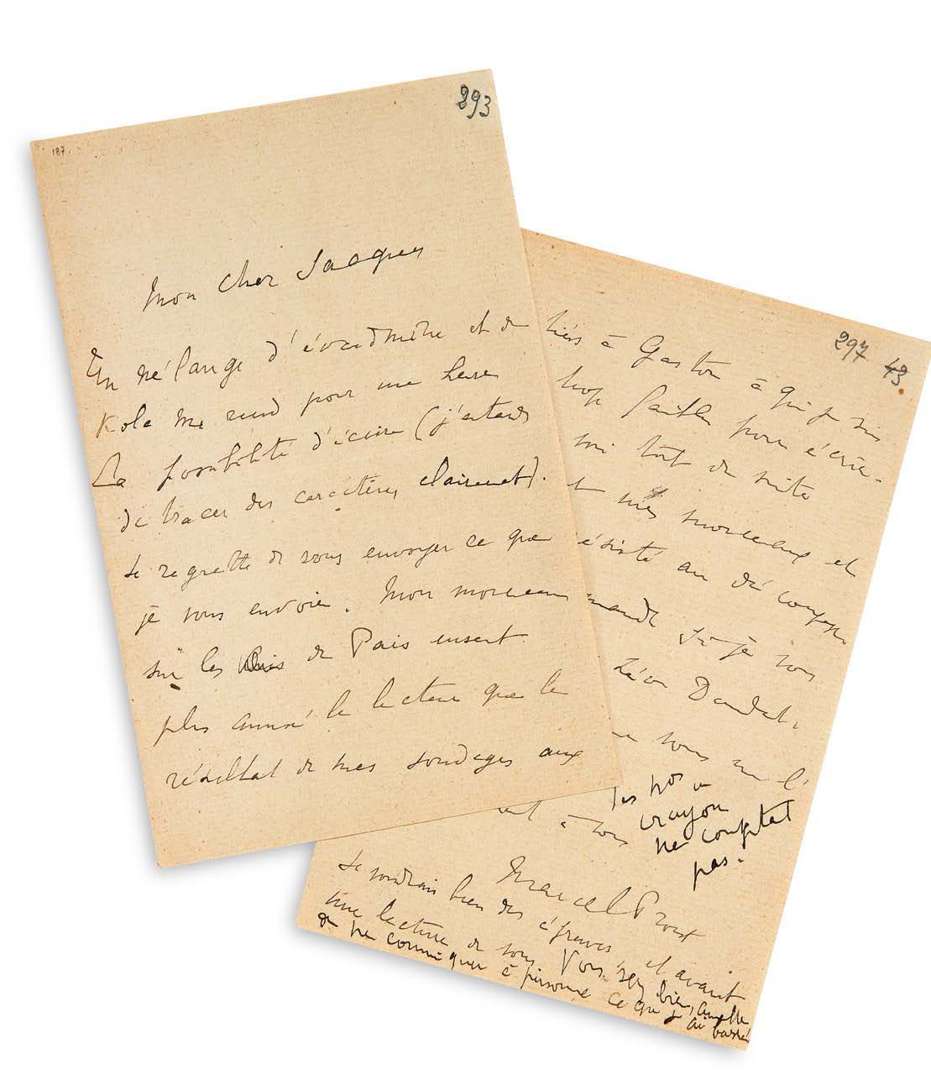
L.A.S. "Marcel Proust", [23 September 1922], to Jacques RIVIÈRE| 5 pages in-8.
One of Proust's last letters, while he was ill and working on his novel La Prisonnière.
[Proust, seriously ill, is putting the last volume of the Recherche du Temps perdu on deck. He has promised Jacques Rivière, director of the Nouvelle
Revue Française, some extracts that he is to provide to the review and which give rise to numerous exchanges between the two men. Proust decided, however, to give the Œuvres libres a large extract covering the period of his life with Albertine, which was published in February 1923. Rivière continued to besiege the exhausted writer to make him keep his initial promise.
Proust finally sent him Le Sommeil d'Albertine and Les Cris de Paris, after a month and a half of fighting. He reduced the first of these fragments, Watching Her Sleep, to six pages, and a second, My Awakenings, to two and a half pages. Until the day of printing, Rivière will have to face the writer's fussy demands concerning the cutting of his text and the corrections. The two excerpts appeared in the Nouvelle Revue
Française on November 1, 1922, only 18 days before Proust's death.
This letter accompanied the first fragment addressed to Jacques Rivière]. "A mixture of evadmine and kola makes it impossible for me to write (I mean to draw characters clearly) for an hour. I regret to send you what I am sending you. My piece on the Cries of
Paris would have amused the reader more than the result of my probes into the depths of sleep. But this is already nearly 15 pages of the N.R.F. You must not abuse it. The piece I am sending you should be entitled: I Watching her sleep. II My awakenings. I did with a meritorious energy if you had seen my state a work of cutting which will make me sentence by sentence the establishment of the volume a torture. Have no fear when you see the name Gisèle instead of Albertine.
I am too honest with you, and I add with Fayard, for a single line of what I am sending you to appear in the Œuvres libres. He will have that less in his extracts. And many other things besides. But I'll leave him the Cris de Paris (it's not the Cris de Paris, I'm telling you, very badly) I think, because without it the work seems to me inextricable. We'll talk about it when I'm better. Besides, I am already much better (thanks to the escape). My doctor, having seen me killing myself on your extracts, thought I was crazy to work in such a state. I don't ask you to come and see me (now I could receive you, perhaps) but I know that evening outings are no good to you. Give my best to Gaston, to whom I am still too weak to write. Write to me at once how my pieces are? and if they have resisted the cutting"... He asks for proofs.
Correspondence, vol. XXI, p. 484.
L.A.S. "Marcel Proust", [23 September 1922], to Jacques RIVIÈRE| 5 pages in-8.
One of Proust's last letters, while he was ill and working on his novel La Prisonnière.
[Proust, seriously ill, is putting the last volume of the Recherche du Temps perdu on deck. He has promised Jacques Rivière, director of the Nouvelle
Revue Française, some extracts that he is to provide to the review and which give rise to numerous exchanges between the two men. Proust decided, however, to give the Œuvres libres a large extract covering the period of his life with Albertine, which was published in February 1923. Rivière continued to besiege the exhausted writer to make him keep his initial promise.
Proust finally sent him Le Sommeil d'Albertine and Les Cris de Paris, after a month and a half of fighting. He reduced the first of these fragments, Watching Her Sleep, to six pages, and a second, My Awakenings, to two and a half pages. Until the day of printing, Rivière will have to face the writer's fussy demands concerning the cutting of his text and the corrections. The two excerpts appeared in the Nouvelle Revue
Française on November 1, 1922, only 18 days before Proust's death.
This letter accompanied the first fragment addressed to Jacques Rivière]. "A mixture of evadmine and kola makes it impossible for me to write (I mean to draw characters clearly) for an hour. I regret to send you what I am sending you. My piece on the Cries of
Paris would have amused the reader more than the result of my probes into the depths of sleep. But this is already nearly 15 pages of the N.R.F. You must not abuse it. The piece I am sending you should be entitled: I Watching her sleep. II My awakenings. I did with a meritorious energy if you had seen my state a work of cutting which will make me sentence by sentence the establishment of the volume a torture. Have no fear when you see the name Gisèle instead of Albertine.
I am too honest with you, and I add with Fayard, for a single line of what I am sending you to appear in the Œuvres libres. He will have that less in his extracts. And many other things besides. But I'll leave him the Cris de Paris (it's not the Cris de Paris, I'm telling you, very badly) I think, because without it the work seems to me inextricable. We'll talk about it when I'm better. Besides, I am already much better (thanks to the escape). My doctor, having seen me killing myself on your extracts, thought I was crazy to work in such a state. I don't ask you to come and see me (now I could receive you, perhaps) but I know that evening outings are no good to you. Give my best to Gaston, to whom I am still too weak to write. Write to me at once how my pieces are? and if they have resisted the cutting"... He asks for proofs.
Correspondence, vol. XXI, p. 484.