
&w=3840&q=75)
&w=3840&q=75)
&w=3840&q=75)
&w=3840&q=75)
&w=3840&q=75)
&w=3840&q=75)
&w=3840&q=75)
&w=3840&q=75)


112
PROUST Marcel (1871-1922).
The item was sold for 48 766 €
Fees include commission and taxes.
PROUST Marcel (1871-1922).
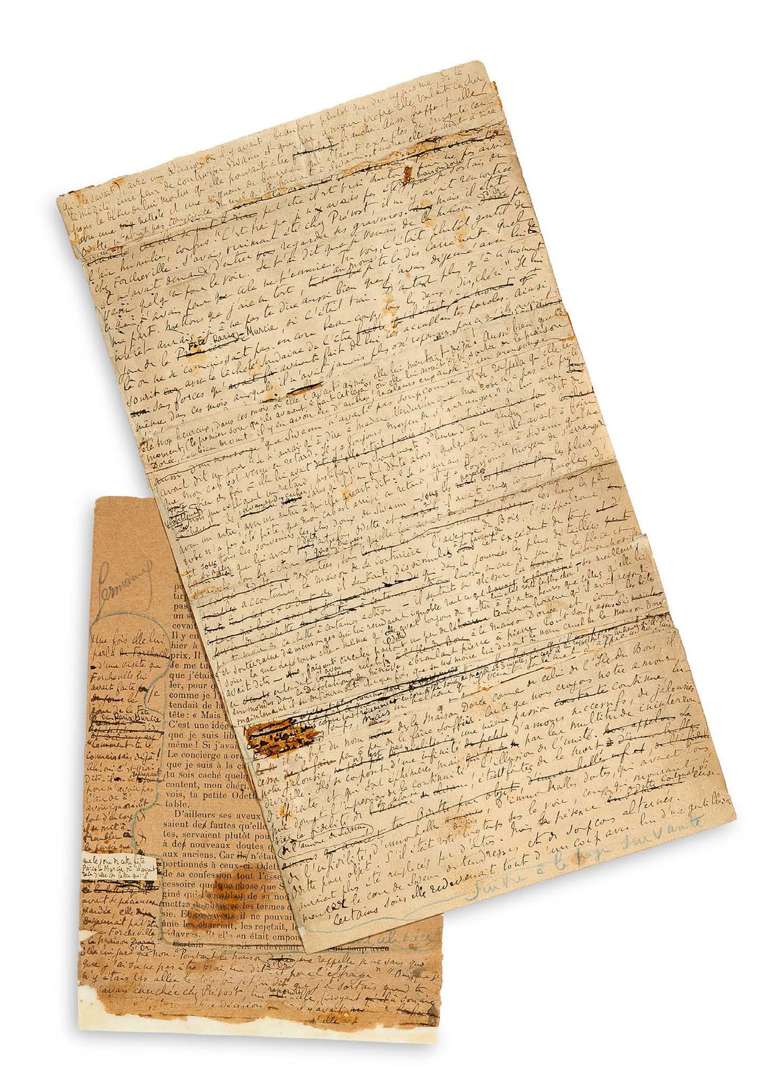
autograph manuscript and corrected proof for Du côté de chez Swann, [1913]| a printed proof sheet of 2 pages in-8 (bottom edge restored), and 1 manuscript page in-fol.
(30.5 x 17 cm) composed of 3 pieces glued end to end.
Long paper on Swann's jealousy, for Un amour de Swann .
This long autograph development is brought on the second proof of Du côté de chez Swann, whose edition will be published by Grasset on November 14, 1913.
These are the first two pages (449-450) of plate 29 of the second proofs, bearing the date stamp of the printer Ch. Colin imprimeur à Mayenne 1 se p 1913, corresponding to pages 362-364 of the Tadié edition in the Bibliothèque de la Pléiade. On these two pages, Proust has made about ten corrections in the margin.
A long addition, inserted at the end of page 450, fills the left margin (with a small glued-on crutch), then continues on the paper (originally glued to the bottom of the page), with erasures and cor
- rections. This long addition corresponds, with some small variations, to pages 364 to 366 of the Pléiade.
Swann, listening to Odette, is overcome with suspicion. "Once she told him of a visit Forcheville had made to her, on the day of the [first farewell performance of Delaunay crossed out] Fête de ParisMurcie. "How you knew him already! Ah, yes, that's right," he said, recovering himself so as not to seem to have ignored him. And suddenly he began to tremble at the thought that on the day of that Paris-Murcie party when he had received from her the letter he had so preciously kept, she might have been lunching with Forcheville, at the Maison [Dorée biffé] d'Or. She swore to him that she was not. "Yet the Maison d'Or reminds me of I don't know what I knew not to be true," he said to frighten her. "Yes, that I had not gone there the evening I told you I was going out, when you [had] sought me out at Prevost's," she answered, (believing from her air that he knew it), with a decision in which there was, much rather than cynicism, shyness, a fear of upsetting Swann, and which from self-love she wished to conceal for the desire of showing him that she could be frank. So she struck with a sharpness and an executioner's vigour which were free from cruelty, for Odette was not aware of the harm she was doing to Swann"... She continued to justify herself... Swann "smiled at her with the sudden cowardice of the being [weak he was at that moment crossed out] without strength that those damning words had made him. So even in those months which he had never dared to think of again because they had been too happy, in those months when she had loved him, she was already lying to him! As well as that moment (the first evening they had "made catleya", when she had told him to get out of the Golden House, how many others must there have been, receivers too of a lie that Swann had not suspected. He remembered that she had once said to him, "I would only have to tell Madame Verdurin that my dress was not ready, that my cab came late. There is always a way to arrange things. To him too [no doubt crossed out] probably many times when she had [said that she had gone to her dressmaker's, that her crossed out] said words that explain a delay, justify a change of time in an appointment, they must have hidden without his suspecting it then, something she had to do with another"... Then this episode ends up fading from his mind. "For what we believe our love, our jealousy, [are not realities strikethrough] is not one and the same [constant strikethrough] continuous, indivisible passion. They are composed of an infinite number of successive loves, of different jealousies, which are ephemeral but by their uninterrupted multitude give the impression of continuity, the illusion of unity. The life of Swann's love, the fidelity of his jealousy, was made up of death, infidelity, innumerable desires, innumerable doubts, all of which had Odette as their object. If he had gone a long time without seeing her, those who died would not have been replaced by others. But Odette's presence continued to sow Swann's heart with alternating tenderness and suspicion. Some evenings she suddenly became kind to him again"... Proust then indicated to the printer, in blue pencil: "Follow on the next page"...
autograph manuscript and corrected proof for Du côté de chez Swann, [1913]| a printed proof sheet of 2 pages in-8 (bottom edge restored), and 1 manuscript page in-fol.
(30.5 x 17 cm) composed of 3 pieces glued end to end.
Long paper on Swann's jealousy, for Un amour de Swann .
This long autograph development is brought on the second proof of Du côté de chez Swann, whose edition will be published by Grasset on November 14, 1913.
These are the first two pages (449-450) of plate 29 of the second proofs, bearing the date stamp of the printer Ch. Colin imprimeur à Mayenne 1 se p 1913, corresponding to pages 362-364 of the Tadié edition in the Bibliothèque de la Pléiade. On these two pages, Proust has made about ten corrections in the margin.
A long addition, inserted at the end of page 450, fills the left margin (with a small glued-on crutch), then continues on the paper (originally glued to the bottom of the page), with erasures and cor
- rections. This long addition corresponds, with some small variations, to pages 364 to 366 of the Pléiade.
Swann, listening to Odette, is overcome with suspicion. "Once she told him of a visit Forcheville had made to her, on the day of the [first farewell performance of Delaunay crossed out] Fête de ParisMurcie. "How you knew him already! Ah, yes, that's right," he said, recovering himself so as not to seem to have ignored him. And suddenly he began to tremble at the thought that on the day of that Paris-Murcie party when he had received from her the letter he had so preciously kept, she might have been lunching with Forcheville, at the Maison [Dorée biffé] d'Or. She swore to him that she was not. "Yet the Maison d'Or reminds me of I don't know what I knew not to be true," he said to frighten her. "Yes, that I had not gone there the evening I told you I was going out, when you [had] sought me out at Prevost's," she answered, (believing from her air that he knew it), with a decision in which there was, much rather than cynicism, shyness, a fear of upsetting Swann, and which from self-love she wished to conceal for the desire of showing him that she could be frank. So she struck with a sharpness and an executioner's vigour which were free from cruelty, for Odette was not aware of the harm she was doing to Swann"... She continued to justify herself... Swann "smiled at her with the sudden cowardice of the being [weak he was at that moment crossed out] without strength that those damning words had made him. So even in those months which he had never dared to think of again because they had been too happy, in those months when she had loved him, she was already lying to him! As well as that moment (the first evening they had "made catleya", when she had told him to get out of the Golden House, how many others must there have been, receivers too of a lie that Swann had not suspected. He remembered that she had once said to him, "I would only have to tell Madame Verdurin that my dress was not ready, that my cab came late. There is always a way to arrange things. To him too [no doubt crossed out] probably many times when she had [said that she had gone to her dressmaker's, that her crossed out] said words that explain a delay, justify a change of time in an appointment, they must have hidden without his suspecting it then, something she had to do with another"... Then this episode ends up fading from his mind. "For what we believe our love, our jealousy, [are not realities strikethrough] is not one and the same [constant strikethrough] continuous, indivisible passion. They are composed of an infinite number of successive loves, of different jealousies, which are ephemeral but by their uninterrupted multitude give the impression of continuity, the illusion of unity. The life of Swann's love, the fidelity of his jealousy, was made up of death, infidelity, innumerable desires, innumerable doubts, all of which had Odette as their object. If he had gone a long time without seeing her, those who died would not have been replaced by others. But Odette's presence continued to sow Swann's heart with alternating tenderness and suspicion. Some evenings she suddenly became kind to him again"... Proust then indicated to the printer, in blue pencil: "Follow on the next page"...