
&w=3840&q=75)
&w=3840&q=75)
&w=3840&q=75)
&w=3840&q=75)
&w=3840&q=75)
&w=3840&q=75)
&w=3840&q=75)
&w=3840&q=75)


108
PROUST Marcel (1871-1922).
The item was sold for 7 800 €
Fees include commission and taxes.
PROUST Marcel (1871-1922).
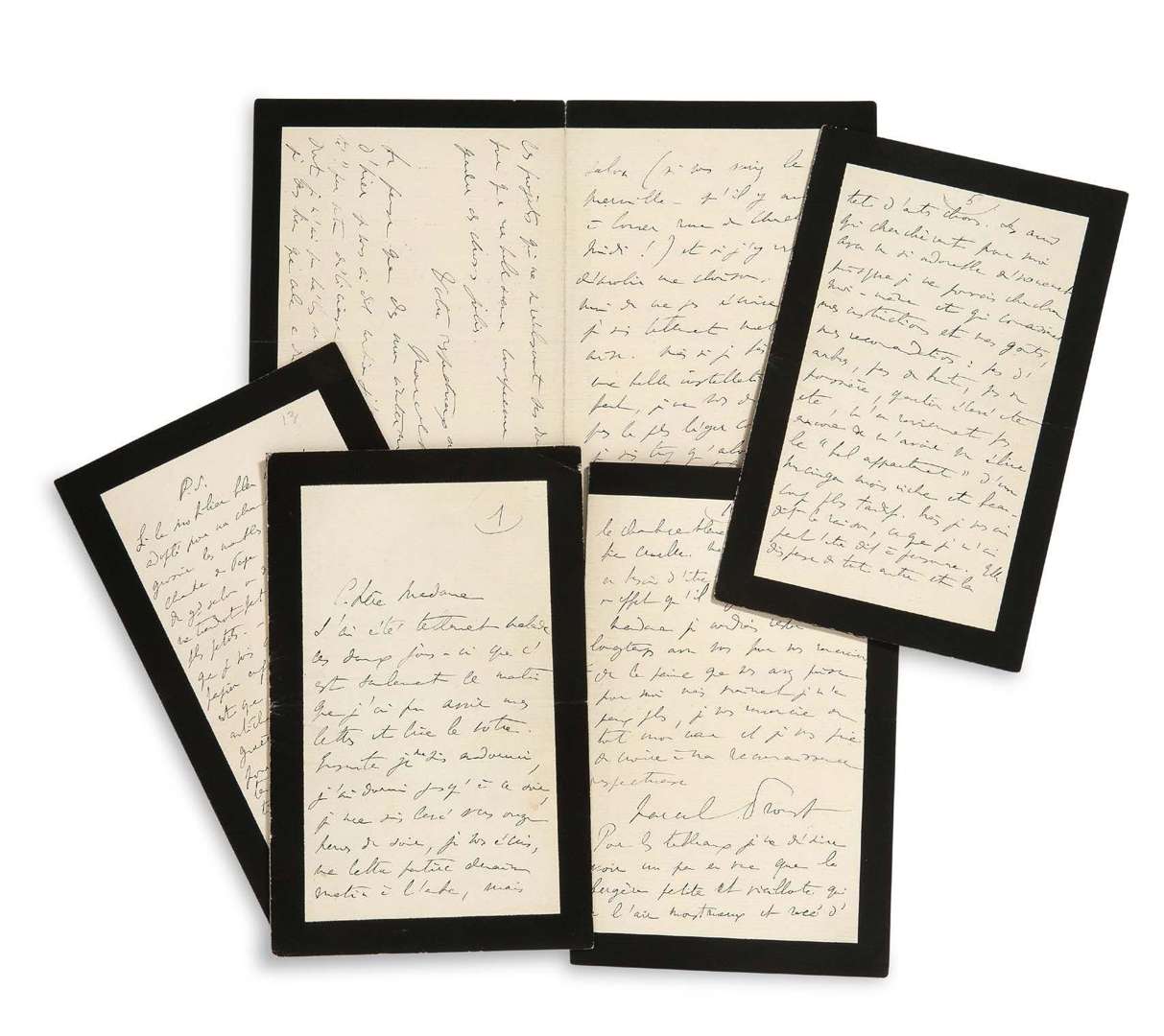
L.A.S. "Marcel Proust", [Versailles around 12 December 1906], to Madame CATUSSE| 18 pages in-8 (mourning paper).
Very long letter about his furniture and his installation at 102 Boulevard Haussmann, where he can dispose of his mother's furniture and the family apartment in the rue de Courcelles.
"Everything you told me seemed to me - through the haze of dissipating discomfort - perfect. I didn't care for the red paper as you thought. It was that particular empire paper that had seemed to me beautiful though red. But it couldn't go there. And I'm not at all hostile to red, on the contrary! I am glad to see that the woodwork can be used, I thought the anteroom was too small, and it will give me great pleasure to have it there again, for Mama had enjoyed it so much, loved her anteroom so much. Apart from this sweetness, it will give me pleasure anyway, for it was delightful, whatever my young sister-in-law thinks! Alas, what you tell me about the apartment on the boulevard
Haussmann [that of her great-uncle Weil, also at 102 boulevard
Haussmann] I know too well! It is at least fifteen years since I saw it, but I remember it as the ugliest thing I have ever seen, the triumph of bourgeois bad taste at a time still too close to be harmless! It is not even old-fashioned in the charming sense of the word. Old-fashioned! It's too ugly to ever be.
But I have told you the sweet and sad attractive force that brought me back to it, despite the horror of the neighborhood, the dust, the Saint
Lazare station, so many other things. The friends who searched for me with such adorable devotion, since I could not search for myself, and who knew my instructions and my tastes, my recommendations: no trees, no noise, no dust, a high neighborhood, etc., etc., still can't believe they saw me choose the "beautiful apartment" of a less wealthy and much later
Nucingen. [...] it will at least have been a transition between the place where Mother lies for me, which is not the cemetery but the apartment in the rue de Courcelles, and an apartment that she would never have seen, entirely foreign.
Then he talks about his stay at the Hôtel des Réservoirs in Versailles| he only woke up at night... "I spent four months in Versailles as if I had spent them in a telephone booth without having known anything about the setting. And in the past I used to go constantly from Paris to Versailles, so much do I love these incomparable places, which our sadness has made more beautiful than they ever were in their original splendour, and which have gained so much in beauty from Louis XIV to Barrès!"...
He asks for news of Reynaldo HAHN: "He phones me all the time to come, but I am really too unwell, and I hope he doesn't take that for indifference. God knows if it is the opposite that I feel for him!"
He does not know when he will be able to settle in Paris, because there is a delay. "As soon as I arrive-even if I am to be well afterwards in the apartment-I shall be ill for a few days, as after any change..."
There are no less than four postscripts to this letter. First, Proust talks about his paintings: "As far as paintings are concerned, I only want to see the small, old-fashioned shepherdess, which has the monstrous, racy look of a Spanish infanta, the portrait of Mama, and my portrait by Blanche.
However, the exact copies of the Snyders will look very well in the dining room. I know that the Govaert Flinck (Tobias and the Angel) is a valuable painting, and in short a very good and somewhat dark painting by one of Rembrandt's best pupils. But I intend to leave it to Robert (and for that matter anything else he wants) as well as the so beautiful portrait of Papa by
Lecomte du Nouy, which was the admiration of Jacques Blanche, but I believe that Robert will have great pleasure in having it. I will also send him Esther and Aman, the Roman history, and the Metsu [...] But for my part, any painting that is not desired, bought with pain and love, is atrocious in an apartment.
[...] A painting that does not please is a horror.
In another postscript, Proust talks about the installation of his room: "If the blue furniture is not adopted for my room, the furniture in Papa's old room could be enlarged with some furniture from the large living room or the small living room, which might not fit in these smaller rooms. The only drawback I see to the nice (relatively) empire paper in the anteroom is that all the woodwork in Mom's anteroom is hardly of the same style. I could perhaps in this case have the walls stretched out in cloth (imitation of the old Jouy cloths, which I had as curtains in my room on the rue de Courcelles, and which I will no longer have if I have blue curtains).
L.A.S. "Marcel Proust", [Versailles around 12 December 1906], to Madame CATUSSE| 18 pages in-8 (mourning paper).
Very long letter about his furniture and his installation at 102 Boulevard Haussmann, where he can dispose of his mother's furniture and the family apartment in the rue de Courcelles.
"Everything you told me seemed to me - through the haze of dissipating discomfort - perfect. I didn't care for the red paper as you thought. It was that particular empire paper that had seemed to me beautiful though red. But it couldn't go there. And I'm not at all hostile to red, on the contrary! I am glad to see that the woodwork can be used, I thought the anteroom was too small, and it will give me great pleasure to have it there again, for Mama had enjoyed it so much, loved her anteroom so much. Apart from this sweetness, it will give me pleasure anyway, for it was delightful, whatever my young sister-in-law thinks! Alas, what you tell me about the apartment on the boulevard
Haussmann [that of her great-uncle Weil, also at 102 boulevard
Haussmann] I know too well! It is at least fifteen years since I saw it, but I remember it as the ugliest thing I have ever seen, the triumph of bourgeois bad taste at a time still too close to be harmless! It is not even old-fashioned in the charming sense of the word. Old-fashioned! It's too ugly to ever be.
But I have told you the sweet and sad attractive force that brought me back to it, despite the horror of the neighborhood, the dust, the Saint
Lazare station, so many other things. The friends who searched for me with such adorable devotion, since I could not search for myself, and who knew my instructions and my tastes, my recommendations: no trees, no noise, no dust, a high neighborhood, etc., etc., still can't believe they saw me choose the "beautiful apartment" of a less wealthy and much later
Nucingen. [...] it will at least have been a transition between the place where Mother lies for me, which is not the cemetery but the apartment in the rue de Courcelles, and an apartment that she would never have seen, entirely foreign.
Then he talks about his stay at the Hôtel des Réservoirs in Versailles| he only woke up at night... "I spent four months in Versailles as if I had spent them in a telephone booth without having known anything about the setting. And in the past I used to go constantly from Paris to Versailles, so much do I love these incomparable places, which our sadness has made more beautiful than they ever were in their original splendour, and which have gained so much in beauty from Louis XIV to Barrès!"...
He asks for news of Reynaldo HAHN: "He phones me all the time to come, but I am really too unwell, and I hope he doesn't take that for indifference. God knows if it is the opposite that I feel for him!"
He does not know when he will be able to settle in Paris, because there is a delay. "As soon as I arrive-even if I am to be well afterwards in the apartment-I shall be ill for a few days, as after any change..."
There are no less than four postscripts to this letter. First, Proust talks about his paintings: "As far as paintings are concerned, I only want to see the small, old-fashioned shepherdess, which has the monstrous, racy look of a Spanish infanta, the portrait of Mama, and my portrait by Blanche.
However, the exact copies of the Snyders will look very well in the dining room. I know that the Govaert Flinck (Tobias and the Angel) is a valuable painting, and in short a very good and somewhat dark painting by one of Rembrandt's best pupils. But I intend to leave it to Robert (and for that matter anything else he wants) as well as the so beautiful portrait of Papa by
Lecomte du Nouy, which was the admiration of Jacques Blanche, but I believe that Robert will have great pleasure in having it. I will also send him Esther and Aman, the Roman history, and the Metsu [...] But for my part, any painting that is not desired, bought with pain and love, is atrocious in an apartment.
[...] A painting that does not please is a horror.
In another postscript, Proust talks about the installation of his room: "If the blue furniture is not adopted for my room, the furniture in Papa's old room could be enlarged with some furniture from the large living room or the small living room, which might not fit in these smaller rooms. The only drawback I see to the nice (relatively) empire paper in the anteroom is that all the woodwork in Mom's anteroom is hardly of the same style. I could perhaps in this case have the walls stretched out in cloth (imitation of the old Jouy cloths, which I had as curtains in my room on the rue de Courcelles, and which I will no longer have if I have blue curtains).