
&w=3840&q=75)
&w=3840&q=75)
&w=3840&q=75)
&w=3840&q=75)
&w=3840&q=75)
&w=3840&q=75)
&w=3840&q=75)
&w=3840&q=75)

107
PROUST Marcel (1871-1922).
The item was sold for 5 070 €
Fees include commission and taxes.
PROUST Marcel (1871-1922).
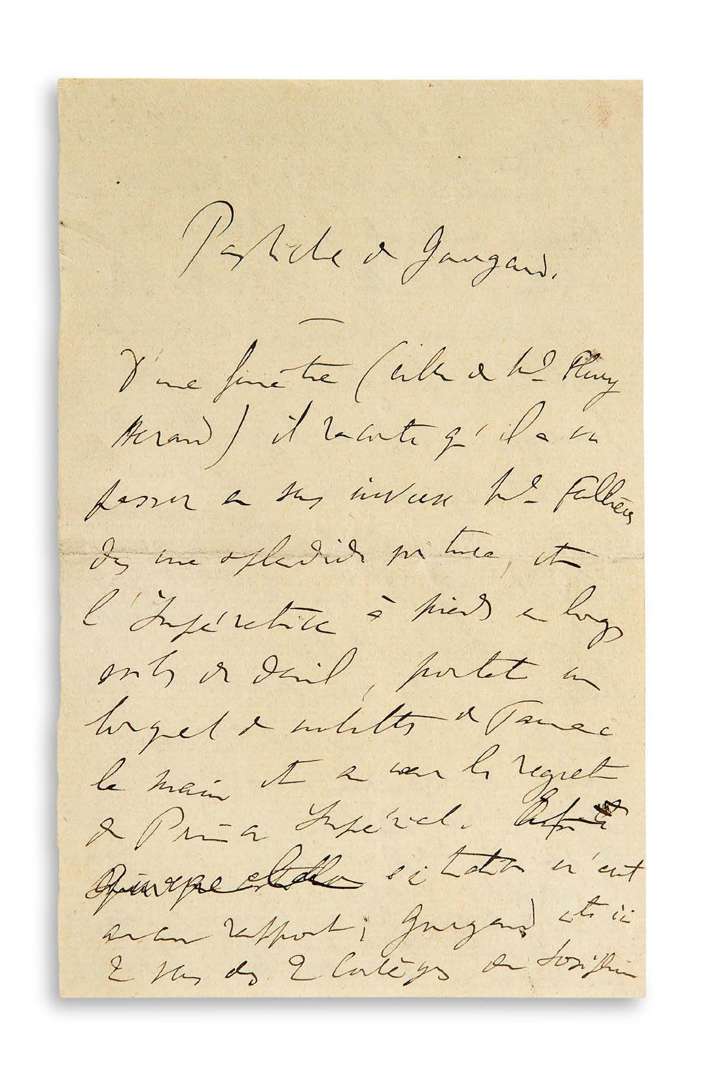
Autograph MANUSCRIT, Pastiche de Gourgaud, [ca. 1908?]| 2 pages in-8.
Amusing pastiche of a society column, written for Reynaldo
Hahn.
[We correct the name read by Philip Kolb as "Gaugard" to Gourgaud.
Member of the Jockey Club and other social circles, ardent collector, Baron Napoleon GOURGAUD (1881-1944) was the great-grandson of Napoleon's companion at Saint Helena. According to Gabriel-Louis
Pringué, "the baron was throughout his life a patron of the arts, an artist, a delicate and affectionate host, whose aristocratic physique and witty conversation charmed". In August 1920, Proust asked the Duc de Guiche where Napoleon Gourgaud was, and said he wanted to "make a pastiche against him" (Correspondance, vol. XIX, p. 410), perhaps to include him in a second series of Pastiches et Mélanges]. "From a window (that of Me Flury Herard) he relates that he saw Me Fallières passing in the opposite direction in a splendid carriage, and the Empress on foot in long mourning veils, carrying a bouquet of Parma violets in her hand and in her heart the regret of the Imperial Prince. Finally, although the situation has no connection, Gourgaud quotes two verses from the 2 Cortèges by
Joséphin Soulary, which he believes to be his own, and invented at the time. And he ends by saying that in the evening at the cotillion of Me Henri de Rothschild he put on a buttonhole made of Parma violets and nobody knew why.
Me de Gagne [?] told him "It's original these violets" but he did not want to profane his secret. And in the evening when he came home and undressed, he "devoutly" put the buttonhole in a vase in front of the Empress's photograph and forgot to answer an invitation from the Molitor Countess.
In the evening, at Me Barrachin's, we found Gourgaud's article "ideal" and
Verdé Delisle said that he could do whatever he wanted with his ten fingers and that it was unfortunate that he did not need that to live.
Published by Philip Kolb in Lettres à Reynaldo Hahn (1956, no. CVIII).
Autograph MANUSCRIT, Pastiche de Gourgaud, [ca. 1908?]| 2 pages in-8.
Amusing pastiche of a society column, written for Reynaldo
Hahn.
[We correct the name read by Philip Kolb as "Gaugard" to Gourgaud.
Member of the Jockey Club and other social circles, ardent collector, Baron Napoleon GOURGAUD (1881-1944) was the great-grandson of Napoleon's companion at Saint Helena. According to Gabriel-Louis
Pringué, "the baron was throughout his life a patron of the arts, an artist, a delicate and affectionate host, whose aristocratic physique and witty conversation charmed". In August 1920, Proust asked the Duc de Guiche where Napoleon Gourgaud was, and said he wanted to "make a pastiche against him" (Correspondance, vol. XIX, p. 410), perhaps to include him in a second series of Pastiches et Mélanges]. "From a window (that of Me Flury Herard) he relates that he saw Me Fallières passing in the opposite direction in a splendid carriage, and the Empress on foot in long mourning veils, carrying a bouquet of Parma violets in her hand and in her heart the regret of the Imperial Prince. Finally, although the situation has no connection, Gourgaud quotes two verses from the 2 Cortèges by
Joséphin Soulary, which he believes to be his own, and invented at the time. And he ends by saying that in the evening at the cotillion of Me Henri de Rothschild he put on a buttonhole made of Parma violets and nobody knew why.
Me de Gagne [?] told him "It's original these violets" but he did not want to profane his secret. And in the evening when he came home and undressed, he "devoutly" put the buttonhole in a vase in front of the Empress's photograph and forgot to answer an invitation from the Molitor Countess.
In the evening, at Me Barrachin's, we found Gourgaud's article "ideal" and
Verdé Delisle said that he could do whatever he wanted with his ten fingers and that it was unfortunate that he did not need that to live.
Published by Philip Kolb in Lettres à Reynaldo Hahn (1956, no. CVIII).