
&w=3840&q=75)
&w=3840&q=75)
&w=3840&q=75)
&w=3840&q=75)
&w=3840&q=75)
&w=3840&q=75)
&w=3840&q=75)
&w=3840&q=75)


103
PROUDHON Pierre-Joseph (1809-1865).
The item was sold for 1 449 €
Fees include commission and taxes.
PROUDHON Pierre-Joseph (1809-1865).
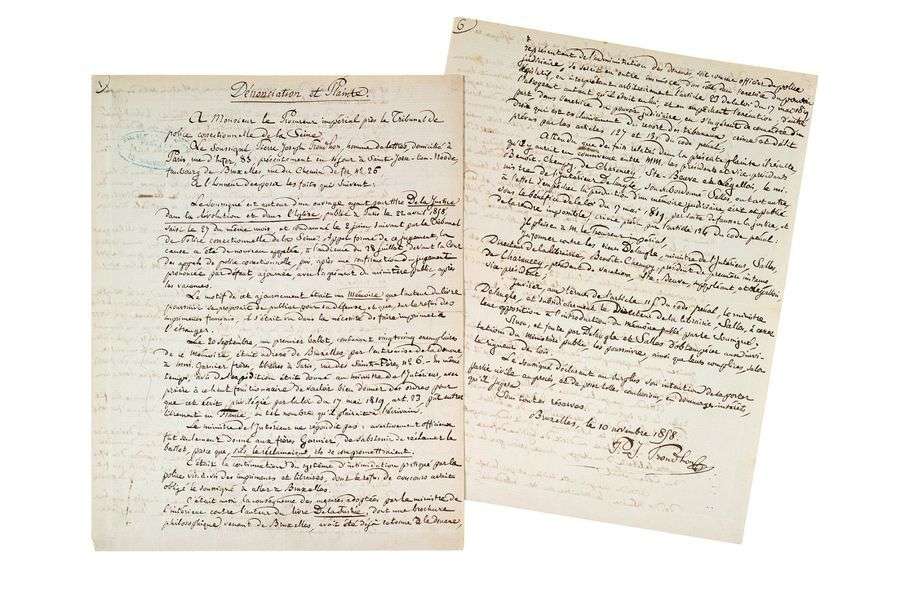
P.A.S. "P.-J. Proudhon", Brussels November 10, 1858| 6 pages in-4, court ink stamp.
Denunciation and complaint about his work De la Justice dans la Révolution et dans l'Église.
Condemned as soon as his book was published, Proudhon fled to Belgium to escape his sentence. His book was banned, but he was allowed to publish a "memoir" in his defense, pending a review of his trial. This memoir, in the face of the refusal of the French printers, was printed abroad| but it was intercepted by the Ministry of the Interior even before it was distributed. Proudhon asked the imperial prosecutor at the Tribunal de police correctionnelle de la Seine to ensure that his rights were respected and took advantage of the opportunity to underline the abuses of the State, the "system of intimidation practised by the police" with his publishers, the Garnier brothers... "It was also the consequence of the measures adopted by the Minister of the Interior against the author of the book De la Justice, a philosophical brochure of which, coming from Brussels, had already been detained at the customs"... Proudhon relates the steps taken by Charles Beslay, "former representative of the people, his proxy and friend", to claim the seized copies. The answer was that "the memoir was seized by order of the Ministry of the Interior, as containing the incriminating passages of the book, and that the police would not allow its distribution"... Proudhon protests against "this act of pure arbitrariness". He continues, with verve, to relate the vain steps taken with the magistrates to have the minister summoned, or to send a summons to the customs... Thus "we would be rid of the memoir, and the trial, and the man"... But Proudhon, "threatened in his liberty and interests by this sort of plot organized for the proscription of his thought and his person, but strong in his right, and certain of the truth of the facts he denounces," asks the prosecutor to inform against the Minister of the Interior Delangle, the director of the Salles bookstore, the magistrates Benoît-Champy, de Charancey, Sainte-Beuve, and Legallois, and to invite the first two to "cease and desist from their opposition to the introduction of the memoir," and if not, to proceed against them...
P.A.S. "P.-J. Proudhon", Brussels November 10, 1858| 6 pages in-4, court ink stamp.
Denunciation and complaint about his work De la Justice dans la Révolution et dans l'Église.
Condemned as soon as his book was published, Proudhon fled to Belgium to escape his sentence. His book was banned, but he was allowed to publish a "memoir" in his defense, pending a review of his trial. This memoir, in the face of the refusal of the French printers, was printed abroad| but it was intercepted by the Ministry of the Interior even before it was distributed. Proudhon asked the imperial prosecutor at the Tribunal de police correctionnelle de la Seine to ensure that his rights were respected and took advantage of the opportunity to underline the abuses of the State, the "system of intimidation practised by the police" with his publishers, the Garnier brothers... "It was also the consequence of the measures adopted by the Minister of the Interior against the author of the book De la Justice, a philosophical brochure of which, coming from Brussels, had already been detained at the customs"... Proudhon relates the steps taken by Charles Beslay, "former representative of the people, his proxy and friend", to claim the seized copies. The answer was that "the memoir was seized by order of the Ministry of the Interior, as containing the incriminating passages of the book, and that the police would not allow its distribution"... Proudhon protests against "this act of pure arbitrariness". He continues, with verve, to relate the vain steps taken with the magistrates to have the minister summoned, or to send a summons to the customs... Thus "we would be rid of the memoir, and the trial, and the man"... But Proudhon, "threatened in his liberty and interests by this sort of plot organized for the proscription of his thought and his person, but strong in his right, and certain of the truth of the facts he denounces," asks the prosecutor to inform against the Minister of the Interior Delangle, the director of the Salles bookstore, the magistrates Benoît-Champy, de Charancey, Sainte-Beuve, and Legallois, and to invite the first two to "cease and desist from their opposition to the introduction of the memoir," and if not, to proceed against them...