
&w=3840&q=75)
&w=3840&q=75)
&w=3840&q=75)
&w=3840&q=75)
&w=3840&q=75)
&w=3840&q=75)
&w=3840&q=75)
&w=3840&q=75)

94
MANN Thomas (1875-1955).
The item was sold for 11 862 €
Fees include commission and taxes.
MANN Thomas (1875-1955).
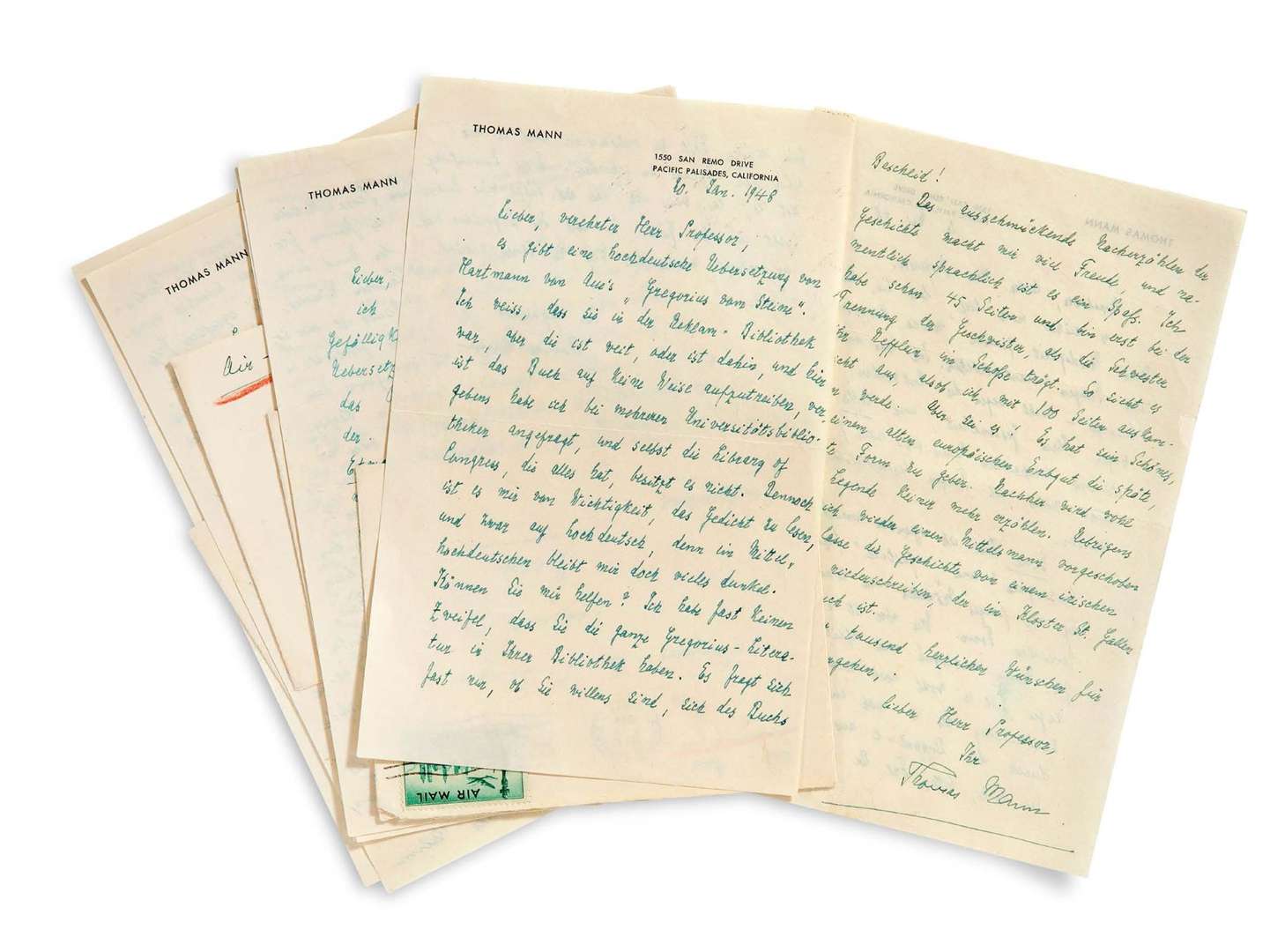
6 L.A.S. "Thomas Mann", Pacifi c Palisades (California) January 20-May 20, 1948, to Professor Samuel SINGER in Bern (Switzerland)| 12 pages in-8 in green ink on his letterhead and address, 4 envelopes| in German.
Interesting correspondence on the genesis of his novel
Der Erwählte (The Chosen).
Samuel SINGER (1860-1948), a philologist and medievalist of Viennese origin, had been teaching German philology and medieval literature at the University of Bern since 1910, to which he devoted numerous works.
He died at the end of 1948. The correspondence begins on the same day that Mann starts writing the short story that will soon become a novel (completed in late 1950 and published in 1951), and concerns the main source of his book, Hartmann von Aue's Gregorius, which Singer will translate for him.
January 20. He seeks a German translation ("eine hochdeutsche
Uebersetzung") of Hartmann von Aue's Gregorius vom Steine. It is important for him to be able to read this poem in German, because too much remains obscure to him in medieval German ("Dennoch ist es mir von Wichtigkeit, das Gedicht zu lesen, und zwar auf hochdeutsch, denn im Mittelhochdeutschen bleibt mir doch vieles dunkel"). He asks Singer, who must have all the Gregorian literature in his library, to lend him this book for a while and to take it across the ocean... February 13. He thanks Singer for his kindness. He explains to him that he wants to tell in modern prose this story which is briefly mentioned in Faust, and which has ramifications in the tradition, as a pious grotesque legend, perhaps from the mouth of an Irish monk who would have lived before Hartman ("Die Sache ist die, dass ich die Geschichte, die schon in Faustus kurz vorkommt, und die so lange, verzweigt Wurzeln in der Tradition hat, gern mit modernen Prosa-Mitteln noch noch einmal erzählen möchte, als fromme Grotesk-Legende, vielleicht durch den Mund Eines, der vor Hartman lebt, eines irischen Mönches der ein
Kloster St. Gallen zu Besuch ist, oder nicht zur Führung der Mund Eines. Gallen zu Besuch ist, oder so"). Then he mentions at length the location of the legend: Aquitaine and Guyenne, Flanders-Artois, etc. March 8. He thanks Singer for sending the rest of his translation, and awaits the next shipment. He imagines a duchy of Flanders-Artois, with French influences, but with names of people from international legends| the story would be written for entertainment by an Irish monk visiting Saint-Gall... ("Ich imaginiere ein Herzogtum von Flandern-Artois, mit französischen Einschlagen, aber mit Personen-Namen wie Grimald, Herburg, Willigis, Sigunde, alles legendär-international. Die Geschichte lasse ich von einem irischen Mönch, der in St. Gallen zu Besuch ist, zur
Unterhaltung aufschreiben. Er ist etwas abstrakt von Person, eigentlich "der Geist der Erzählung", und es ist weder ganz sicher, wann er dort sitzt, noch in welcher Sprache er eigentlich schreibt. Er sagt, es sei die Sprache selbst")... Etc. April 13 and 27. List of questions concerning the vocabulary, the German translation of some terms of Chrétien de Troyes' time, and the medieval equivalent of some expressions... 20 May. After new philological questions, Mann talks about the development of his story, which, from a short story, will become a novel, and give a modern form to an old European heritage : " Das ausschmückende Nacherzählen der Geschichte macht mir viel Freude, und namentlich sprachlich ist es ein Spass. Ich habe schon 45 Seiten und bin erst bei der Trennung der
Geschwister, als die Schwester ihr Neffl ein im Schosse trägt. So it doesn't matter if I have 100 pages to go. Aber sei es! Es hat sein Schönes, so einem alten europäischen Erbgut die späte, letzte
Form zu geben. Now the legend will no longer be repeated.
Uebrigens habe ich wieder einen Mittelsmann vorgeschoben und lasse die Geschichte von einem irischen Mönch wiedersechreiben, der im
Kloster St. Gallen zu Besuch ist"...
6 L.A.S. "Thomas Mann", Pacifi c Palisades (California) January 20-May 20, 1948, to Professor Samuel SINGER in Bern (Switzerland)| 12 pages in-8 in green ink on his letterhead and address, 4 envelopes| in German.
Interesting correspondence on the genesis of his novel
Der Erwählte (The Chosen).
Samuel SINGER (1860-1948), a philologist and medievalist of Viennese origin, had been teaching German philology and medieval literature at the University of Bern since 1910, to which he devoted numerous works.
He died at the end of 1948. The correspondence begins on the same day that Mann starts writing the short story that will soon become a novel (completed in late 1950 and published in 1951), and concerns the main source of his book, Hartmann von Aue's Gregorius, which Singer will translate for him.
January 20. He seeks a German translation ("eine hochdeutsche
Uebersetzung") of Hartmann von Aue's Gregorius vom Steine. It is important for him to be able to read this poem in German, because too much remains obscure to him in medieval German ("Dennoch ist es mir von Wichtigkeit, das Gedicht zu lesen, und zwar auf hochdeutsch, denn im Mittelhochdeutschen bleibt mir doch vieles dunkel"). He asks Singer, who must have all the Gregorian literature in his library, to lend him this book for a while and to take it across the ocean... February 13. He thanks Singer for his kindness. He explains to him that he wants to tell in modern prose this story which is briefly mentioned in Faust, and which has ramifications in the tradition, as a pious grotesque legend, perhaps from the mouth of an Irish monk who would have lived before Hartman ("Die Sache ist die, dass ich die Geschichte, die schon in Faustus kurz vorkommt, und die so lange, verzweigt Wurzeln in der Tradition hat, gern mit modernen Prosa-Mitteln noch noch einmal erzählen möchte, als fromme Grotesk-Legende, vielleicht durch den Mund Eines, der vor Hartman lebt, eines irischen Mönches der ein
Kloster St. Gallen zu Besuch ist, oder nicht zur Führung der Mund Eines. Gallen zu Besuch ist, oder so"). Then he mentions at length the location of the legend: Aquitaine and Guyenne, Flanders-Artois, etc. March 8. He thanks Singer for sending the rest of his translation, and awaits the next shipment. He imagines a duchy of Flanders-Artois, with French influences, but with names of people from international legends| the story would be written for entertainment by an Irish monk visiting Saint-Gall... ("Ich imaginiere ein Herzogtum von Flandern-Artois, mit französischen Einschlagen, aber mit Personen-Namen wie Grimald, Herburg, Willigis, Sigunde, alles legendär-international. Die Geschichte lasse ich von einem irischen Mönch, der in St. Gallen zu Besuch ist, zur
Unterhaltung aufschreiben. Er ist etwas abstrakt von Person, eigentlich "der Geist der Erzählung", und es ist weder ganz sicher, wann er dort sitzt, noch in welcher Sprache er eigentlich schreibt. Er sagt, es sei die Sprache selbst")... Etc. April 13 and 27. List of questions concerning the vocabulary, the German translation of some terms of Chrétien de Troyes' time, and the medieval equivalent of some expressions... 20 May. After new philological questions, Mann talks about the development of his story, which, from a short story, will become a novel, and give a modern form to an old European heritage : " Das ausschmückende Nacherzählen der Geschichte macht mir viel Freude, und namentlich sprachlich ist es ein Spass. Ich habe schon 45 Seiten und bin erst bei der Trennung der
Geschwister, als die Schwester ihr Neffl ein im Schosse trägt. So it doesn't matter if I have 100 pages to go. Aber sei es! Es hat sein Schönes, so einem alten europäischen Erbgut die späte, letzte
Form zu geben. Now the legend will no longer be repeated.
Uebrigens habe ich wieder einen Mittelsmann vorgeschoben und lasse die Geschichte von einem irischen Mönch wiedersechreiben, der im
Kloster St. Gallen zu Besuch ist"...