
&w=3840&q=75)
&w=3840&q=75)
&w=3840&q=75)
&w=3840&q=75)
&w=3840&q=75)
&w=3840&q=75)
&w=3840&q=75)
&w=3840&q=75)

73
GIDE André (1869-1951).
The item was sold for 922 €
Fees include commission and taxes.
GIDE André (1869-1951).
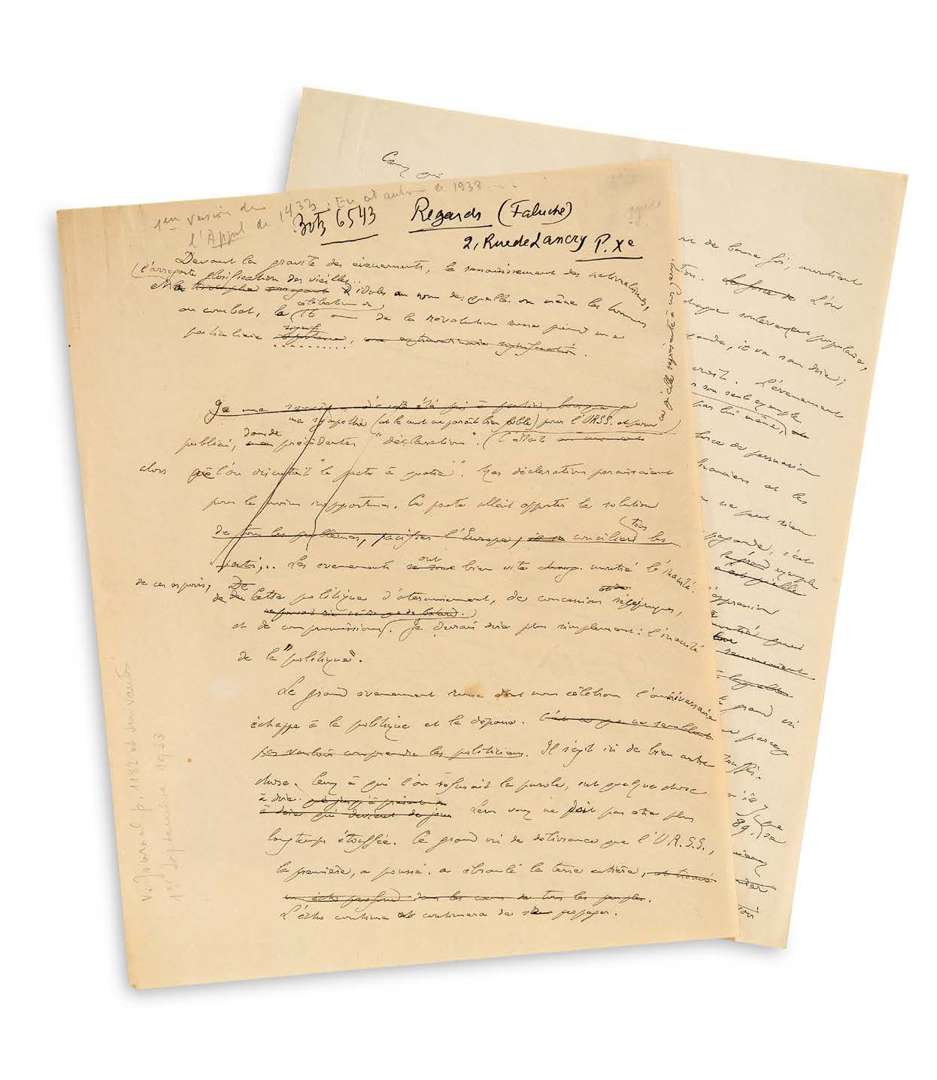
autograph manuscript, [Un Appel, September 1933]| 3 pages in-4.
Draft of his declaration for the commemoration of the October Bolshevik revolution.
Beautiful political text by Gide, written at the time when he began to publicly commit himself to the communists. The manuscript, a very early draft, contains 34 autograph corrections, including a long passage of six perfectly legible lines.
This text was written for the World Youth Congress against Fascism and War, which met in Paris on 22, 23 and 24 September 1933 at the Mutualité, under the honorary presidency of Henri Barbusse, Romain Rolland, Francis
Jourdain and André Gide. Gide's speech, of which we have here the first draft, which will be reworked, was reproduced for the commemoration of the October Revolution in Regards (November 1933), L'Humanité (November 5, 1933), Lu (November 10, 1933), and, finally, in the Nouvelle Revue
Française (April 1, 1935), before being collected by Yvonne
Davet in Littérature engagée.
Proof of the importance that Gide attached to these pages, he copied them into his Journal on November 1, 1933. Having become a "fellow traveller" of the Communist Party, Gide participated in the Writers' Congress in 1935. This commitment culminated in an invitation to visit the USSR in 1936, from which we know that he returned with his eyes opened to the true nature of the regime. The Return from the U.S.S.R. marked the break with Stalinism. But in 1933, when he wrote this text, he was full of enthusiasm for the achievements of Soviet Russia. He therefore defended the USSR against the attacks it was suffering, celebrating the example of October and the hope it had given rise to in all other nations.
"In view of the seriousness of events, the revival of nationalism, and the arrogant glorification of the old idols in the name of which men are led into battle, the celebration of the sixteenth anniversary of the Russian Revolution takes on a special significance.
The following passage has been crossed out and deleted from the final version: "I remember being taken to task when I published, in previous 'statements', my sympathy (and the word seems very weak) for the USSR and what it represents in our eyes. It was at that time that the "four-party pact" was being discussed. This pact was going to provide the solution to all the problems, to pacify Europe, to reconcile all the parties. Then he continues: "Events soon showed the futility of these hopes, of this policy of procrastination, of reciprocal concessions and compromises. I should say more simply: the futility of the "policy". The great Russian event whose anniversary we are celebrating escapes politics and goes beyond it. It is about something else. Those who were denied a voice have something to say. Their voice must not be silenced any longer. The great cry for deliverance which the USSR was the first to raise has shaken the whole world [and has found a deep echo in the hearts of all peoples]. The echo continues and will continue to spread"... Etc.
autograph manuscript, [Un Appel, September 1933]| 3 pages in-4.
Draft of his declaration for the commemoration of the October Bolshevik revolution.
Beautiful political text by Gide, written at the time when he began to publicly commit himself to the communists. The manuscript, a very early draft, contains 34 autograph corrections, including a long passage of six perfectly legible lines.
This text was written for the World Youth Congress against Fascism and War, which met in Paris on 22, 23 and 24 September 1933 at the Mutualité, under the honorary presidency of Henri Barbusse, Romain Rolland, Francis
Jourdain and André Gide. Gide's speech, of which we have here the first draft, which will be reworked, was reproduced for the commemoration of the October Revolution in Regards (November 1933), L'Humanité (November 5, 1933), Lu (November 10, 1933), and, finally, in the Nouvelle Revue
Française (April 1, 1935), before being collected by Yvonne
Davet in Littérature engagée.
Proof of the importance that Gide attached to these pages, he copied them into his Journal on November 1, 1933. Having become a "fellow traveller" of the Communist Party, Gide participated in the Writers' Congress in 1935. This commitment culminated in an invitation to visit the USSR in 1936, from which we know that he returned with his eyes opened to the true nature of the regime. The Return from the U.S.S.R. marked the break with Stalinism. But in 1933, when he wrote this text, he was full of enthusiasm for the achievements of Soviet Russia. He therefore defended the USSR against the attacks it was suffering, celebrating the example of October and the hope it had given rise to in all other nations.
"In view of the seriousness of events, the revival of nationalism, and the arrogant glorification of the old idols in the name of which men are led into battle, the celebration of the sixteenth anniversary of the Russian Revolution takes on a special significance.
The following passage has been crossed out and deleted from the final version: "I remember being taken to task when I published, in previous 'statements', my sympathy (and the word seems very weak) for the USSR and what it represents in our eyes. It was at that time that the "four-party pact" was being discussed. This pact was going to provide the solution to all the problems, to pacify Europe, to reconcile all the parties. Then he continues: "Events soon showed the futility of these hopes, of this policy of procrastination, of reciprocal concessions and compromises. I should say more simply: the futility of the "policy". The great Russian event whose anniversary we are celebrating escapes politics and goes beyond it. It is about something else. Those who were denied a voice have something to say. Their voice must not be silenced any longer. The great cry for deliverance which the USSR was the first to raise has shaken the whole world [and has found a deep echo in the hearts of all peoples]. The echo continues and will continue to spread"... Etc.