
&w=3840&q=75)
&w=3840&q=75)
&w=3840&q=75)
&w=3840&q=75)
&w=3840&q=75)
&w=3840&q=75)
&w=3840&q=75)
&w=3840&q=75)


72
GIDE André (1869-1951).
The item was sold for 6 590 €
Fees include commission and taxes.
GIDE André (1869-1951).
TAPScript with autograph corrections, Les Fauxmonnayeurs, Seconde partie, [1925]| 187 leaves in-4 (21 x 27 cm), bound in one volume in-4 half Lavallière morocco with corners, gilt edges, white vellum-covered boards, five-ribbed spine, gilt title (P.L. Martin).
Important typescript with many corrections of the second part of the novel, with an abandoned end.
Les Faux-monnayeurs, André Gide's masterpiece of fiction, was published in 1925 by the Nouvelle Revue Française.
This typescript is extensively corrected: it contains more than 400 autograph corrections and additions in ink, including nearly 120 lines that have been crossed out, which are still perfectly legible, and especially one abandoned end.
The pagination is discontinuous, starting over at each chapter, or non-existent (especially for "Édouard's Diary"). Gide has modified the cutting and numbering of the chapters.
Among the autograph additions, in addition to the dates inserted in "Édouard's Diary", and epigraphs (borrowed from Flaubert, Fénelon, Pascal), one will note some details, such as this one concerning Ghéridanisol: "A little older than the others, and more advanced in his studies"| or this sentence at the end of chapter V: "Poor Olivier! Instead of hiding from his parents, why didn't he just go back to them? He would have found his uncle Edouard near his mother"| or this one, in chap. XII (Edouard's diary): "The books I have written up to now seem to me comparable to those pools in public gardens, with a precise outline, perfect perhaps, but where the water is lifeless. Now I want to let it flow according to its slope, sometimes fast and sometimes slow, in lacerations that I refuse to foresee."
More than twenty lines have been crossed out in chap. IV, on the return to the Vedel boarding house and the teachers| about ten lines on Sarah in chap. VIII| in chap. XI, page 6 concerning Strouvilhou has been crossed out.
The end of the novel is longer in the typescript than in the book| it begins at the bottom of page 8 of the last chapter and ends on page 10, with the word END| it has 45 lines, and will be replaced in the book by a short paragraph. We quote the beginning and end of it: "Bernard's visit. He would prefer it if I did not go and ask him again to come to the cottage where he has been staying since he left the boarding house. He has just been fired at the door of the Grand Journal, where I had brought him in as a proofreader, following a sudden impulse that he takes too much pleasure in telling. [...] Here he is again without a job. But the very day he was taken off the paper, he met Caloub, his younger brother, whom he had not seen for some time. The little one showed himself, it seems, quite moved to find him, and
Bernard could not remain insensible to his joy. As he questioned him, the boy told him that the old judge was not well| an attack of liver, stronger than the previous ones, laid him on his side. Then Bernard, forgetting his resolutions, listened only to his heart. He ran to Profitendieu, threw himself into his arms... - And I understood, he told me, that a false father can be even more of a father than a real one."
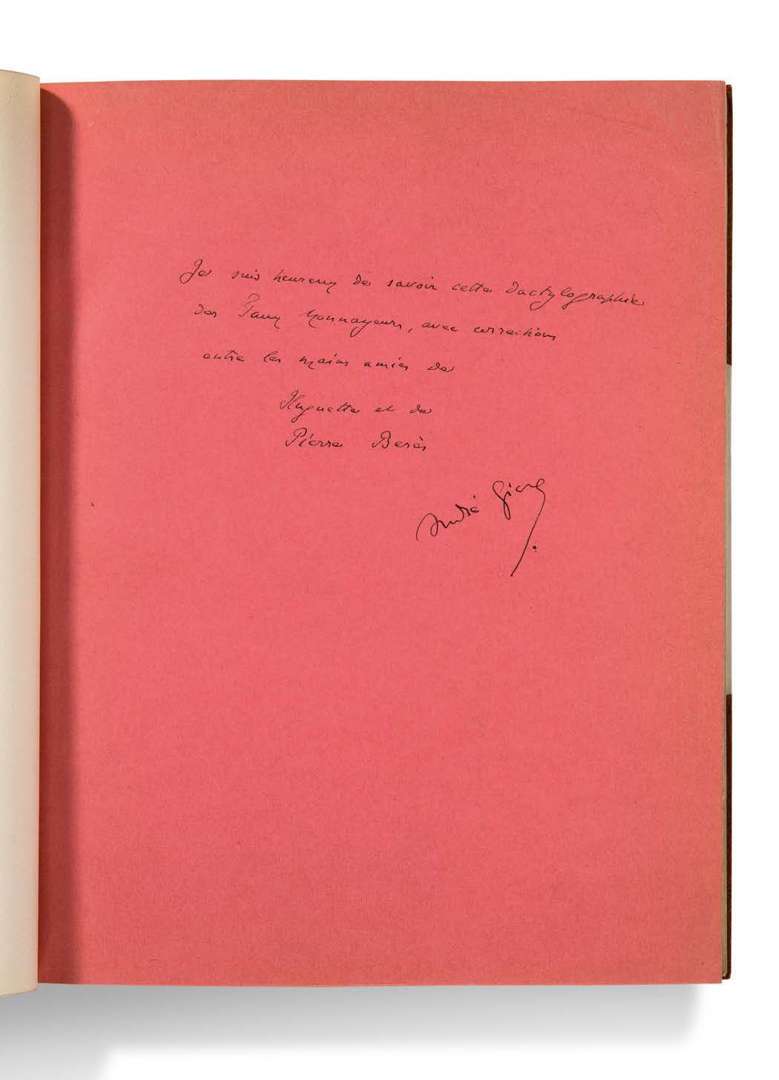
On the pink cardboard cover that has been preserved, Gide has written this letter a.s. "I am happy to know that this typing of Les Faux Monnayeurs, with corrections, is in the friendly hands of Huguette and Pierre Berès.
André Gide "
TAPScript with autograph corrections, Les Fauxmonnayeurs, Seconde partie, [1925]| 187 leaves in-4 (21 x 27 cm), bound in one volume in-4 half Lavallière morocco with corners, gilt edges, white vellum-covered boards, five-ribbed spine, gilt title (P.L. Martin).
Important typescript with many corrections of the second part of the novel, with an abandoned end.
Les Faux-monnayeurs, André Gide's masterpiece of fiction, was published in 1925 by the Nouvelle Revue Française.
This typescript is extensively corrected: it contains more than 400 autograph corrections and additions in ink, including nearly 120 lines that have been crossed out, which are still perfectly legible, and especially one abandoned end.
The pagination is discontinuous, starting over at each chapter, or non-existent (especially for "Édouard's Diary"). Gide has modified the cutting and numbering of the chapters.
Among the autograph additions, in addition to the dates inserted in "Édouard's Diary", and epigraphs (borrowed from Flaubert, Fénelon, Pascal), one will note some details, such as this one concerning Ghéridanisol: "A little older than the others, and more advanced in his studies"| or this sentence at the end of chapter V: "Poor Olivier! Instead of hiding from his parents, why didn't he just go back to them? He would have found his uncle Edouard near his mother"| or this one, in chap. XII (Edouard's diary): "The books I have written up to now seem to me comparable to those pools in public gardens, with a precise outline, perfect perhaps, but where the water is lifeless. Now I want to let it flow according to its slope, sometimes fast and sometimes slow, in lacerations that I refuse to foresee."
More than twenty lines have been crossed out in chap. IV, on the return to the Vedel boarding house and the teachers| about ten lines on Sarah in chap. VIII| in chap. XI, page 6 concerning Strouvilhou has been crossed out.
The end of the novel is longer in the typescript than in the book| it begins at the bottom of page 8 of the last chapter and ends on page 10, with the word END| it has 45 lines, and will be replaced in the book by a short paragraph. We quote the beginning and end of it: "Bernard's visit. He would prefer it if I did not go and ask him again to come to the cottage where he has been staying since he left the boarding house. He has just been fired at the door of the Grand Journal, where I had brought him in as a proofreader, following a sudden impulse that he takes too much pleasure in telling. [...] Here he is again without a job. But the very day he was taken off the paper, he met Caloub, his younger brother, whom he had not seen for some time. The little one showed himself, it seems, quite moved to find him, and
Bernard could not remain insensible to his joy. As he questioned him, the boy told him that the old judge was not well| an attack of liver, stronger than the previous ones, laid him on his side. Then Bernard, forgetting his resolutions, listened only to his heart. He ran to Profitendieu, threw himself into his arms... - And I understood, he told me, that a false father can be even more of a father than a real one."
On the pink cardboard cover that has been preserved, Gide has written this letter a.s. "I am happy to know that this typing of Les Faux Monnayeurs, with corrections, is in the friendly hands of Huguette and Pierre Berès.
André Gide "