
&w=3840&q=75)
&w=3840&q=75)
&w=3840&q=75)
&w=3840&q=75)
&w=3840&q=75)
&w=3840&q=75)
&w=3840&q=75)
&w=3840&q=75)


63
FRANCE Anatole (1844-1924).
The item was sold for 5 850 €
Fees include commission and taxes.
FRANCE Anatole (1844-1924).
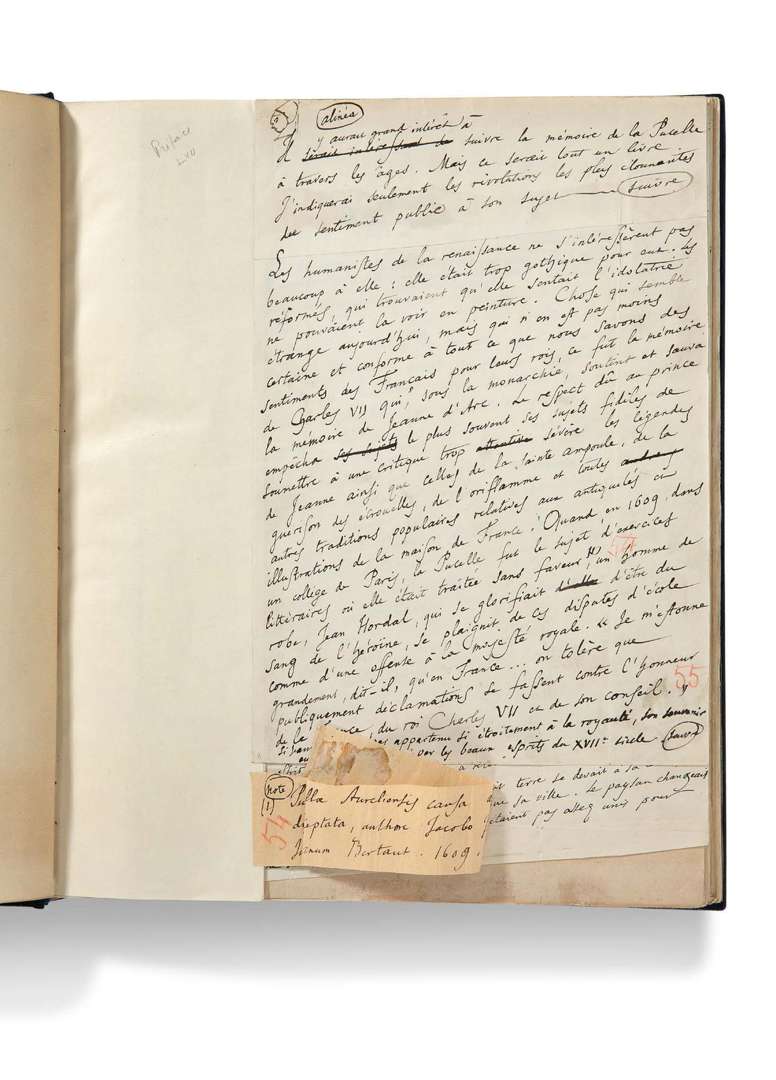
MANUSCRIPTS and autograph NOTES, and PROOFS with autograph corrections and additions, for the Life of Joan of Arc| 230 leaves of various sizes, of which a hundred are entirely autograph, mounted on tabs and bound in a volume in-4, blue morocco, 3 fillets on the boards, spine decorated with fleur-de-lys and vegetal motifs and mosaic along the length, inside 3 fillets with mosaic corner motifs decorated with swords and fleurs-de-lys, black and mauve brocaded silk endpapers, double endpapers, case (Ch. Septier).
Precious set of corrected manuscripts and plates for the first edition of the Vie de Jeanne d'Arc. Anatole France worked for more than twenty years on his Vie de Jeanne d'Arc, the longest of his works, giving from 1884 to 1907 to various newspapers and magazines studies on JEANNE D'ARC which will be included in full or in more or less reworked fragments in the two volumes of his work, published in 1908 by Calmann-Lévy. This means that there is no manuscript, but scattered fragments| this collection is probably the most important set known. Let us quote the description given by Georges Blaizot's elegant pen in the catalogue of the Paul Voûte sale: "A very precious collection of autographed pages and abundantly corrected proofs, which is not far from constituting the whole of the two in-8 volumes of the complete work. Nothing is more eloquent than these sheets covered with crests, studded with added notes, streaked with deletions| entire pages that are completely autograph and of a very different drafting from the one printed show the immense labour of this "lazy" man| according to his habit France wrote all his book on papers of different sizes| this disordered alternation of pieces so meticulously arranged still contributes to make of this important whole one of the most beautiful, one of the most suggestive documents franciens which is possible to dream and to meet. These manuscripts and proofs testify to the author's work at an already advanced stage of preparation of the book, probably at the time of the arrival of the first plates (stamps from the Chaix printing house in Saint-Ouen dated October-December 1906, some of them in the 2nd or 3rd proof), where France was going to considerably rework and complete his text. Numerous autograph sheets are attached to the Preface, which is elaborated through additions on papers of different formats. Let us quote the beginning of a few developments: "The word 'homeland' did not exist at the time of Joan of Arc. It was called the kingdom of France. No one, not even the legal experts, knew exactly what its limits were, and they were constantly changing. [...] If the Hundred Years' War did not create national feeling in France, it nourished it. .... "It was not Joan who drove the English out of France| if she helped to save Orleans, she rather delayed the deliverance, by causing the opportunity to recover Normandy to be missed by the march of the Coronation"... "Was this idea of a holy and warlike mission, of which Joan became aware through her Voices, formed in her mind spontaneously, without the intervention of any intelligent will, or was it suggested to her by some person whose influence she was unknowingly under? "This news that a little saint of humble condition, a poor woman of Our Lord, was bringing divine help to the people of Orléans struck the spirits of those who had become devout with fear and were exalted by the fever of the siege"... These leaves are abundantly erased and corrected, increased by collages of printed fragments and numerous blanks, and several are decorated with original drawings: women's heads, cat's or dog's heads, naked women, birds, knights, unicorn, imperial eagle, bat, griffins and dragons, bishops, portrait of Charles VII, vase, etc. The plates have been corrected and cut out, with many marginal additions or with the help of added crutches, sometimes very developed and folding. France has also written numerous notes on various historical points (the age of Jeanne, that of Charles VII, the end of Jean de Luxembourg Count of Ligny, etc.), and quotations from the writings of other authors.), and quotations from scholars, often with bibliographical references, for the footnotes: the Bulletin de l'Académie delphinale, the Journal d'un bourgeois de Paris, Recherches de la France by Étienne Pasquier, the Chroniques de Froissart, Chroniqueurs de l'abbaye des Dunes by Kervyn de Lettenhove, etc. PROVENANCE Paul VOÛTE Library (9-11 March 1938, no. 592| bookplate).
MANUSCRIPTS and autograph NOTES, and PROOFS with autograph corrections and additions, for the Life of Joan of Arc| 230 leaves of various sizes, of which a hundred are entirely autograph, mounted on tabs and bound in a volume in-4, blue morocco, 3 fillets on the boards, spine decorated with fleur-de-lys and vegetal motifs and mosaic along the length, inside 3 fillets with mosaic corner motifs decorated with swords and fleurs-de-lys, black and mauve brocaded silk endpapers, double endpapers, case (Ch. Septier).
Precious set of corrected manuscripts and plates for the first edition of the Vie de Jeanne d'Arc. Anatole France worked for more than twenty years on his Vie de Jeanne d'Arc, the longest of his works, giving from 1884 to 1907 to various newspapers and magazines studies on JEANNE D'ARC which will be included in full or in more or less reworked fragments in the two volumes of his work, published in 1908 by Calmann-Lévy. This means that there is no manuscript, but scattered fragments| this collection is probably the most important set known. Let us quote the description given by Georges Blaizot's elegant pen in the catalogue of the Paul Voûte sale: "A very precious collection of autographed pages and abundantly corrected proofs, which is not far from constituting the whole of the two in-8 volumes of the complete work. Nothing is more eloquent than these sheets covered with crests, studded with added notes, streaked with deletions| entire pages that are completely autograph and of a very different drafting from the one printed show the immense labour of this "lazy" man| according to his habit France wrote all his book on papers of different sizes| this disordered alternation of pieces so meticulously arranged still contributes to make of this important whole one of the most beautiful, one of the most suggestive documents franciens which is possible to dream and to meet. These manuscripts and proofs testify to the author's work at an already advanced stage of preparation of the book, probably at the time of the arrival of the first plates (stamps from the Chaix printing house in Saint-Ouen dated October-December 1906, some of them in the 2nd or 3rd proof), where France was going to considerably rework and complete his text. Numerous autograph sheets are attached to the Preface, which is elaborated through additions on papers of different formats. Let us quote the beginning of a few developments: "The word 'homeland' did not exist at the time of Joan of Arc. It was called the kingdom of France. No one, not even the legal experts, knew exactly what its limits were, and they were constantly changing. [...] If the Hundred Years' War did not create national feeling in France, it nourished it. .... "It was not Joan who drove the English out of France| if she helped to save Orleans, she rather delayed the deliverance, by causing the opportunity to recover Normandy to be missed by the march of the Coronation"... "Was this idea of a holy and warlike mission, of which Joan became aware through her Voices, formed in her mind spontaneously, without the intervention of any intelligent will, or was it suggested to her by some person whose influence she was unknowingly under? "This news that a little saint of humble condition, a poor woman of Our Lord, was bringing divine help to the people of Orléans struck the spirits of those who had become devout with fear and were exalted by the fever of the siege"... These leaves are abundantly erased and corrected, increased by collages of printed fragments and numerous blanks, and several are decorated with original drawings: women's heads, cat's or dog's heads, naked women, birds, knights, unicorn, imperial eagle, bat, griffins and dragons, bishops, portrait of Charles VII, vase, etc. The plates have been corrected and cut out, with many marginal additions or with the help of added crutches, sometimes very developed and folding. France has also written numerous notes on various historical points (the age of Jeanne, that of Charles VII, the end of Jean de Luxembourg Count of Ligny, etc.), and quotations from the writings of other authors.), and quotations from scholars, often with bibliographical references, for the footnotes: the Bulletin de l'Académie delphinale, the Journal d'un bourgeois de Paris, Recherches de la France by Étienne Pasquier, the Chroniques de Froissart, Chroniqueurs de l'abbaye des Dunes by Kervyn de Lettenhove, etc. PROVENANCE Paul VOÛTE Library (9-11 March 1938, no. 592| bookplate).