
&w=3840&q=75)
&w=3840&q=75)
&w=3840&q=75)
&w=3840&q=75)
&w=3840&q=75)
&w=3840&q=75)
&w=3840&q=75)
&w=3840&q=75)


56
FLAUBERT Gustave (1821-1880).
The item was sold for 9 100 €
Fees include commission and taxes.
FLAUBERT Gustave (1821-1880).
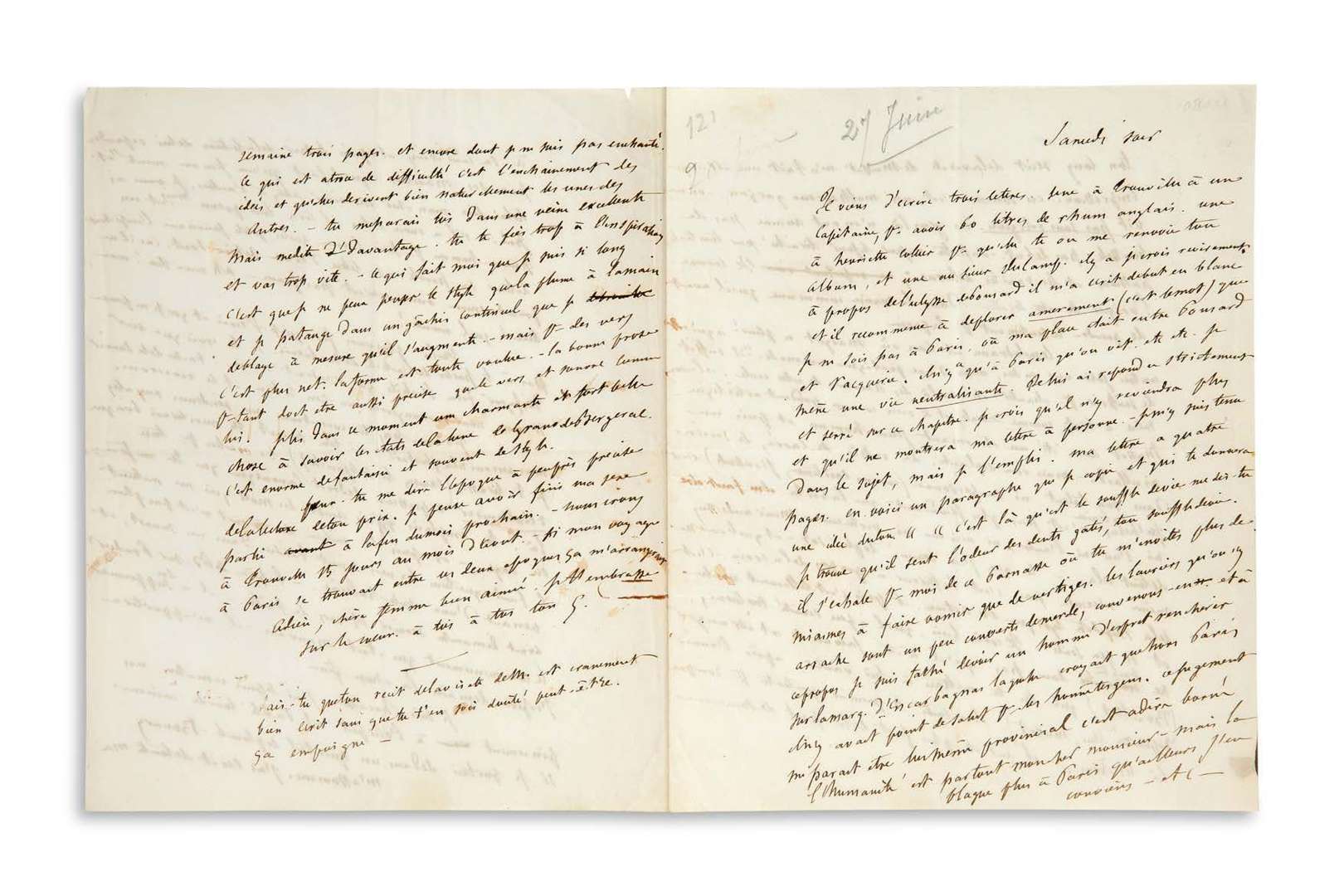
L.A.S. "your G.", Saturday evening [26 June 1852], to Louise COLET| 4 pages small in-4, envelope with postmarks and red wax seal (small trace of rust on p. 4).
Magnificent letter on life in Paris, Alfred de Musset, poetry and prose, and on the progress of Madame Bovary.
He wrote to a captain in Trouville to order English rum, to Henriette COLLIER to get Louise's album back, and to Maxime DU CAMP: "I think there is a turnaround about PONSARD's Ulysses, he wrote to me outright and he begins again to bitterly deplore (that is the word) that I am not in Paris, where my place was between Ponsard and
Vacquerie. It is only in Paris that one lives, etc. etc. I lead a neutral life
- reading. I answered him strictly and tightly on this point. I think he will not return to it and will not show my letter to anyone. - I have kept to the subject, but I am filling it up. My letter is four pages long.
Here is a paragraph that I have copied and that will give you an idea of the tone: "This is where the breath of life is, you tell me. I find that your breath of life smells like spoiled teeth. It exhales for me, from this Parnassus where you invite me more miasmas to make me vomit than dizzy. The laurels that are snatched there are a bit covered in shit, let's agree on that". And in this regard I am annoyed to see a man of spirit echoing the Marquise d'Escarbagnas who believed that outside Paris there was no salvation for honest people. This judgment seems to me to be provincial, that is to say, narrow-minded. Humanity is everywhere, my dear sir - but the joke is more in Paris than elsewhere, I agree - etc.
"
The story of Louise Colet's visit to Alfred de MUSSET made "a strange impression on him. In short, he is an unfortunate boy. - One cannot live without religion. These people have none. No compass, no goal. - One floats from day to day torn by all the passions and vanities of the street| [respecting nothing crossed out] I find the origin of this decadence in the common mania he had of mistaking sentiment for poetry.
The melodrama is good where Margot wept which is a very pretty line in itself, but of a convenient poetics. - "It is enough to suffer to sing" etc. These are the axioms of this school.
This leads you to everything, as a moral, and to nothing as an artistic product
- tic. Musset was a charming young man and then an old man.
- But there is nothing planted, stale, square, or serene in his talent or his person (as an existence I mean). It is that, alas, vice is no more fertile than virtue. One must be neither the one nor the other, neither vicious nor virtuous - but above all that. - What I found most foolish - and which even drunkenness does not excuse - was the fury about the cross. - It's lyrical stupidity in action, and then it's so intentional and so unsentimental. I do believe that he has not listened much to Melaenis [by Louis
BOUILHET]. Don't you see that he was jealous of this stranger (Bouilhet) whom you began to praise, after having rejected him (him, Musset). He seized the first pretext to break off the dogs. - It would have been stronger for you to subscribe to his condition and then, on the evening of the reading, to answer him with his maxims "that a woman must lie" and to say to him, my dear sir, go to others, I have played you. - If he wants you he will read your poem. - But he is a poor man to admit that the little newspapers prevent him from keeping his word. - His letter of apology finishes everything, because he still does not promise anything, it is not frank - Ah my
God! my God! what a world!"
Then he talks about an article that Nefftzer should do on Melaenis: "If not, we will rearrange yours a little and see it again. He criticizes the corrections made by Louise Colet on her poem Les Résidences royales, and does not like her sonnet: "You deserve that I pull your ears (excuse the subjunctive) for your reintronizing expression of canon law that you put me there! You sometimes use words that make me angry. - And then the middle of the sonnet is not full, it is necessary that all the verses are tense in a sonnet, and coming from a single breath ". Bouilhet writes his poem on Pradier, but "had to delete the beginning which was bad"...
Then he talks about the difficult work on Madame Bovary: "I am exhausted.
Since this morning I have had a twinge in my occiput and my head is heavy as if I were carrying a quintal of lead inside. Bovary is knocking me out. I have written three pages in my whole week, and still I am not happy with them.
What is atrociously difficult is the sequence of ideas and the fact that they flow naturally from one to another. - You seem to me to be in an excellent vein, but meditate more. You rely too much on inspiration and go too fast.
- What makes me so long is that I
L.A.S. "your G.", Saturday evening [26 June 1852], to Louise COLET| 4 pages small in-4, envelope with postmarks and red wax seal (small trace of rust on p. 4).
Magnificent letter on life in Paris, Alfred de Musset, poetry and prose, and on the progress of Madame Bovary.
He wrote to a captain in Trouville to order English rum, to Henriette COLLIER to get Louise's album back, and to Maxime DU CAMP: "I think there is a turnaround about PONSARD's Ulysses, he wrote to me outright and he begins again to bitterly deplore (that is the word) that I am not in Paris, where my place was between Ponsard and
Vacquerie. It is only in Paris that one lives, etc. etc. I lead a neutral life
- reading. I answered him strictly and tightly on this point. I think he will not return to it and will not show my letter to anyone. - I have kept to the subject, but I am filling it up. My letter is four pages long.
Here is a paragraph that I have copied and that will give you an idea of the tone: "This is where the breath of life is, you tell me. I find that your breath of life smells like spoiled teeth. It exhales for me, from this Parnassus where you invite me more miasmas to make me vomit than dizzy. The laurels that are snatched there are a bit covered in shit, let's agree on that". And in this regard I am annoyed to see a man of spirit echoing the Marquise d'Escarbagnas who believed that outside Paris there was no salvation for honest people. This judgment seems to me to be provincial, that is to say, narrow-minded. Humanity is everywhere, my dear sir - but the joke is more in Paris than elsewhere, I agree - etc.
"
The story of Louise Colet's visit to Alfred de MUSSET made "a strange impression on him. In short, he is an unfortunate boy. - One cannot live without religion. These people have none. No compass, no goal. - One floats from day to day torn by all the passions and vanities of the street| [respecting nothing crossed out] I find the origin of this decadence in the common mania he had of mistaking sentiment for poetry.
The melodrama is good where Margot wept which is a very pretty line in itself, but of a convenient poetics. - "It is enough to suffer to sing" etc. These are the axioms of this school.
This leads you to everything, as a moral, and to nothing as an artistic product
- tic. Musset was a charming young man and then an old man.
- But there is nothing planted, stale, square, or serene in his talent or his person (as an existence I mean). It is that, alas, vice is no more fertile than virtue. One must be neither the one nor the other, neither vicious nor virtuous - but above all that. - What I found most foolish - and which even drunkenness does not excuse - was the fury about the cross. - It's lyrical stupidity in action, and then it's so intentional and so unsentimental. I do believe that he has not listened much to Melaenis [by Louis
BOUILHET]. Don't you see that he was jealous of this stranger (Bouilhet) whom you began to praise, after having rejected him (him, Musset). He seized the first pretext to break off the dogs. - It would have been stronger for you to subscribe to his condition and then, on the evening of the reading, to answer him with his maxims "that a woman must lie" and to say to him, my dear sir, go to others, I have played you. - If he wants you he will read your poem. - But he is a poor man to admit that the little newspapers prevent him from keeping his word. - His letter of apology finishes everything, because he still does not promise anything, it is not frank - Ah my
God! my God! what a world!"
Then he talks about an article that Nefftzer should do on Melaenis: "If not, we will rearrange yours a little and see it again. He criticizes the corrections made by Louise Colet on her poem Les Résidences royales, and does not like her sonnet: "You deserve that I pull your ears (excuse the subjunctive) for your reintronizing expression of canon law that you put me there! You sometimes use words that make me angry. - And then the middle of the sonnet is not full, it is necessary that all the verses are tense in a sonnet, and coming from a single breath ". Bouilhet writes his poem on Pradier, but "had to delete the beginning which was bad"...
Then he talks about the difficult work on Madame Bovary: "I am exhausted.
Since this morning I have had a twinge in my occiput and my head is heavy as if I were carrying a quintal of lead inside. Bovary is knocking me out. I have written three pages in my whole week, and still I am not happy with them.
What is atrociously difficult is the sequence of ideas and the fact that they flow naturally from one to another. - You seem to me to be in an excellent vein, but meditate more. You rely too much on inspiration and go too fast.
- What makes me so long is that I