
&w=3840&q=75)
&w=3840&q=75)
&w=3840&q=75)
&w=3840&q=75)
&w=3840&q=75)
&w=3840&q=75)
&w=3840&q=75)
&w=3840&q=75)


CARTIER
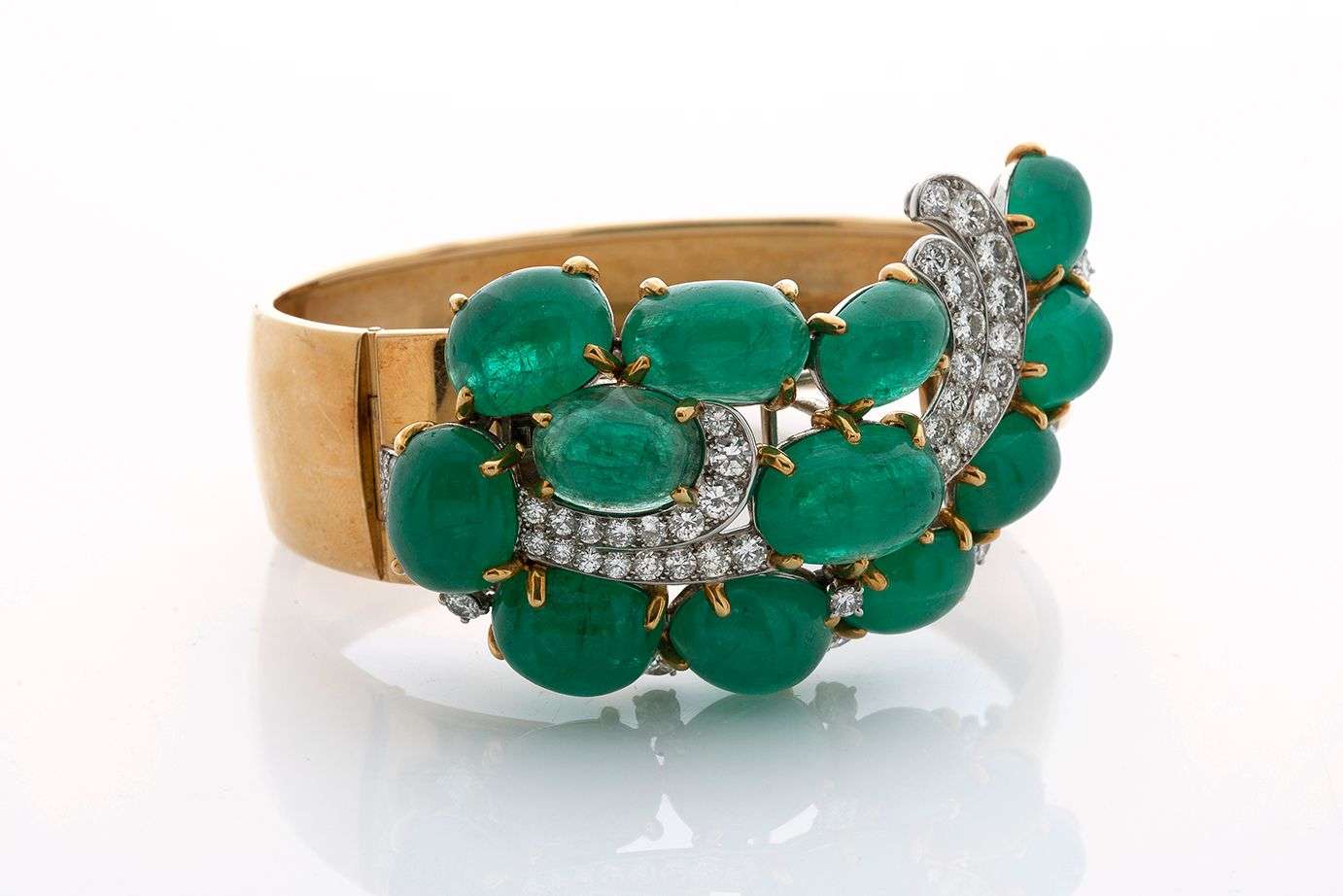
A bracelet featuring a prominent ‘Kashmir’ motif
Fees include commission and taxes.
A bracelet featuring a prominent ‘Kashmir’ motif
Cabochon emeralds and round diamonds.
Signed and numbered, maker’s mark. Circa 1945–50. Platinum (950) and 18k yellow gold (750). Original case.
Diam.: 6.1 cm – Wt.: 73 g. The central motif can be worn as a clip
. Height: approx. 6.2 cm.
A platinum, gold, emerald and diamond bracelet, signed Cartier
The paisley-patterned bracelet we are presenting here demonstrates the influence of Islamic art on Cartier’s stylistic repertoire. This distinctive pattern, known as the ‘paisley pattern’ or ‘cachemire motif’, is also referred to as ‘Boteh’, which means ‘bouquet of flowers’ in Persian. The origins of this symbol are a matter of debate and it has been interpreted in many ways. The boteh feature is found extensively in Mughal art from the 16th to the 18th century, as evidenced by the turban jewellery dating from the mid-18th century, on display at the Victoria and Albert Museum in London. The paisley pattern also appears on other items such as shawls and Persian carpets, which travelled along the Silk Road and, later, by ship via the European trading posts established in the East by the East India Companies. For the creation of the exhibition “Cartier and the Arts of Islam: At the Sources of Modernity”, running at the Musée des Arts Décoratifs in Paris until February 2022, the house’s archives and library were consulted. Louis Cartier had built up a collection of Islamic art from which he drew inspiration for new aesthetics. Louis encouraged his designers to train their eyes, to borrow the motifs they observed, and he made the works of art in his collection available to them. Charles Jacqueau, Cartier’s creative director from 1911 to 1935 and a designer of genius, drew inspiration from everything he observed and that caught his eye. His drawings and gouaches, held at the Petit Palais and on loan for the exhibition, bear witness to his prolific creativity. In 1910, the Ballets Russes, directed by Serge Diaghilev, performed Scheherazade in Paris, sparking a craze for Persian style in France. Cartier embraced this exotic trend, with coloured gemstones bringing new life to the jewellery of Belle Époque socialites seeking novelty. Set as cabochons, sapphires, emeralds and rubies juxtaposed with sparkling diamonds enchanted the house’s clients. New gemstones also made their appearance, such as onyx, turquoise, amethyst and rock crystal… This diversification of its palette earned Cartier a pioneering position in the use of coloured gemstones. Throughout the 20th century, this repertoire of motifs inherited from Islamic art, far from losing its appeal, became an integral part of the Cartier style and retains all its contemporary relevance.