
&w=3840&q=75)
&w=3840&q=75)
&w=3840&q=75)
&w=3840&q=75)
&w=3840&q=75)
&w=3840&q=75)
&w=3840&q=75)
&w=3840&q=75)


121
FLAUBERT Gustave (1821-1880)
The item was sold for 3 538 €
Fees include commission and taxes.
FLAUBERT Gustave (1821-1880)
Salammbô
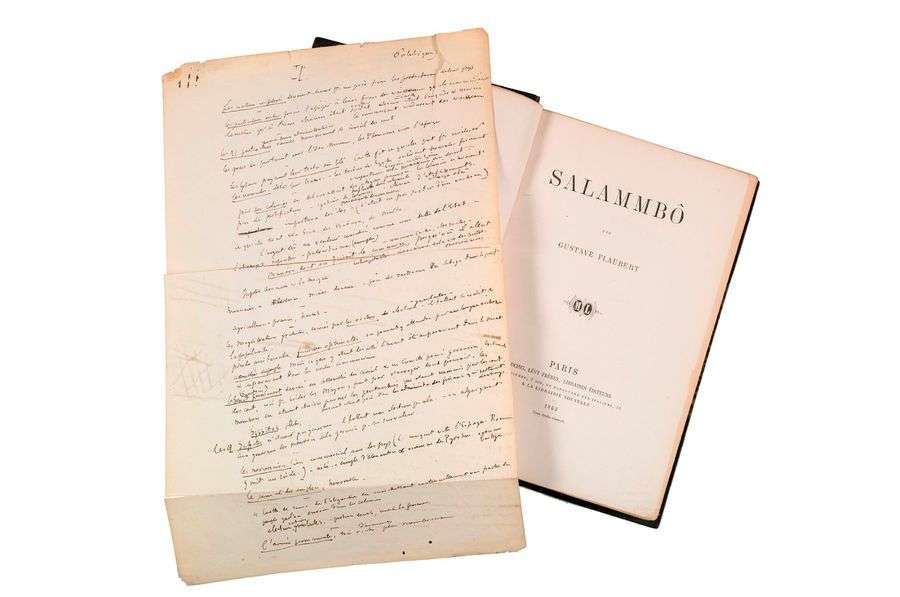
Paris, Michel Lévy Frères, 1863. In-8 (240 x 160 mm), 474 pp.
Dark green half-maroquin with corners, spine titled and decorated with gilt fillets, untrimmed, cover and spine preserved (binding signed Canape).
First edition. A first issue copy with errors notably on pages 5 "effraya" instead of "effrayèrent", 80 and 251 "Scissites" instead of "Syssites" and on pages 368 and 370. Salammbô was the second novel published by Gustave Flaubert. After five years of describing the provincial petty bourgeoisie for Madame Bovary, he hurried to look for a new subject, as far removed as possible. At the end of March 1857, his decision was made: "I am going to write a novel whose action will take place three centuries before Jesus Christ, because I feel the need to get out of the modern world, in which my pen has been soaked too much and which, moreover, tires me as much to reproduce as it disgusts me to see.
Salammbô was published in November 1862 by Michel Lévy, and was a rapid success in the world, amplified by a double polemic with Sainte-Beuve who considered the novel a failure and reproached Flaubert for taking liberties with the elements established by archaeologists. Flaubert defended himself vehemently, believing that his archaeology was probable and the Orient immutable.
Attached is a very fine manuscript leaf of 2 folio pages, written on both sides, with erasures and corrections from page 9 of the original edition concerning the story of Spendius from "a great sigh escaped from his chest| he stammered, he giggled under the clear tears that washed his face" to "and there was one who risked their lives for the inconceivable pleasure of drinking from it. The enclosed manuscript shows many variations with the printed text on page 9 of the edition. Flaubert has crossed it out with two lines. On the verso, he has written two numerous notes, titled "
II Politique", concerning the tribe of Lybians, the way trade was done, the Syssites, the mercenaries, etc.
These notes have been used in the work and show the particular care with which
Flaubert worked on his texts.
(A few small restorations to the cover, manuscript sheet separated in two, a few small tears without missing| used condition of the binding).
Salammbô
Paris, Michel Lévy Frères, 1863. In-8 (240 x 160 mm), 474 pp.
Dark green half-maroquin with corners, spine titled and decorated with gilt fillets, untrimmed, cover and spine preserved (binding signed Canape).
First edition. A first issue copy with errors notably on pages 5 "effraya" instead of "effrayèrent", 80 and 251 "Scissites" instead of "Syssites" and on pages 368 and 370. Salammbô was the second novel published by Gustave Flaubert. After five years of describing the provincial petty bourgeoisie for Madame Bovary, he hurried to look for a new subject, as far removed as possible. At the end of March 1857, his decision was made: "I am going to write a novel whose action will take place three centuries before Jesus Christ, because I feel the need to get out of the modern world, in which my pen has been soaked too much and which, moreover, tires me as much to reproduce as it disgusts me to see.
Salammbô was published in November 1862 by Michel Lévy, and was a rapid success in the world, amplified by a double polemic with Sainte-Beuve who considered the novel a failure and reproached Flaubert for taking liberties with the elements established by archaeologists. Flaubert defended himself vehemently, believing that his archaeology was probable and the Orient immutable.
Attached is a very fine manuscript leaf of 2 folio pages, written on both sides, with erasures and corrections from page 9 of the original edition concerning the story of Spendius from "a great sigh escaped from his chest| he stammered, he giggled under the clear tears that washed his face" to "and there was one who risked their lives for the inconceivable pleasure of drinking from it. The enclosed manuscript shows many variations with the printed text on page 9 of the edition. Flaubert has crossed it out with two lines. On the verso, he has written two numerous notes, titled "
II Politique", concerning the tribe of Lybians, the way trade was done, the Syssites, the mercenaries, etc.
These notes have been used in the work and show the particular care with which
Flaubert worked on his texts.
(A few small restorations to the cover, manuscript sheet separated in two, a few small tears without missing| used condition of the binding).