
&w=3840&q=75)
&w=3840&q=75)
&w=3840&q=75)
&w=3840&q=75)
&w=3840&q=75)
&w=3840&q=75)
&w=3840&q=75)
&w=3840&q=75)


47
BARTHÉLÉMY JEAN DURUPT, DIT CHARLES DURUPT
The item was sold for 8 567 €
Fees include commission and taxes.
BARTHÉLÉMY JEAN DURUPT, DIT CHARLES DURUPT
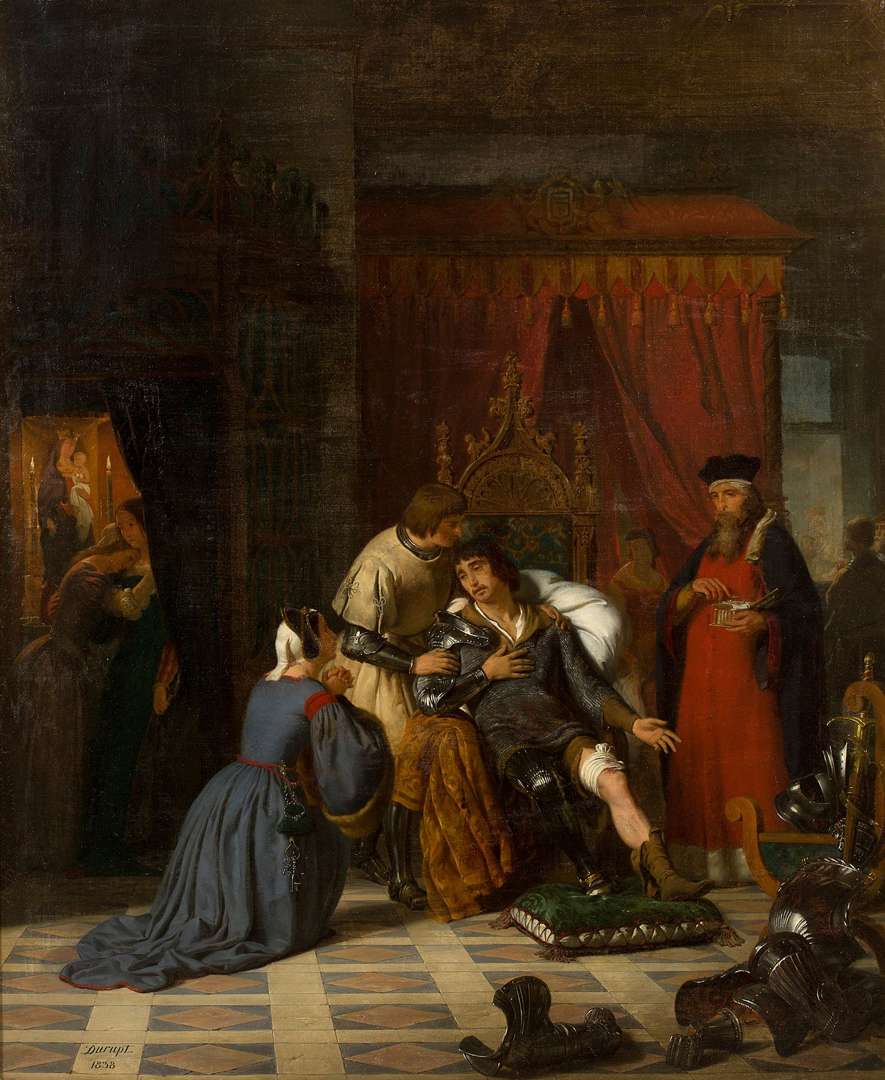
Bayard in Brescia
Oil on canvas
Signed and dated lower left Durupt 1838
100,5 x 82,5 cm
EXHIBITION
Most probably presented at the number 608 of the Salon of 1838.
Student of Antoine Jean-Gros (1771 - 1835), Charles Durupt exhibited at the Salon from 1827 until his death in 1838, year in which our painting was also presented.
He depicts a passage from the life of the knight Bayard who distinguished himself in the Italian wars in the 15th century and who is known to us through the account of his comrade in arms Jacques de Maillès, La Très joyeuse et très plaisante histoire du gentil seigneur de Bayart. The scene represented here was described by the painter himself in the following terms: "After the capture of Brescia, Bayard, wounded, was taken to a house of rich appearance. The lady of the house said to him, throwing herself upon his knees, "Our lord, may it be your good pleasure to save my honour and life, and two maidens whom I have." The good knight replied, "Madam, as long as I live, to you and your daughters shall not be made displeasure, nor to my person."
Our painting takes up many of the codes of the troubadour painting movement. Founded by the Lyon painters Fleury Richard (1777-1852) and Pierre Révoil (1776-1852) who met in the studio of Jacques-Louis David (1748- 1825), this style draws on the imagination of the Middle Ages and the Renaissance. Fleury Richard was Joséphine de Beauharnais' favourite painter and the troubadour style was quite popular during the First Empire.
In our painting, with this choice of an anecdotal and melancholic scene from the small history of medieval France, we find the same desire to "approach the private life of historical figures" (François-René Martin, Le Temps de la peinture, 2007) that characterizes the painters of the troubadour style. The great attention paid to costumes and furniture from the Middle Ages, the influence of Dutch bourgeois interiors, particularly in the treatment of colours, and the dark green curtain half-open over the two young girls, reminiscent of Valentine of Milan mourning the death of her husband Louis of Orleans, Fleury de Richard's most famous painting, are all elements that clearly show the influence of this style on Charles Durupt.
That same year at the Salon, he also presented the next scene in the story of the valiant knight in a painting entitled Départ de Bayard de Brescia.
Bayard in Brescia
Oil on canvas
Signed and dated lower left Durupt 1838
100,5 x 82,5 cm
EXHIBITION
Most probably presented at the number 608 of the Salon of 1838.
Student of Antoine Jean-Gros (1771 - 1835), Charles Durupt exhibited at the Salon from 1827 until his death in 1838, year in which our painting was also presented.
He depicts a passage from the life of the knight Bayard who distinguished himself in the Italian wars in the 15th century and who is known to us through the account of his comrade in arms Jacques de Maillès, La Très joyeuse et très plaisante histoire du gentil seigneur de Bayart. The scene represented here was described by the painter himself in the following terms: "After the capture of Brescia, Bayard, wounded, was taken to a house of rich appearance. The lady of the house said to him, throwing herself upon his knees, "Our lord, may it be your good pleasure to save my honour and life, and two maidens whom I have." The good knight replied, "Madam, as long as I live, to you and your daughters shall not be made displeasure, nor to my person."
Our painting takes up many of the codes of the troubadour painting movement. Founded by the Lyon painters Fleury Richard (1777-1852) and Pierre Révoil (1776-1852) who met in the studio of Jacques-Louis David (1748- 1825), this style draws on the imagination of the Middle Ages and the Renaissance. Fleury Richard was Joséphine de Beauharnais' favourite painter and the troubadour style was quite popular during the First Empire.
In our painting, with this choice of an anecdotal and melancholic scene from the small history of medieval France, we find the same desire to "approach the private life of historical figures" (François-René Martin, Le Temps de la peinture, 2007) that characterizes the painters of the troubadour style. The great attention paid to costumes and furniture from the Middle Ages, the influence of Dutch bourgeois interiors, particularly in the treatment of colours, and the dark green curtain half-open over the two young girls, reminiscent of Valentine of Milan mourning the death of her husband Louis of Orleans, Fleury de Richard's most famous painting, are all elements that clearly show the influence of this style on Charles Durupt.
That same year at the Salon, he also presented the next scene in the story of the valiant knight in a painting entitled Départ de Bayard de Brescia.