
&w=3840&q=75)
&w=3840&q=75)
&w=3840&q=75)
&w=3840&q=75)
&w=3840&q=75)
&w=3840&q=75)
&w=3840&q=75)
&w=3840&q=75)


45
ATTRIBUÉ À FRANÇOIS SABLET
The item was sold for 8 450 €
Fees include commission and taxes.
ATTRIBUÉ À FRANÇOIS SABLET
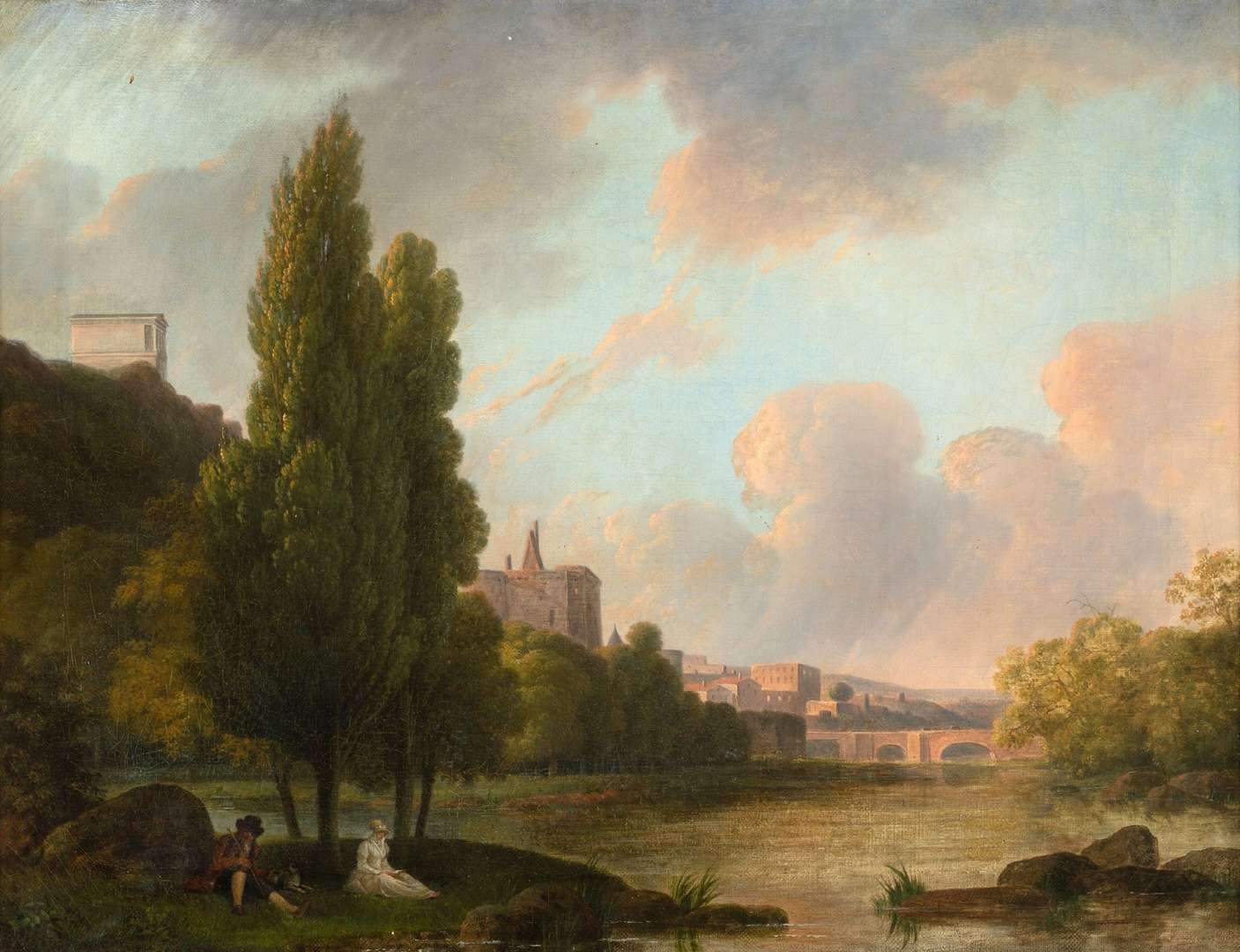
Views of Clisson with La Garenne Lemot overlooking
Oil on canvas (pair)
52 x 68 cm (each)
Designated in his marriage contract as "portrait painter, adult son of Sieur Jacob Sablet, peintre en bâtimens (sic)", François Sablet was a Swiss portrait and landscape painter with a picturesque and poetic style. Born in Morges, Switzerland
Switzerland, he quickly studied with passion the green nature that surrounds him because his father, a merchant of paintings and art objects, wanted to make him a "painter of merit". In 1767, he entered the studio of Joseph-Marie Vien (1716 - 1809) at the Royal Academy of Painting and Sculpture in
then left for Italy, in particular for Rome, for about ten years. He stayed there for so long and with such success that he earned the nickname of "Sablet the Roman" on his return. He would have then probably worked with Elisabeth Vigée-
Lebrun (1755 - 1842).
A meeting with the architect Mathurin Crucy (1749 - 1826) led him to Nantes around 1803, where he settled and carried out commissions of portraits and landscapes for the local bourgeoisie. In 1809 he was commissioned by the city of Nantes, by a letter from M. Crucy accompanied by an iconographic program comprising six different scenes, to execute a series of paintings in homage to Napoleon to decorate the city's stock exchange. Indeed, a year earlier, during his visit to Nantes, the emperor had ordered the completion of its construction by allocating half of the necessary credits to the municipality. The Bourse was finally inaugurated in 1812 and Sablet's compositions met with some success, notably his Entry of Napoleon into Nantes. However, with the fall of the Empire, the paintings disappeared, certainly destroyed because they commemorated too strongly the glories of the fallen emperor.
Our painting bears witness to the art and personality of the painter, who was able to execute various types of commissions with equal ease, but also to his belonging to Swiss culture with subjects that denote an ideal of charity.
Views of Clisson with La Garenne Lemot overlooking
Oil on canvas (pair)
52 x 68 cm (each)
Designated in his marriage contract as "portrait painter, adult son of Sieur Jacob Sablet, peintre en bâtimens (sic)", François Sablet was a Swiss portrait and landscape painter with a picturesque and poetic style. Born in Morges, Switzerland
Switzerland, he quickly studied with passion the green nature that surrounds him because his father, a merchant of paintings and art objects, wanted to make him a "painter of merit". In 1767, he entered the studio of Joseph-Marie Vien (1716 - 1809) at the Royal Academy of Painting and Sculpture in
then left for Italy, in particular for Rome, for about ten years. He stayed there for so long and with such success that he earned the nickname of "Sablet the Roman" on his return. He would have then probably worked with Elisabeth Vigée-
Lebrun (1755 - 1842).
A meeting with the architect Mathurin Crucy (1749 - 1826) led him to Nantes around 1803, where he settled and carried out commissions of portraits and landscapes for the local bourgeoisie. In 1809 he was commissioned by the city of Nantes, by a letter from M. Crucy accompanied by an iconographic program comprising six different scenes, to execute a series of paintings in homage to Napoleon to decorate the city's stock exchange. Indeed, a year earlier, during his visit to Nantes, the emperor had ordered the completion of its construction by allocating half of the necessary credits to the municipality. The Bourse was finally inaugurated in 1812 and Sablet's compositions met with some success, notably his Entry of Napoleon into Nantes. However, with the fall of the Empire, the paintings disappeared, certainly destroyed because they commemorated too strongly the glories of the fallen emperor.
Our painting bears witness to the art and personality of the painter, who was able to execute various types of commissions with equal ease, but also to his belonging to Swiss culture with subjects that denote an ideal of charity.