
&w=3840&q=75)
&w=3840&q=75)
&w=3840&q=75)
&w=3840&q=75)
&w=3840&q=75)
&w=3840&q=75)
&w=3840&q=75)
&w=3840&q=75)


34
FRANÇOIS VANLOO AIX-EN-PROVENCE, 1708 - 1732, TURIN
The item was sold for 1 820 €
Fees include commission and taxes.
FRANÇOIS VANLOO AIX-EN-PROVENCE, 1708 - 1732, TURIN
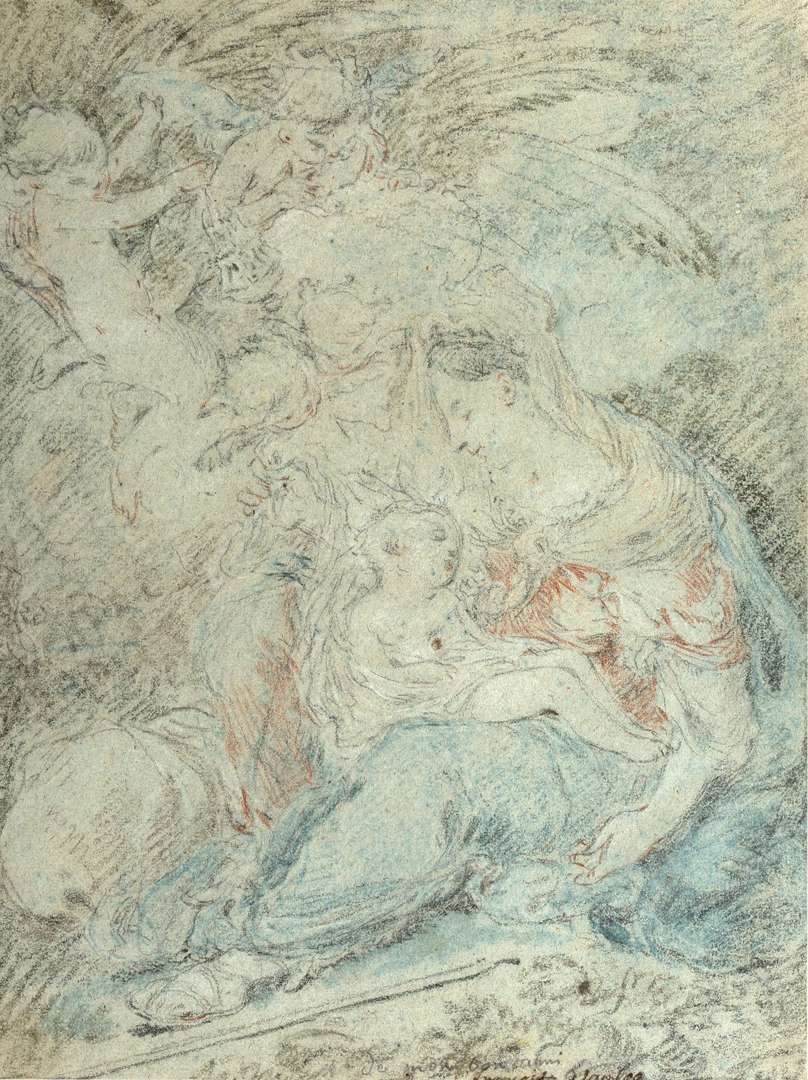
Resting during the Flight to Egypt
Black stone and red chalk on blue paper
30 x 22,4 cm
PROVENANCE
Stamped lower left from the collection of the Marquis Philippe de Chennevières (L. 2072)| then from the collection of La Raudière, Paris
In the current state of knowledge about François Vanloo (1708-1732), son of Jean-Baptiste (1684-1745) and nephew of the famous Carle (1705-1765), this drawing is a fascinating testimony, though not without its uncertainties. François Vanloo's work is very poorly known. In 1732, his death from a horse accident while accompanying his uncle Carle to Turin left a painful memory to his entourage, as testified by the painter Michel-François Dandré-Bardon in his Vie de Carle Vanloo, 1765: "François was born with the most beautiful genius, & had signalled it early by distinguished works. Several ingenious drawings of invention & after Nature| various figures painted in the most beautiful tone, with an admirable brush & with the greatest ease| finally his painting representing the Triumph of Galatea, work which is supported perfectly in the middle of the excellent Paintings, gathered in the Cabinet of Mr. Louis-Michel Vanloo his brother, publish the rare talents of François. Carle was at the height of his joy. He was bringing back to France a nephew worthy of his name and a friend whom he cherished tenderly, when the most unfortunate of catastrophes took him away. They were travelling in a wheel-chair. The impetuous ardour of the horses, which François perhaps too imprudently ventured to drive, betrayed his dexterity. He fell with one foot caught in the stirrup. The steeds carry off their victim. They drag him for a long time among the brambles and stones. Such was the unfortunate Hippolitis dragged by his horses. What a spectacle for Carle! At the peril of his own life, he wants to free his nephew and fix the untamed steeds. The fatal destiny was fulfilled: all the wounds were fatal| François Vanloo died in Turin in his twenty-second year."
The museum of the Château de Fontainebleau preserves the aforementioned and well-documented Triumph of Galatea| it was acquired for the king's cabinet at the sale of the Prince of Conti for a notable sum (1700 livres) on April 8, 1777 (INV 6250| B 1005| Conti sale, p.216, no 717 - source: joconde/50130000504). The beautiful study of cherubs snorting in the branches of the palm tree finds rather convincing echoes in the putti leaning on the clouds on the right of the Galatea composition, or in the firm anatomy and tense extremities of the small bottle under Polyphemus on the left. Similarly, the figure of the Virgin shows a physiognomic treatment of the profile in a very slight three-quarter view and of the forearms with almond-shaped hands, which is also found in the Galatea. Stylistic comparisons between our drawing and other proven graphic productions by François are not legion: the Écorchement de Marsyas in the Metropolitan Museum (red chalk, 24.2 x 41 7 cm) cannot fully serve as a reference for his manner around 1730, as this drawing is so close to the research and manner of Carle, with whom he stayed at the Académie de France in Rome between 1729 and 1732. On the other hand, the Guerrier à demi nu étendu in the graphic arts department of the Louvre (RF 30279, recto| 28 x 44.5 cm), whose authorship by François is guaranteed by its localized signature and its history (it was given to the museum by the Aix collector François Charles de Cormis, Lugt L. 3550), makes it possible to check the autograph character of our drawing, from the point of view of the analogy of conception of the extremities (feet, forearms and hands) and of the physiognomies (the nose and the mouth of the Virgin, the closed eyes marked by a spot of Christ Child).
This drawing is perhaps one of the few known drawings by François Vanloo, probably executed in Rome before his accidental death in 1732. We do not believe that there is any reason to doubt the authenticity of the inscription, although it has been painted over in black to contrast with the painter's name - for two reasons. Firstly, the painter died too young and his number of works was too limited to be a sought-after signature for the ancient art market. In addition, the spelling and writing (of the patronymic in particular) are typical of the first half of the 18th century, as can be seen from the comparison with the inscription on the right-hand side of the Warrior, Half-Naked, Lying Down in the Louvre Museum. Finally, it would seem curious that Philippe de Chennevières should have acquired this drawing without some certainty. During his studies in Aix-en-Provence, while still young, he initiated his famous collection, whose stamp can be found on our drawing, in contact with some of the most discerning collectors, ...
Read more in the e-catalogue
Resting during the Flight to Egypt
Black stone and red chalk on blue paper
30 x 22,4 cm
PROVENANCE
Stamped lower left from the collection of the Marquis Philippe de Chennevières (L. 2072)| then from the collection of La Raudière, Paris
In the current state of knowledge about François Vanloo (1708-1732), son of Jean-Baptiste (1684-1745) and nephew of the famous Carle (1705-1765), this drawing is a fascinating testimony, though not without its uncertainties. François Vanloo's work is very poorly known. In 1732, his death from a horse accident while accompanying his uncle Carle to Turin left a painful memory to his entourage, as testified by the painter Michel-François Dandré-Bardon in his Vie de Carle Vanloo, 1765: "François was born with the most beautiful genius, & had signalled it early by distinguished works. Several ingenious drawings of invention & after Nature| various figures painted in the most beautiful tone, with an admirable brush & with the greatest ease| finally his painting representing the Triumph of Galatea, work which is supported perfectly in the middle of the excellent Paintings, gathered in the Cabinet of Mr. Louis-Michel Vanloo his brother, publish the rare talents of François. Carle was at the height of his joy. He was bringing back to France a nephew worthy of his name and a friend whom he cherished tenderly, when the most unfortunate of catastrophes took him away. They were travelling in a wheel-chair. The impetuous ardour of the horses, which François perhaps too imprudently ventured to drive, betrayed his dexterity. He fell with one foot caught in the stirrup. The steeds carry off their victim. They drag him for a long time among the brambles and stones. Such was the unfortunate Hippolitis dragged by his horses. What a spectacle for Carle! At the peril of his own life, he wants to free his nephew and fix the untamed steeds. The fatal destiny was fulfilled: all the wounds were fatal| François Vanloo died in Turin in his twenty-second year."
The museum of the Château de Fontainebleau preserves the aforementioned and well-documented Triumph of Galatea| it was acquired for the king's cabinet at the sale of the Prince of Conti for a notable sum (1700 livres) on April 8, 1777 (INV 6250| B 1005| Conti sale, p.216, no 717 - source: joconde/50130000504). The beautiful study of cherubs snorting in the branches of the palm tree finds rather convincing echoes in the putti leaning on the clouds on the right of the Galatea composition, or in the firm anatomy and tense extremities of the small bottle under Polyphemus on the left. Similarly, the figure of the Virgin shows a physiognomic treatment of the profile in a very slight three-quarter view and of the forearms with almond-shaped hands, which is also found in the Galatea. Stylistic comparisons between our drawing and other proven graphic productions by François are not legion: the Écorchement de Marsyas in the Metropolitan Museum (red chalk, 24.2 x 41 7 cm) cannot fully serve as a reference for his manner around 1730, as this drawing is so close to the research and manner of Carle, with whom he stayed at the Académie de France in Rome between 1729 and 1732. On the other hand, the Guerrier à demi nu étendu in the graphic arts department of the Louvre (RF 30279, recto| 28 x 44.5 cm), whose authorship by François is guaranteed by its localized signature and its history (it was given to the museum by the Aix collector François Charles de Cormis, Lugt L. 3550), makes it possible to check the autograph character of our drawing, from the point of view of the analogy of conception of the extremities (feet, forearms and hands) and of the physiognomies (the nose and the mouth of the Virgin, the closed eyes marked by a spot of Christ Child).
This drawing is perhaps one of the few known drawings by François Vanloo, probably executed in Rome before his accidental death in 1732. We do not believe that there is any reason to doubt the authenticity of the inscription, although it has been painted over in black to contrast with the painter's name - for two reasons. Firstly, the painter died too young and his number of works was too limited to be a sought-after signature for the ancient art market. In addition, the spelling and writing (of the patronymic in particular) are typical of the first half of the 18th century, as can be seen from the comparison with the inscription on the right-hand side of the Warrior, Half-Naked, Lying Down in the Louvre Museum. Finally, it would seem curious that Philippe de Chennevières should have acquired this drawing without some certainty. During his studies in Aix-en-Provence, while still young, he initiated his famous collection, whose stamp can be found on our drawing, in contact with some of the most discerning collectors, ...
Read more in the e-catalogue