
&w=3840&q=75)
&w=3840&q=75)
&w=3840&q=75)
&w=3840&q=75)
&w=3840&q=75)
&w=3840&q=75)


277
SAND George (1804-1876)
The item was sold for 455 €
Fees include commission and taxes.
SAND George (1804-1876)
L.A.S. "G. Sand", Palaiseau 6 March [1865, to Doctor Pierre-Paul DARCHY]| 4 pages in-8.
Beautiful letter of literary advice to her doctor friend. There is a very well developed and followed idea.
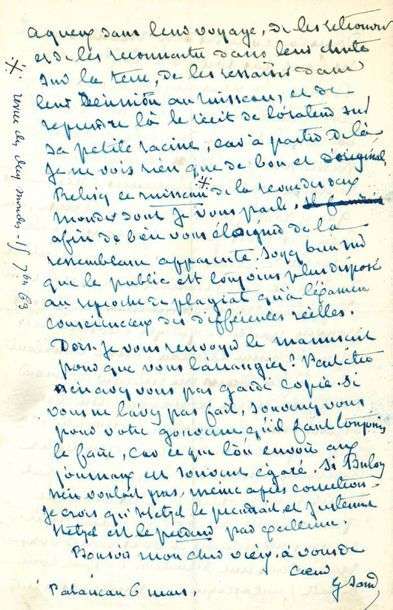
If the style had the charm of the subject, it would be very successful: without being incorrect, careless or bad, it does not have the harmony and freshness that the picture has. Apply yourself to acquiring that elegance which is not demonstrated, but felt, and which is not precisely in the word, nor in the cut of the sentence, nor in the musical number, but in all that at once. His little fable is "very well done and very pretty", but is too reminiscent of "a bluette of mine" that appeared in the Revue des deux mondes [in September 1863, Ce que dit le ruisseau]: "It is a good man who listens to what a stream says and hears words. Your article seems a reminiscence and a development of mine. [...] I like my form better, but I like your content better, it is clearer and more complete. The beginning should be changed: "instead of three little boys and the fishing party which are uninteresting, instead of the meadow and the brook which recall my beginning, if you could start from something very opposite as a picture, from a kettle on the fire in a Flemish interior or a steam factory, or the spirits of a locomotive on a journey, or something better you would find, but more positive and clear-cut than a reverie by the water, there is nothing to prevent you from placing yourself in a quite fantastic situation of mind, following these watery spirits on their journey, finding and recognizing them in their fall under the earth, recapturing them in their reunion with the stream, and there taking up the speaker's tale of his little root, for from this I see nothing but good and original."Correspondence, XIX, n° 11507.
L.A.S. "G. Sand", Palaiseau 6 March [1865, to Doctor Pierre-Paul DARCHY]| 4 pages in-8.
Beautiful letter of literary advice to her doctor friend. There is a very well developed and followed idea.
If the style had the charm of the subject, it would be very successful: without being incorrect, careless or bad, it does not have the harmony and freshness that the picture has. Apply yourself to acquiring that elegance which is not demonstrated, but felt, and which is not precisely in the word, nor in the cut of the sentence, nor in the musical number, but in all that at once. His little fable is "very well done and very pretty", but is too reminiscent of "a bluette of mine" that appeared in the Revue des deux mondes [in September 1863, Ce que dit le ruisseau]: "It is a good man who listens to what a stream says and hears words. Your article seems a reminiscence and a development of mine. [...] I like my form better, but I like your content better, it is clearer and more complete. The beginning should be changed: "instead of three little boys and the fishing party which are uninteresting, instead of the meadow and the brook which recall my beginning, if you could start from something very opposite as a picture, from a kettle on the fire in a Flemish interior or a steam factory, or the spirits of a locomotive on a journey, or something better you would find, but more positive and clear-cut than a reverie by the water, there is nothing to prevent you from placing yourself in a quite fantastic situation of mind, following these watery spirits on their journey, finding and recognizing them in their fall under the earth, recapturing them in their reunion with the stream, and there taking up the speaker's tale of his little root, for from this I see nothing but good and original."Correspondence, XIX, n° 11507.