
&w=3840&q=75)
&w=3840&q=75)
&w=3840&q=75)
&w=3840&q=75)
&w=3840&q=75)
&w=3840&q=75)


276
SAND George (1804-1876)
The item was sold for 975 €
Fees include commission and taxes.
SAND George (1804-1876)
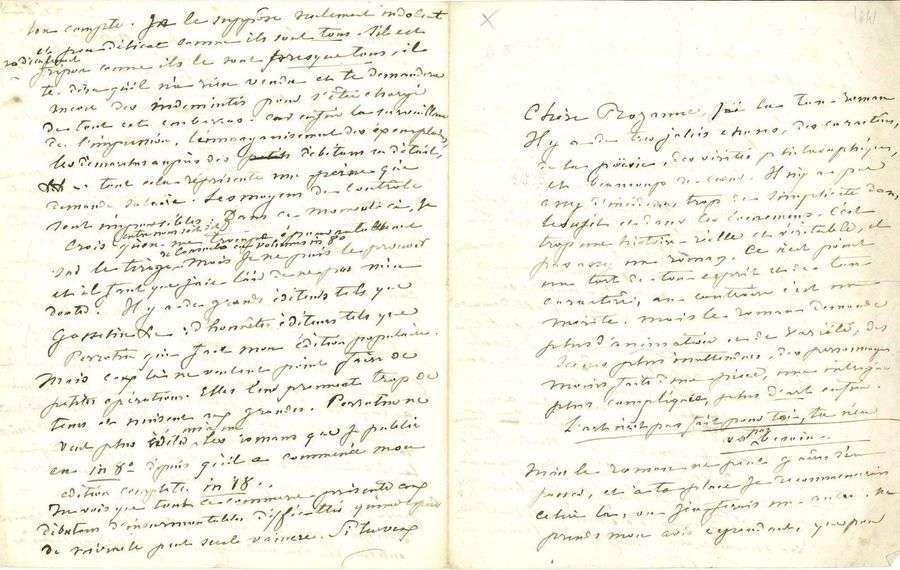
L.A.S. "George", [Paris late November 1842?], to her friend Rozanne
BOURGOING| 6 pages small in-4 with her small gothic cipher (slightly split at the fold).
Very long and beautiful letter on the art of the novel, on reviews and publishers, and on her novel Consuelo.she has read Rozanne's "novel" [Héléna, short story published in Vienna in 1844] "There are very pretty things, characters, poetry, philosophical truths, and a lot of heart. There are not enough incidens, too much simplicity in the subject and in the events. It is too much a real and true story, and not enough a novel. This is not a fault of your mind or your character, on the contrary it is a merit. But the novel requires more animation and variety, more unexpected scenes, less one-piece characters, a more complicated plot, and more art. Art is not for you, you don't need it. But the novel can hardly do without it, and if I were you I would start this one over again, or I would write another. Take my advice, however, only for what you think it is worth. It is possible that by dint of writing novels myself, my taste is spoiled, as it is with good wine when one has smelled too much of Boutarin's piot. I have very little confidence in my judgement and beg you not to accept it without examination".
She can help him to publish Héléna, "but the difficulties are great.
First of all, the Revue indépendante has too many novels, apart from mine| it is presented with them every day, and instead it asks for articles on politics, bibliography and science, of which the present world is very poor, or very stingy. The Revue de Paris is closed to me as Paradise is to the devil. Buloz and Bonnaire hold the keys in one hand and those of the Revue des 2 Mondes in the other. My recommendation would therefore be very unfortunate, quarrelled with us, furious, desperate as they are at the moment. It would be necessary to find a publisher, but "these gentlemen do not want to risk an unknown name [...] There are no more publishers trusting in the word of others, even less adventurous publishers able and willing to risk a small sum. They are all ruined, the public is blamed. Business goes to the devil: that's what they all say, and when I have tried everything possible, for the hundredth time in my life in such an encounter, I will get a refusal." She will try, but she warns: "We will print you on condition that you pay the printing costs and the advertisements if you want them (which is essential to the success of the book and is very expensive). Then the bookseller will agree to sell and share the profits with you. But he will take his share, and when he has taken it, he will no longer take care of the sale, your book will be out of print, forgotten, and he will not sell twenty copies on your account.
I only assume that he is indolent and not very delicate as they all are. If he is radically rascal, as almost all of them are, he will tell you that he has not sold anything and will still ask you for compensation for having taken on all this embarrassment. After all, the supervision of the printing, the storage of copies, the approaches to debtors in detail, &c. all this represents a pain that demands a salary. The means of control are impossible.
Thus, she thinks that she is "appallingly deceived about the printing of Consuelo in 8º volumes. But I cannot prove it, and I have to look as if I don't suspect it. There are great publishers such as
Gosselin &c. and honest publishers such as Perrotin, who produces my popular edition. But those do not want to do small operations.
They take up too much time and harm the big ones. PERROTIN does not want to publish one by one the novels I publish in 8º since he started my complete edition in 18". It is therefore likely to cost 2,500 to 3,000 francs per volume, "without much hope of being compensated by sales. If the novel is successful, you will find publishers without difficulty, and the second novel will work on its own. But one does not know what success is all about: "Above all, you have to amuse the reader, or surprise him"... She has re-subscribed Rozanne to the Revue indépendante, which is not run by Anselme Pététin, "but by two men who share the same ideas and feelings that have governed the journal up to now. LEROUX has given them this direction which was taking up too much of his time, and preventing him from writing and publishing accurately.
These gentlemen have brought in funds, and have put us in a position to make a deposit and to publish every fortnight. Leroux continues to write in it as in the past, and I also assiduously,
Consuelo being still destined to do many numbers. I will also put in some pieces that will not be published separately any time soon. Finally, I believe that if this magazine has interested you up to now, it will not interest you any less in the future, and I myself will take the same interest in it as you did in the past.
L.A.S. "George", [Paris late November 1842?], to her friend Rozanne
BOURGOING| 6 pages small in-4 with her small gothic cipher (slightly split at the fold).
Very long and beautiful letter on the art of the novel, on reviews and publishers, and on her novel Consuelo.she has read Rozanne's "novel" [Héléna, short story published in Vienna in 1844] "There are very pretty things, characters, poetry, philosophical truths, and a lot of heart. There are not enough incidens, too much simplicity in the subject and in the events. It is too much a real and true story, and not enough a novel. This is not a fault of your mind or your character, on the contrary it is a merit. But the novel requires more animation and variety, more unexpected scenes, less one-piece characters, a more complicated plot, and more art. Art is not for you, you don't need it. But the novel can hardly do without it, and if I were you I would start this one over again, or I would write another. Take my advice, however, only for what you think it is worth. It is possible that by dint of writing novels myself, my taste is spoiled, as it is with good wine when one has smelled too much of Boutarin's piot. I have very little confidence in my judgement and beg you not to accept it without examination".
She can help him to publish Héléna, "but the difficulties are great.
First of all, the Revue indépendante has too many novels, apart from mine| it is presented with them every day, and instead it asks for articles on politics, bibliography and science, of which the present world is very poor, or very stingy. The Revue de Paris is closed to me as Paradise is to the devil. Buloz and Bonnaire hold the keys in one hand and those of the Revue des 2 Mondes in the other. My recommendation would therefore be very unfortunate, quarrelled with us, furious, desperate as they are at the moment. It would be necessary to find a publisher, but "these gentlemen do not want to risk an unknown name [...] There are no more publishers trusting in the word of others, even less adventurous publishers able and willing to risk a small sum. They are all ruined, the public is blamed. Business goes to the devil: that's what they all say, and when I have tried everything possible, for the hundredth time in my life in such an encounter, I will get a refusal." She will try, but she warns: "We will print you on condition that you pay the printing costs and the advertisements if you want them (which is essential to the success of the book and is very expensive). Then the bookseller will agree to sell and share the profits with you. But he will take his share, and when he has taken it, he will no longer take care of the sale, your book will be out of print, forgotten, and he will not sell twenty copies on your account.
I only assume that he is indolent and not very delicate as they all are. If he is radically rascal, as almost all of them are, he will tell you that he has not sold anything and will still ask you for compensation for having taken on all this embarrassment. After all, the supervision of the printing, the storage of copies, the approaches to debtors in detail, &c. all this represents a pain that demands a salary. The means of control are impossible.
Thus, she thinks that she is "appallingly deceived about the printing of Consuelo in 8º volumes. But I cannot prove it, and I have to look as if I don't suspect it. There are great publishers such as
Gosselin &c. and honest publishers such as Perrotin, who produces my popular edition. But those do not want to do small operations.
They take up too much time and harm the big ones. PERROTIN does not want to publish one by one the novels I publish in 8º since he started my complete edition in 18". It is therefore likely to cost 2,500 to 3,000 francs per volume, "without much hope of being compensated by sales. If the novel is successful, you will find publishers without difficulty, and the second novel will work on its own. But one does not know what success is all about: "Above all, you have to amuse the reader, or surprise him"... She has re-subscribed Rozanne to the Revue indépendante, which is not run by Anselme Pététin, "but by two men who share the same ideas and feelings that have governed the journal up to now. LEROUX has given them this direction which was taking up too much of his time, and preventing him from writing and publishing accurately.
These gentlemen have brought in funds, and have put us in a position to make a deposit and to publish every fortnight. Leroux continues to write in it as in the past, and I also assiduously,
Consuelo being still destined to do many numbers. I will also put in some pieces that will not be published separately any time soon. Finally, I believe that if this magazine has interested you up to now, it will not interest you any less in the future, and I myself will take the same interest in it as you did in the past.