
&w=3840&q=75)
&w=3840&q=75)
&w=3840&q=75)
&w=3840&q=75)
&w=3840&q=75)
&w=3840&q=75)


RENAN Ernest (1823-1892)
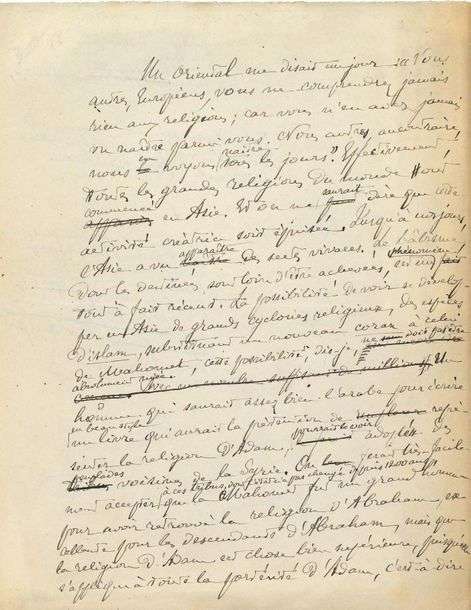
AUTOGRAPHIC MANUSCRIT, [The Experimental Method in Religion, 1879]| 9 pages in-4, with erasures and corrections. Working manuscript of this important study on the history of religions. This text, which has numerous erasures and corrections, appeared untitled as an introduction to Part II "Christianity" of Volume III Religion of the English publication The Hundred Greatest Men.
Portraits of the one hundred greatest men of history (London, 1879)| it was collected, under the title La Méthode expérimentale en religion, at the head of Nouvelles Études d'histoire religieuse [New Studies in Religious History] (Calmann Lévy, 1884)].
All the great religions of the world began in Asia. Even recently, sects have shown their vivacity (Babism), and it would be possible to see "great religious cyclones, species of Islam, substituting a new Koran for that of Mohammed": "A man who knew Arabic well enough to write in beautiful style a book which would claim to represent the religion of Adam, could see it adopted by the tribes near Syria. It would be very easy to make these tribes, whose condition has not changed for 1200 years, accept that Mohammed was a great man for having recovered the religion of Abraham, which is excellent for the descendants of Abraham, but that the religion of Adam is far superior, since it applies to all of Adam's posterity, that is to say, to all of humanity. A fireworks display on the mountain of Safet, supported by a few million people, could easily be considered as the appearance of the Messiah"...
And to tell an anecdote about the Persian who almost founded a religion with the motto Liberty, Equality, Fraternity... He juxtaposes the aptitude of the Asians to create religions with the torpor of the Europeans, speaks of the so-called pagan religions, of Indo-European mythology, of Celtic druidism and of Christianity which, so pure at its origins, absorbed the superstitions of the Celtic and Italic races and became "a true paganism"...
He compares the saints of the Norman and Breton chapels to the "innumerable Gallic gods", with similar functions: it is to believe that, "in the deep layers of the people, religion has changed little"...
AUTOGRAPHIC MANUSCRIT, [The Experimental Method in Religion, 1879]| 9 pages in-4, with erasures and corrections. Working manuscript of this important study on the history of religions. This text, which has numerous erasures and corrections, appeared untitled as an introduction to Part II "Christianity" of Volume III Religion of the English publication The Hundred Greatest Men.
Portraits of the one hundred greatest men of history (London, 1879)| it was collected, under the title La Méthode expérimentale en religion, at the head of Nouvelles Études d'histoire religieuse [New Studies in Religious History] (Calmann Lévy, 1884)].
All the great religions of the world began in Asia. Even recently, sects have shown their vivacity (Babism), and it would be possible to see "great religious cyclones, species of Islam, substituting a new Koran for that of Mohammed": "A man who knew Arabic well enough to write in beautiful style a book which would claim to represent the religion of Adam, could see it adopted by the tribes near Syria. It would be very easy to make these tribes, whose condition has not changed for 1200 years, accept that Mohammed was a great man for having recovered the religion of Abraham, which is excellent for the descendants of Abraham, but that the religion of Adam is far superior, since it applies to all of Adam's posterity, that is to say, to all of humanity. A fireworks display on the mountain of Safet, supported by a few million people, could easily be considered as the appearance of the Messiah"...
And to tell an anecdote about the Persian who almost founded a religion with the motto Liberty, Equality, Fraternity... He juxtaposes the aptitude of the Asians to create religions with the torpor of the Europeans, speaks of the so-called pagan religions, of Indo-European mythology, of Celtic druidism and of Christianity which, so pure at its origins, absorbed the superstitions of the Celtic and Italic races and became "a true paganism"...
He compares the saints of the Norman and Breton chapels to the "innumerable Gallic gods", with similar functions: it is to believe that, "in the deep layers of the people, religion has changed little"...