
&w=3840&q=75)
&w=3840&q=75)
&w=3840&q=75)
&w=3840&q=75)
&w=3840&q=75)
&w=3840&q=75)


271
PROUST Marcel (1871-1922)
The item was sold for 103 627 €
Fees include commission and taxes.
PROUST Marcel (1871-1922)
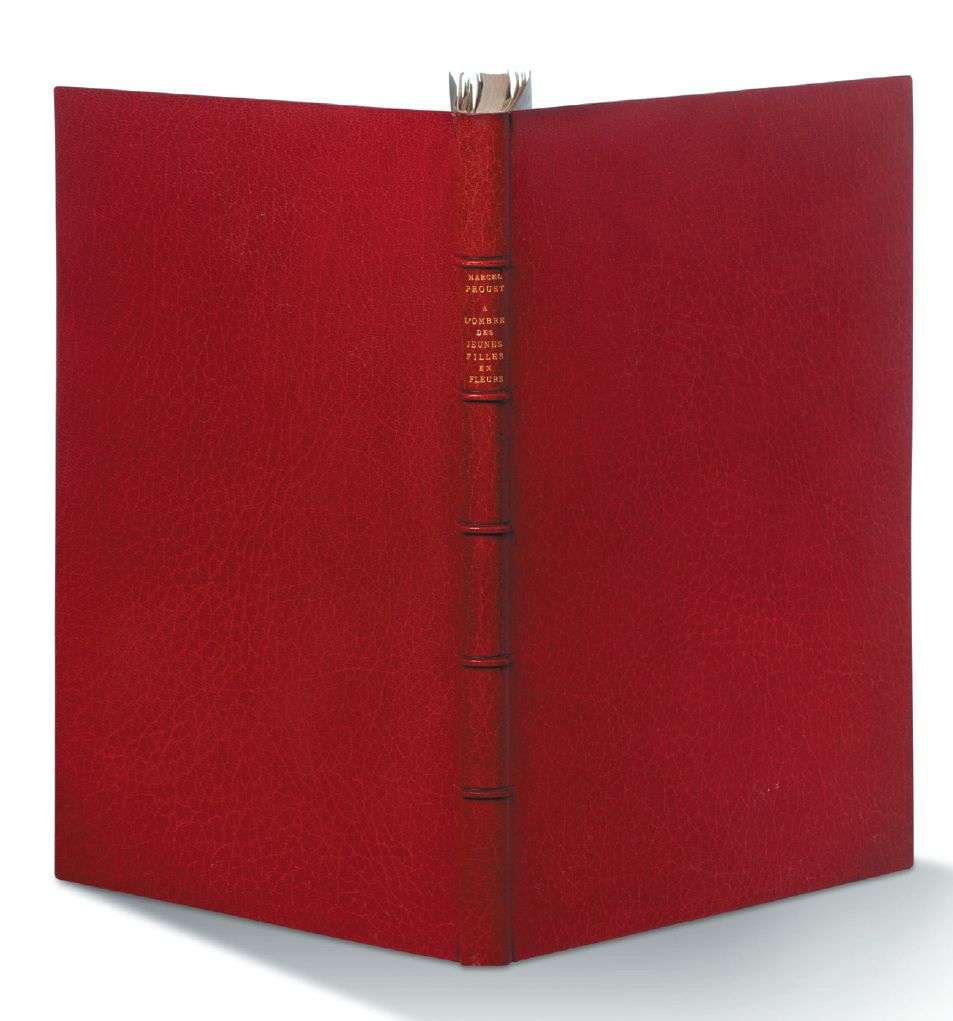
- À l'ombre des jeunes filles en fleurs (Paris, Éditions de la Nouvelle
Revue Française, 1920)| in-4 (32,5 x 21,5 cm), bound in red jansenist morocco, inner lace, pink moire lining and endpapers, edges gilt (P.L. Martin)| case damaged.
Precious copy of the deluxe edition of À l'ombre des jeunes filles en fleurs, enriched with six large unpublished plates presenting two important passages of the manuscript, including the beginning of the novel, and the beginnings of the narrator's affair with Albertine.
Deluxe edition reprinted in quarto grape format, printed at 50 copies on Bible paper with very wide margins (this one n° XLIX), two years after the original edition, enriched with fragments of the autograph manuscript and corrected proofs.
Portrait-frontispiece after Jacques-Émile Blanche, reproduced in heliogravure on Arches paper.
It was Proust, in a bad financial situation, who had the idea of having Gallimard produce this deluxe edition of his novel (awarded the Goncourt Prize), enriched with fragments of the manuscript and proofs, and sold by subscription. He had been struck by the work of Mlle Rallet, a typist at the N.R.F. To facilitate her task, she had cut out and glued end to end on large sheets of paper the papers added by Proust to the proofs of his novel or taken from his workbooks, as well as the corrected proofs (drawn up by
Grasset for the edition planned for 1914, then those recomposed by
Gallimard for the 1918 edition), thus forming "an extraordinary marquetry", in the words of Pierre Clarac. Proust commented on these plates as follows: "the manuscript [...] in spite of my dreadful handwriting [...] is delightful and has the air of a palimpsest because of the person who pasted it together with infinite taste" (Correspondance, t. XVIII, p. 295).
This was the last manuscript Proust sent to Gallimard in October 1917, for the "second volume" (À l'ombre des jeunes filles en fleurs) of his novel À la recherche du temps perdu. [See
Francine Goujon, "Le manuscrit dispersé d'À l'ombre des jeunes filles en fleurs : le "Cahier violet", Bulletin Marcel Proust, no. 49, 1999|
Pyra Wise, "L'édition de luxe et le manuscrit dispersé d'À l'ombre des jeunes filles en fleurs", Bulletin d'informations proustiennes, no. 33, 2003, and "Le généticien en mosaïste. The Reconstruction of the Manuscript of À l'ombre des jeunes filles en fleurs," Genesis, no. 36, 2013)].
Autograph address signed by Proust on the false title to his youthful friend and fellow student at the Lycée Condorcet, the banker Horace
FINALY (1871-1945): 'To my dear friend of old and of all time, Monsieur Horace Finaly, with fond memories of days gone by
Marcel Proust'.
The papers are glued on six large folding sheets of strong paper, each measuring about 50 x 13 cm| the fifth is larger (47.5 x 27.5 cm), and is mounted on two columns. These plates, hitherto unpublished, correspond to two important passages of the novel: plates 1 to 3 give the beginning of the novel (Pléiade ed. Tadié, t. I, p. 423-428), plates 4 to 6 are related to the second part (Pléiade ed. Tadié, t. II, p. 280-285)| they bring together 34 pieces of the manuscript (some of which were glued by Proust himself) and 3 fragments of proofs. These two sequences of texts contain erasures, corrections and additions, as well as variants with the final text.
Plates 1 to 3 (Pléiade t. I, p. 423-428). In connection with the narrator's mother's plan to invite M. de Norpois, the narrator describes the change in Swann's character since his marriage to Odette de Crécy and his new relationships| how Professor Cottard has become more serious and respectable, a recognized scholar| and finally the portrait of M. de Norpois and the political evolution of the diplomat.
- The first plate, marked "N° 1" in blue pencil, entirely autographed, presents 3 pieces of manuscript (paginated 1 and 2)| it bears at the head the title: "A la Recherche du Temps Perdu - Deuxième volume : A l'ombre des jeunes filles en fleur" [without final s].
Then the novel begins: "My mother [having expressed the regret crossed out], when it was question of having M. de Norpois to dinner, that Professor Cottard was away and that she herself had ceased to associate with Swann entirely, as both would undoubtedly have interested the former ambassador, my father replied that an eminent guest, an illustrious scholar, like Cottard, could never do badly at a dinner party, but that Swann, with his ostentation, with his way of shouting from the rooftops his slightest relations, [embarrassing and striking out] <était un vulgaire esbrouffeur>that the Marquis de Norpois would have found, according to his expression, 'stinking'. <était un vulgaire esbrouffeur>.. To the point of "sounding as high as the wife of" (Pléiade p. 424).
- The
- À l'ombre des jeunes filles en fleurs (Paris, Éditions de la Nouvelle
Revue Française, 1920)| in-4 (32,5 x 21,5 cm), bound in red jansenist morocco, inner lace, pink moire lining and endpapers, edges gilt (P.L. Martin)| case damaged.
Precious copy of the deluxe edition of À l'ombre des jeunes filles en fleurs, enriched with six large unpublished plates presenting two important passages of the manuscript, including the beginning of the novel, and the beginnings of the narrator's affair with Albertine.
Deluxe edition reprinted in quarto grape format, printed at 50 copies on Bible paper with very wide margins (this one n° XLIX), two years after the original edition, enriched with fragments of the autograph manuscript and corrected proofs.
Portrait-frontispiece after Jacques-Émile Blanche, reproduced in heliogravure on Arches paper.
It was Proust, in a bad financial situation, who had the idea of having Gallimard produce this deluxe edition of his novel (awarded the Goncourt Prize), enriched with fragments of the manuscript and proofs, and sold by subscription. He had been struck by the work of Mlle Rallet, a typist at the N.R.F. To facilitate her task, she had cut out and glued end to end on large sheets of paper the papers added by Proust to the proofs of his novel or taken from his workbooks, as well as the corrected proofs (drawn up by
Grasset for the edition planned for 1914, then those recomposed by
Gallimard for the 1918 edition), thus forming "an extraordinary marquetry", in the words of Pierre Clarac. Proust commented on these plates as follows: "the manuscript [...] in spite of my dreadful handwriting [...] is delightful and has the air of a palimpsest because of the person who pasted it together with infinite taste" (Correspondance, t. XVIII, p. 295).
This was the last manuscript Proust sent to Gallimard in October 1917, for the "second volume" (À l'ombre des jeunes filles en fleurs) of his novel À la recherche du temps perdu. [See
Francine Goujon, "Le manuscrit dispersé d'À l'ombre des jeunes filles en fleurs : le "Cahier violet", Bulletin Marcel Proust, no. 49, 1999|
Pyra Wise, "L'édition de luxe et le manuscrit dispersé d'À l'ombre des jeunes filles en fleurs", Bulletin d'informations proustiennes, no. 33, 2003, and "Le généticien en mosaïste. The Reconstruction of the Manuscript of À l'ombre des jeunes filles en fleurs," Genesis, no. 36, 2013)].
Autograph address signed by Proust on the false title to his youthful friend and fellow student at the Lycée Condorcet, the banker Horace
FINALY (1871-1945): 'To my dear friend of old and of all time, Monsieur Horace Finaly, with fond memories of days gone by
Marcel Proust'.
The papers are glued on six large folding sheets of strong paper, each measuring about 50 x 13 cm| the fifth is larger (47.5 x 27.5 cm), and is mounted on two columns. These plates, hitherto unpublished, correspond to two important passages of the novel: plates 1 to 3 give the beginning of the novel (Pléiade ed. Tadié, t. I, p. 423-428), plates 4 to 6 are related to the second part (Pléiade ed. Tadié, t. II, p. 280-285)| they bring together 34 pieces of the manuscript (some of which were glued by Proust himself) and 3 fragments of proofs. These two sequences of texts contain erasures, corrections and additions, as well as variants with the final text.
Plates 1 to 3 (Pléiade t. I, p. 423-428). In connection with the narrator's mother's plan to invite M. de Norpois, the narrator describes the change in Swann's character since his marriage to Odette de Crécy and his new relationships| how Professor Cottard has become more serious and respectable, a recognized scholar| and finally the portrait of M. de Norpois and the political evolution of the diplomat.
- The first plate, marked "N° 1" in blue pencil, entirely autographed, presents 3 pieces of manuscript (paginated 1 and 2)| it bears at the head the title: "A la Recherche du Temps Perdu - Deuxième volume : A l'ombre des jeunes filles en fleur" [without final s].
Then the novel begins: "My mother [having expressed the regret crossed out], when it was question of having M. de Norpois to dinner, that Professor Cottard was away and that she herself had ceased to associate with Swann entirely, as both would undoubtedly have interested the former ambassador, my father replied that an eminent guest, an illustrious scholar, like Cottard, could never do badly at a dinner party, but that Swann, with his ostentation, with his way of shouting from the rooftops his slightest relations, [embarrassing and striking out] <était un vulgaire esbrouffeur>that the Marquis de Norpois would have found, according to his expression, 'stinking'. <était un vulgaire esbrouffeur>.. To the point of "sounding as high as the wife of" (Pléiade p. 424).
- The