
&w=3840&q=75)
&w=3840&q=75)
&w=3840&q=75)
&w=3840&q=75)
&w=3840&q=75)
&w=3840&q=75)


247
BRETON André (1896-1966)
The item was sold for 520 €
Fees include commission and taxes.
BRETON André (1896-1966)
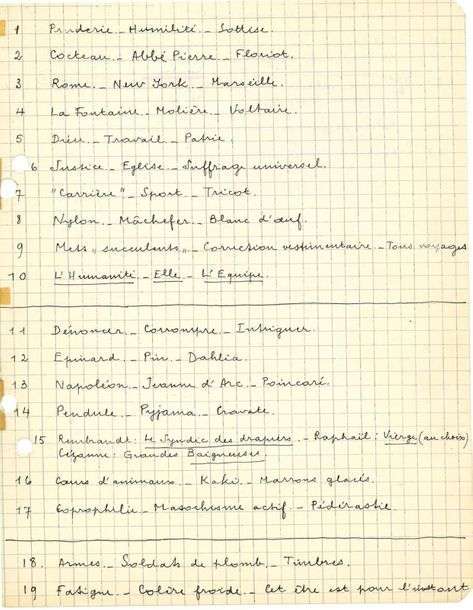
P.A.S. "AB."| 1 1/2 pages in-4 on squared and perforated binder sheet.
Answers to a 23-point questionnaire. "1 Prudence. - Humility.
- Foolishness. 2 Cocteau. - Abbé Pierre. - Floriot. 3 Rome. - New York. -
Marseille. 4 La Fontaine. - Molière. - Voltaire. 5 God. - Work. - Fatherland.
6 Justice. - Church. - Universal suffrage. 7 "Career". - Sport. - Knitting.
[...] 13 Napoleon. - Joan of Arc. - Poincaré. 14 Clock. - Pyjamas. -
Tie. 15 Rembrandt : The Syndic of the drapers. - Raphael: Virgin (of your choice). Cézanne : Large Bathers"... Etc. Reading Lancelot Lengyel's book, L'Art gaulois dans les médailles, was a revelation for Breton who, from then on, became enthusiastic about Gallic genius and Celtic art. "The superb album [...] which
Lancelot Lengyel has given us [...] has come at the right time to shed light on the subject. At its time, because a very lively effervescence around a subject which, on the current level, takes on a sudden importance and acuteness - such as the discussions around abstract art - has every chance of bringing out of the more or less distant past a capital element of decision and also of putting the emerging area of the past back in its true light [...]". As a quarrel between "supporters and detractors of abstract art" began, Breton defended Kandinsky's Principle of Inner Necessity and advocated a return to the "first signs". Breton took up Lengyel's words, for whom "the Greek form was born of an anthropomorphic vision of the world that freezes movement and crystallizes emotion. Celtic art, on the other hand, springs from a vision of the infinite that dissolves the concrete and leads to the abstraction of the visible. To the philosophy that this implies," he concludes, "and that can be held as that of the true enlightenment, the foreign invaders of the year 50 have substituted their own, whose misdeeds we are in a position today to appreciate. It is doubtful that the growing arrogance of the latter is sufficient to avoid the repercussion on all levels of life of artistic movements such as surrealism and abstractivism - both of which access the same 'forests of symbols' in the rediscovered tradition of Gallic art, in a complete break with the Latin spirit".
Published with a few variations in the third revised edition of Le Surréalisme et la peinture in 1965
P.A.S. "AB."| 1 1/2 pages in-4 on squared and perforated binder sheet.
Answers to a 23-point questionnaire. "1 Prudence. - Humility.
- Foolishness. 2 Cocteau. - Abbé Pierre. - Floriot. 3 Rome. - New York. -
Marseille. 4 La Fontaine. - Molière. - Voltaire. 5 God. - Work. - Fatherland.
6 Justice. - Church. - Universal suffrage. 7 "Career". - Sport. - Knitting.
[...] 13 Napoleon. - Joan of Arc. - Poincaré. 14 Clock. - Pyjamas. -
Tie. 15 Rembrandt : The Syndic of the drapers. - Raphael: Virgin (of your choice). Cézanne : Large Bathers"... Etc. Reading Lancelot Lengyel's book, L'Art gaulois dans les médailles, was a revelation for Breton who, from then on, became enthusiastic about Gallic genius and Celtic art. "The superb album [...] which
Lancelot Lengyel has given us [...] has come at the right time to shed light on the subject. At its time, because a very lively effervescence around a subject which, on the current level, takes on a sudden importance and acuteness - such as the discussions around abstract art - has every chance of bringing out of the more or less distant past a capital element of decision and also of putting the emerging area of the past back in its true light [...]". As a quarrel between "supporters and detractors of abstract art" began, Breton defended Kandinsky's Principle of Inner Necessity and advocated a return to the "first signs". Breton took up Lengyel's words, for whom "the Greek form was born of an anthropomorphic vision of the world that freezes movement and crystallizes emotion. Celtic art, on the other hand, springs from a vision of the infinite that dissolves the concrete and leads to the abstraction of the visible. To the philosophy that this implies," he concludes, "and that can be held as that of the true enlightenment, the foreign invaders of the year 50 have substituted their own, whose misdeeds we are in a position today to appreciate. It is doubtful that the growing arrogance of the latter is sufficient to avoid the repercussion on all levels of life of artistic movements such as surrealism and abstractivism - both of which access the same 'forests of symbols' in the rediscovered tradition of Gallic art, in a complete break with the Latin spirit".
Published with a few variations in the third revised edition of Le Surréalisme et la peinture in 1965