
&w=3840&q=75)
&w=3840&q=75)
&w=3840&q=75)
&w=3840&q=75)
&w=3840&q=75)
&w=3840&q=75)


246
BRETON André (1896-1966)
The item was sold for 1 170 €
Fees include commission and taxes.
BRETON André (1896-1966)
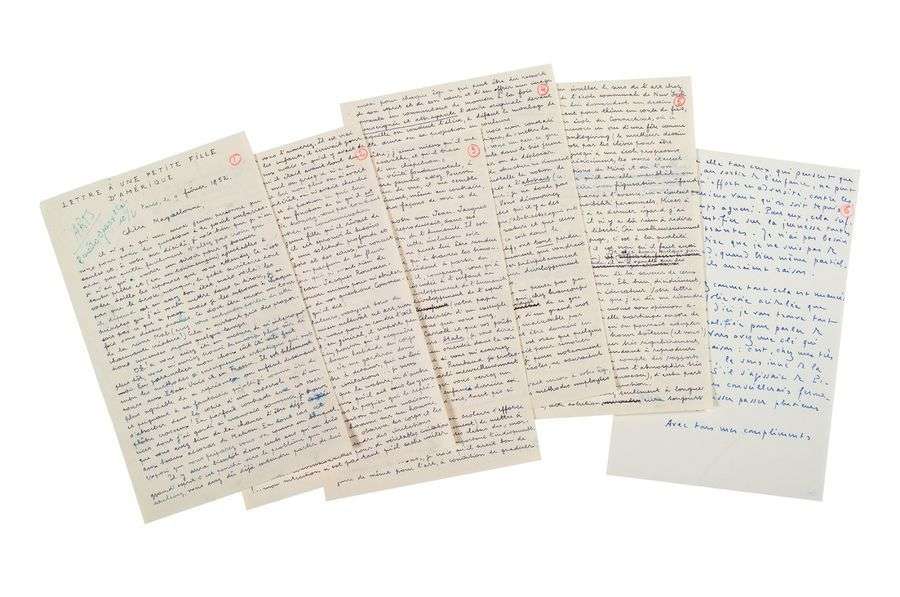
AUTOGRAPH MANUSCRIPT. "Letter to a Little Girl in America".
S.l.n.d. (1952). 5 and 1 ff. in-8, slight wetness on 1st leaf.
This manuscript published in the journal des Arts is an attempt to answer a young person's embarrassing questions about teaching art and awakening a sensitivity for abstract art.
(...) Better than anyone else, our friend Jean-Jacques [Rousseau] understood that childhood reproduced in its successive stages the evolution of humanity (...) It is therefore of great interest that this evolution be traced to the child, and it can only be made more faithful and sensitive to him through the artistic testimonies which follow one another from the most primitive. Still, you must understand that at no time the work presented to the child is situated at a stage of development of humanity that exceeds the stage of development of the spirit corresponding to his age (your father will explain). To clarify myself with an example, let us say that I learn from you that you were, as a child, crazy about Lewis Carroll and that your tastes today lead you to Atala, I will tell you that you seem to me to be very well oriented in the path of knowledge, whereas if you were to assure me that you are reading Rimbaud, I would protest, even though Rimbaud spoke marvellously of childhood, but to judge you will see one day that you need to have the whole of childhood behind you. Eager to know as I see you, so much the worse if that should make you angry (...). Everything that presents itself at a very young age is only an object of pleasure or displeasure. The associations of color and structure only come later| later still, the notion of generality is established, which leads by degrees to the abstract (...) You will discover yourself in a few years that there are so-called "abstract" artists, especially in America, who have been able to keep in touch with nature, and that those who have lost this contact (...) have lost everything (...). Going even further, I do not think that the voluntary "deformations" which, in many modern artists, are the product of what grown-ups call "intellectual speculation", inaccessible by definition to childhood, can be given as an example to childhood. But it is true that some modern artists have done their utmost to reconnect with the world of childhood: I am thinking in particular of Klee and Miró, who cannot be too highly regarded in schools. Through my daughter, who was still there at your age, I was able to get an idea of the methods used in the United States to awaken a sense of art in children. (...) So? you say. The last page is written by his second wife, Jacqueline Lambavte.
AUTOGRAPH MANUSCRIPT. "Letter to a Little Girl in America".
S.l.n.d. (1952). 5 and 1 ff. in-8, slight wetness on 1st leaf.
This manuscript published in the journal des Arts is an attempt to answer a young person's embarrassing questions about teaching art and awakening a sensitivity for abstract art.
(...) Better than anyone else, our friend Jean-Jacques [Rousseau] understood that childhood reproduced in its successive stages the evolution of humanity (...) It is therefore of great interest that this evolution be traced to the child, and it can only be made more faithful and sensitive to him through the artistic testimonies which follow one another from the most primitive. Still, you must understand that at no time the work presented to the child is situated at a stage of development of humanity that exceeds the stage of development of the spirit corresponding to his age (your father will explain). To clarify myself with an example, let us say that I learn from you that you were, as a child, crazy about Lewis Carroll and that your tastes today lead you to Atala, I will tell you that you seem to me to be very well oriented in the path of knowledge, whereas if you were to assure me that you are reading Rimbaud, I would protest, even though Rimbaud spoke marvellously of childhood, but to judge you will see one day that you need to have the whole of childhood behind you. Eager to know as I see you, so much the worse if that should make you angry (...). Everything that presents itself at a very young age is only an object of pleasure or displeasure. The associations of color and structure only come later| later still, the notion of generality is established, which leads by degrees to the abstract (...) You will discover yourself in a few years that there are so-called "abstract" artists, especially in America, who have been able to keep in touch with nature, and that those who have lost this contact (...) have lost everything (...). Going even further, I do not think that the voluntary "deformations" which, in many modern artists, are the product of what grown-ups call "intellectual speculation", inaccessible by definition to childhood, can be given as an example to childhood. But it is true that some modern artists have done their utmost to reconnect with the world of childhood: I am thinking in particular of Klee and Miró, who cannot be too highly regarded in schools. Through my daughter, who was still there at your age, I was able to get an idea of the methods used in the United States to awaken a sense of art in children. (...) So? you say. The last page is written by his second wife, Jacqueline Lambavte.