
&w=3840&q=75)
&w=3840&q=75)
&w=3840&q=75)
&w=3840&q=75)
&w=3840&q=75)
&w=3840&q=75)
&w=3840&q=75)
&w=3840&q=75)


917
LAWRENCE Thomas Edward (1888-1935) explorateur, orientaliste, agent politi
The item was sold for 2 108 €
Fees include commission and taxes.
LAWRENCE Thomas Edward (1888-1935) explorateur, orientaliste, agent politique et écrivain anglais [LAWRENCE D'ARABIE]
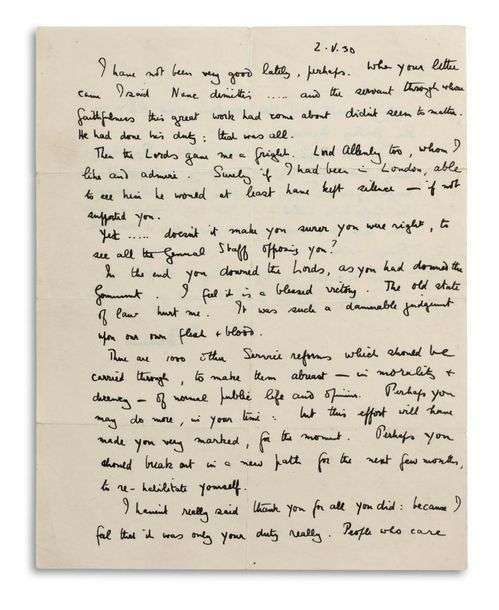
L.A.S. of his pseudonym "TEShaw", May 2, 1930, [to Ernest THURTLE]| 1 page and a half in-4 (traces of folds)| in English.
Nice letter on the abolition of the death penalty for cowardice in the British army.
[Ernest THURTLE (1884-1954), Labour MP, had campaigned for the abolition of the death penalty for cowardice in the British army. His proposal, approved by the House of Commons , was fiercely opposed by Field Marshal Allenby and rejected by the House of Lords, but imposed by the Commons].
When Thurtle's letter arrived, T.E. said Nunc dimittis, and the servant whose devotion to duty made this great work possible did not seem to matter. He had done his duty: that was all. Then the Lords frightened him. Lord ALLENBY too, whom he loves and admires. No doubt, had he been in London and seen it, Allenby would have kept silent, if not supported the proposer. And yet, does it not confirm its rightness, that the whole state general opposes it? In the end, he defeated the Lords as he defeated the government. It's a blessed victory. The old law was hurting him. It was a horrible judgment on their brothers in flesh and blood. There would be a thousand other reforms of the service to be made, to achieve the basic morality and decency of normal life and public opinion.
Perhaps Thurtle will do more in his life, but this effort will have distinguished him Lawrence did not thank him for everything he did: in fact, it was only his duty. Those who love their countries a little do not like to see them defiled. Damn the high-ranking officers, you poor reptiles! They always swear that these things are necessary for discipline... One word, in confidence: Discipline itself is not necessary. One fights better without it. Yet the English are born with it, and can no more lose it than their nails...
«When your letter came I said Nunc dimittis ... and the servant through whose faithfulness this great work had corne about didn't seem to matter. He had don
L.A.S. of his pseudonym "TEShaw", May 2, 1930, [to Ernest THURTLE]| 1 page and a half in-4 (traces of folds)| in English.
Nice letter on the abolition of the death penalty for cowardice in the British army.
[Ernest THURTLE (1884-1954), Labour MP, had campaigned for the abolition of the death penalty for cowardice in the British army. His proposal, approved by the House of Commons , was fiercely opposed by Field Marshal Allenby and rejected by the House of Lords, but imposed by the Commons].
When Thurtle's letter arrived, T.E. said Nunc dimittis, and the servant whose devotion to duty made this great work possible did not seem to matter. He had done his duty: that was all. Then the Lords frightened him. Lord ALLENBY too, whom he loves and admires. No doubt, had he been in London and seen it, Allenby would have kept silent, if not supported the proposer. And yet, does it not confirm its rightness, that the whole state general opposes it? In the end, he defeated the Lords as he defeated the government. It's a blessed victory. The old law was hurting him. It was a horrible judgment on their brothers in flesh and blood. There would be a thousand other reforms of the service to be made, to achieve the basic morality and decency of normal life and public opinion.
Perhaps Thurtle will do more in his life, but this effort will have distinguished him Lawrence did not thank him for everything he did: in fact, it was only his duty. Those who love their countries a little do not like to see them defiled. Damn the high-ranking officers, you poor reptiles! They always swear that these things are necessary for discipline... One word, in confidence: Discipline itself is not necessary. One fights better without it. Yet the English are born with it, and can no more lose it than their nails...
«When your letter came I said Nunc dimittis ... and the servant through whose faithfulness this great work had corne about didn't seem to matter. He had don