
&w=3840&q=75)
&w=3840&q=75)
&w=3840&q=75)
&w=3840&q=75)
&w=3840&q=75)
&w=3840&q=75)
&w=3840&q=75)
&w=3840&q=75)

912
LAFAYETTE Marie-Joseph de (1757-1834) général et homme politique
The item was sold for 9 360 €
Fees include commission and taxes.
LAFAYETTE Marie-Joseph de (1757-1834) général et homme politique
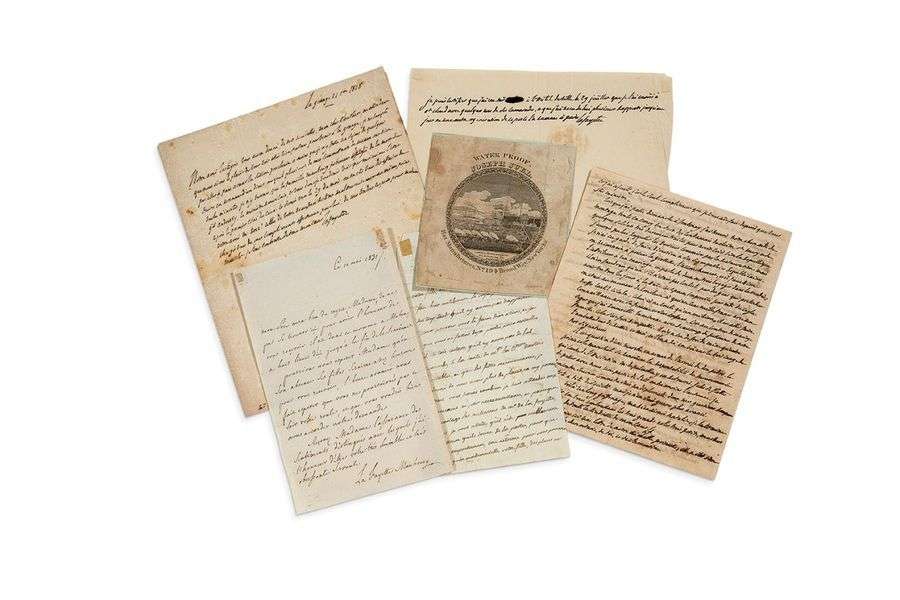
2 L.A.S. "Lafayette" and "Lf", 1828-1833| half page in-4 with address, 4 pages in-4 very full.
Important political letter to his granddaughter Nathalie.
La Grange September 21, 1828, to the liberal journalist Joseph MASCLET, known as "Eleuthère". Lasteyrie will have given him some news: "I do not intend to go to Paris before the next session unless I stay there for a few hours on my way back from a dinner to which several of my constituents from Meaux have kindly invited me.
I would see there only the Maubourg family justly sorry for the death of gal Andreossy, the American minister, and you, whose state I would like to see for myself after the first try of the waters" .
Paris May 29, 1833, to his granddaughter Nathalie, Mrs Adolphe PÉRIER.
A long letter talking about their relatives, but also about political affairs: the town hall of Carpentras| conventional republicanism as opposed to the school of American republicanism| the espionage to which he was subjected| social conflicts... "The government's maxim is to unveil, and to deceive as mine was to enlighten and bring together" . Its doctrine is that of "natural and social rights, of the sovereignty of the people, and this people armed as a whole and appointing its officers, looking upon the election of all magistrates and especially the presidency as the complement of the social order [...].
I think it is very important that true republicans, men of things and not of words who put freedom above all else, seek to reassure ridiculously frightened minds, as if, even supposing the momentary triumph of anarchists alone, which is not possible, the friends of justice and legal order, and even the healthy and disinterested part of the golden mean, would not very quickly rally to the adversaries of anarchy. It occurred to me that some very lively men, Étienne Arago, Raspail, La Boissière, were in favour of order, and of disapproving of the measures and words that frighten the ignorant or
2 L.A.S. "Lafayette" and "Lf", 1828-1833| half page in-4 with address, 4 pages in-4 very full.
Important political letter to his granddaughter Nathalie.
La Grange September 21, 1828, to the liberal journalist Joseph MASCLET, known as "Eleuthère". Lasteyrie will have given him some news: "I do not intend to go to Paris before the next session unless I stay there for a few hours on my way back from a dinner to which several of my constituents from Meaux have kindly invited me.
I would see there only the Maubourg family justly sorry for the death of gal Andreossy, the American minister, and you, whose state I would like to see for myself after the first try of the waters" .
Paris May 29, 1833, to his granddaughter Nathalie, Mrs Adolphe PÉRIER.
A long letter talking about their relatives, but also about political affairs: the town hall of Carpentras| conventional republicanism as opposed to the school of American republicanism| the espionage to which he was subjected| social conflicts... "The government's maxim is to unveil, and to deceive as mine was to enlighten and bring together" . Its doctrine is that of "natural and social rights, of the sovereignty of the people, and this people armed as a whole and appointing its officers, looking upon the election of all magistrates and especially the presidency as the complement of the social order [...].
I think it is very important that true republicans, men of things and not of words who put freedom above all else, seek to reassure ridiculously frightened minds, as if, even supposing the momentary triumph of anarchists alone, which is not possible, the friends of justice and legal order, and even the healthy and disinterested part of the golden mean, would not very quickly rally to the adversaries of anarchy. It occurred to me that some very lively men, Étienne Arago, Raspail, La Boissière, were in favour of order, and of disapproving of the measures and words that frighten the ignorant or