RENE BOIVIN
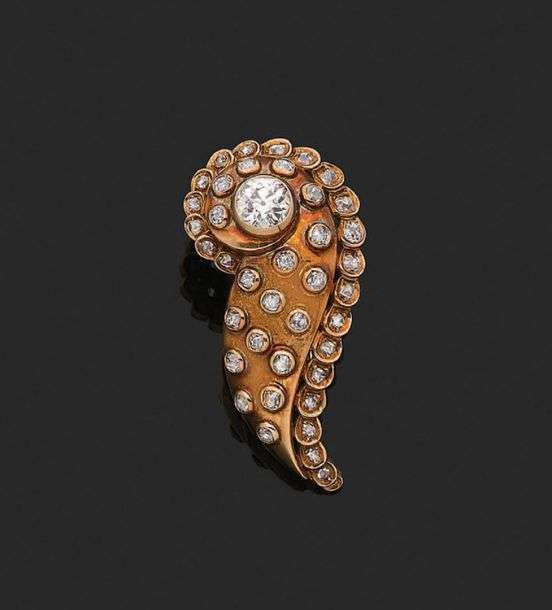
Clip "S"
Old cut round diamonds, 18K (750) yellow gold
Master stamp
In its case
L.: 4 cm - Pb.: 11.31 gr
BIBLIOGRAPHY Page 128 for a drawing of two similar clips
A diamond and gold clip
RENÉ BOIVIN
Born in 1864 of draper parents, trained by his brother goldsmith and chiseler in the jewellery tradeRENÉ BOIVIN Jeanne Boivin lerie, René Boivin founded the jewellery house bearing his name in 1890. In 1893, he married Jeanne Poiret, sister of the famous couturier Paul Poiret. Together, they developed an original and modern style, strongly influenced by Haute Couture and contemporary artistic trends - Cubism, Art Deco - in order to create jewellery that would be among the most audacious of the early 20th century. René Boivin's most sought-after jewels remain the creations that were created from the 1920s onwards. Indeed, following the premature death of her husband, Jeanne Boivin took over the management of the company| at the same time, she hired the young designer Suzanne Belperron, who had just graduated from the School of Fine Arts and won first prize in the Decorative Arts competition. The two women are at the origin of a new orientation in Boivin's creations, with undoubtedly more feminine taste and sensibility, with less geometric and angular compositions, celebrating curves and round shapes. This collaboration enabled the Boivin house to take off again, whose impetus was renewed by the arrival of Juliette Moutard who succeeded Suzanne Belperron in 1931 and remained at the service of Jeanne Boivin until 1970, when Juliette Moutard gave up her brushes to Marie Caroline de Brosses. The strength and renown of the Boivin firm is based on the consistency of a recognizable style that has been able to blend with the wide variety of sources of inspiration of its various collaborators: shells and marine themes for Jeanne Boivin, animal and floral subjects for Juliette Moutard. The combination of these diverse female ta
Clip "S"
Old cut round diamonds, 18K (750) yellow gold
Master stamp
In its case
L.: 4 cm - Pb.: 11.31 gr
BIBLIOGRAPHY Page 128 for a drawing of two similar clips
A diamond and gold clip
RENÉ BOIVIN
Born in 1864 of draper parents, trained by his brother goldsmith and chiseler in the jewellery tradeRENÉ BOIVIN Jeanne Boivin lerie, René Boivin founded the jewellery house bearing his name in 1890. In 1893, he married Jeanne Poiret, sister of the famous couturier Paul Poiret. Together, they developed an original and modern style, strongly influenced by Haute Couture and contemporary artistic trends - Cubism, Art Deco - in order to create jewellery that would be among the most audacious of the early 20th century. René Boivin's most sought-after jewels remain the creations that were created from the 1920s onwards. Indeed, following the premature death of her husband, Jeanne Boivin took over the management of the company| at the same time, she hired the young designer Suzanne Belperron, who had just graduated from the School of Fine Arts and won first prize in the Decorative Arts competition. The two women are at the origin of a new orientation in Boivin's creations, with undoubtedly more feminine taste and sensibility, with less geometric and angular compositions, celebrating curves and round shapes. This collaboration enabled the Boivin house to take off again, whose impetus was renewed by the arrival of Juliette Moutard who succeeded Suzanne Belperron in 1931 and remained at the service of Jeanne Boivin until 1970, when Juliette Moutard gave up her brushes to Marie Caroline de Brosses. The strength and renown of the Boivin firm is based on the consistency of a recognizable style that has been able to blend with the wide variety of sources of inspiration of its various collaborators: shells and marine themes for Jeanne Boivin, animal and floral subjects for Juliette Moutard. The combination of these diverse female ta
D'une famille d'orfèvre et bijoutier, René Boivin s'installe dans les années 1890 alors même qu'il épouse Jeanne Poiret, sœur de Paul Poiret. Ensemble ils vont développer un style original et moderne pour créer des bijoux des plus audacieux en ce début de XXè siècle. Les Bijoux de la Maison René Boivin sur lesquels nous porterons essentiellement notre attention sont les bijoux créés à partir des années 1920. En effet, lorsque René Boivin meurt prématurément en 1917, sa femme et collaboratrice Jeanne Boivin reprend avec audace la direction de la Maison. Sa sensibilité et son goût la guidèrent probablement lorsqu'elle embauche en 1919, une jeune dessinatrice du nom de Suzanne Belperron tout juste diplômée de l'école des Beaux-Arts et ayant reçue le premier prix du concours des Arts Décoratifs. Cette collaboration permet à la Maison Boivin de prendre un nouvel essor qui fut renouvelé à l'arrivée de Juliette Moutart qui travaille pour Jeanne Boivin et pour sa fille Germaine pendant près de 30 ans. Leurs champs d'inspirations sont variés allant des coquillages et sujets marins pour Jeanne Boivin aux sujets animaliers et floraux pour Juliette Moutart et d'inspirations fantastiques ou chimériques pour Germaine Boivin. Ces associations de talents féminins ont permis à la Maison René Boivin de proposer des bijoux très novateurs, des pièces atypiques qui ont remporté un vif succès. Les bijoux les plus produits seront les bagues et les bracelets. Les matières sont également très originales car elles emploient des matériaux nouveaux en joaillerie tels que le bois, le cristal, l'agate... associés à des pierres précieuses ou non... De nombreuses créations deviendront mythiques, le bracelet "tranche", le bracelet "barbare", la bague "quatre corps" qui se décline de toutes les couleurs, les broches "étoiles de mer" souvent articulées, les pendentifs animaliers tels que le "crabe" ou "l'otarie" ou le "Moineau de Paris"...
&w=3840&q=75)
&w=3840&q=75)
&w=3840&q=75)
&w=3840&q=75)
&w=3840&q=75)
&w=3840&q=75)