
&w=3840&q=75)
&w=3840&q=75)
&w=3840&q=75)
&w=3840&q=75)
&w=3840&q=75)
&w=3840&q=75)
&w=3840&q=75)
&w=3840&q=75)

180
TEBRIZ (CHAÎNE ET TRAME EN COTON,
The item was sold for 1 449 €
Fees include commission and taxes.
TEBRIZ (COTTON CHAIN AND WOVEN WOVEN,
WOVEN CHAIN), NORTH-WEST
FROM PERsia, TO 1940-1950
Due to its proximity to Turkish ports, Tebriz
significantly developed the trade
with Europe and thus became a large
carpet production centre. At the end of the 18th century
, large carpet factories
were established here. Tebriz carpets
are characterized by high quality and
fineness of knotting and feature a wide variety of designs
: the classic central medallion design
with four spandrels, the vase design
vases, the herati open field design,
figurative or landscape designs, the prayer rugs of
or the garden carpets. "In fact, there is a
very wide variety of Persian carpets:
- The carpets of manufactures in which
the models or cartons are rewoven
several times identically| a workshop master
or "ustad" directs the work by
chanting: "a red knot, a green knot,
two blue knots, etc...". It is no longer
the creative work of a single craftsman that
will give rise to the spirit of the carpet, but it is the technical prowess of the craftsman
, the harmony of the cardboard
and the colours, the quality of the wools that
determine the beauty and success of the carpet.
Let us quote the masterpieces of the great masters
from the Tabriz region (Djaffer, Hajji Jalil), or
from Keschan (Mortashem), Kirman and Ispahan.
- Carpets from village workshops (Senneh,
Hamadan, Chiraz, Ferrahan...)
- Or weavings from nomadic tribes,
like the Khasgai from the Chiraz region:
the weaver creates his own pattern. (...)
All materials are used through
Persia: the warps can be made of wool
sheep's wool, goat's hair, or even
camel, cotton, silk. Velvet can
be knotted in wool or silk, cotton can
also be used to enhance certain patterns "
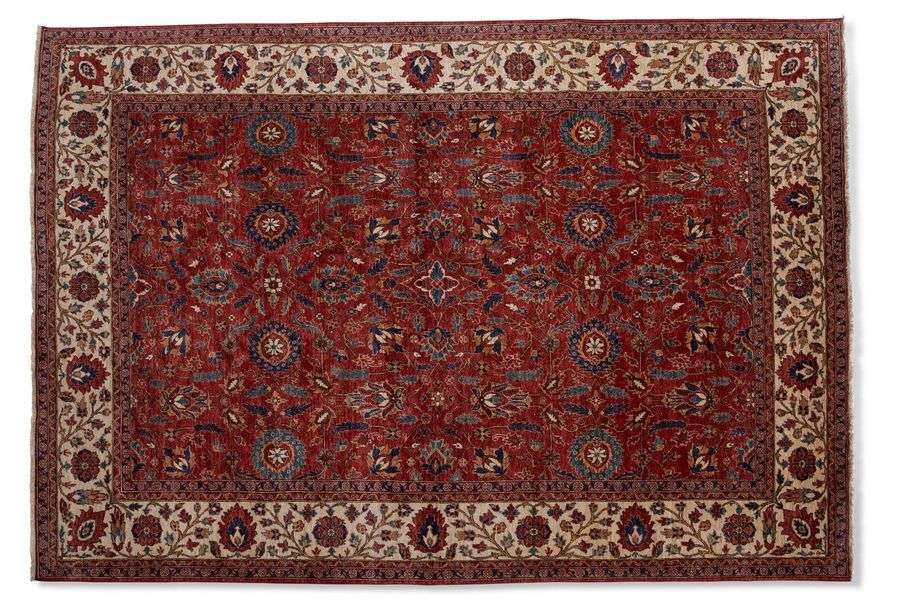
The carpet is embellished with an elegant decor
stylized floral poly
WOVEN CHAIN), NORTH-WEST
FROM PERsia, TO 1940-1950
Due to its proximity to Turkish ports, Tebriz
significantly developed the trade
with Europe and thus became a large
carpet production centre. At the end of the 18th century
, large carpet factories
were established here. Tebriz carpets
are characterized by high quality and
fineness of knotting and feature a wide variety of designs
: the classic central medallion design
with four spandrels, the vase design
vases, the herati open field design,
figurative or landscape designs, the prayer rugs of
or the garden carpets. "In fact, there is a
very wide variety of Persian carpets:
- The carpets of manufactures in which
the models or cartons are rewoven
several times identically| a workshop master
or "ustad" directs the work by
chanting: "a red knot, a green knot,
two blue knots, etc...". It is no longer
the creative work of a single craftsman that
will give rise to the spirit of the carpet, but it is the technical prowess of the craftsman
, the harmony of the cardboard
and the colours, the quality of the wools that
determine the beauty and success of the carpet.
Let us quote the masterpieces of the great masters
from the Tabriz region (Djaffer, Hajji Jalil), or
from Keschan (Mortashem), Kirman and Ispahan.
- Carpets from village workshops (Senneh,
Hamadan, Chiraz, Ferrahan...)
- Or weavings from nomadic tribes,
like the Khasgai from the Chiraz region:
the weaver creates his own pattern. (...)
All materials are used through
Persia: the warps can be made of wool
sheep's wool, goat's hair, or even
camel, cotton, silk. Velvet can
be knotted in wool or silk, cotton can
also be used to enhance certain patterns "
The carpet is embellished with an elegant decor
stylized floral poly