
&w=3840&q=75)
&w=3840&q=75)
&w=3840&q=75)
&w=3840&q=75)
&w=3840&q=75)
&w=3840&q=75)
&w=3840&q=75)
&w=3840&q=75)


146
MANUFACTURE WERNER & MIETH, BERLIN
The item was sold for 36 400 €
Fees include commission and taxes.
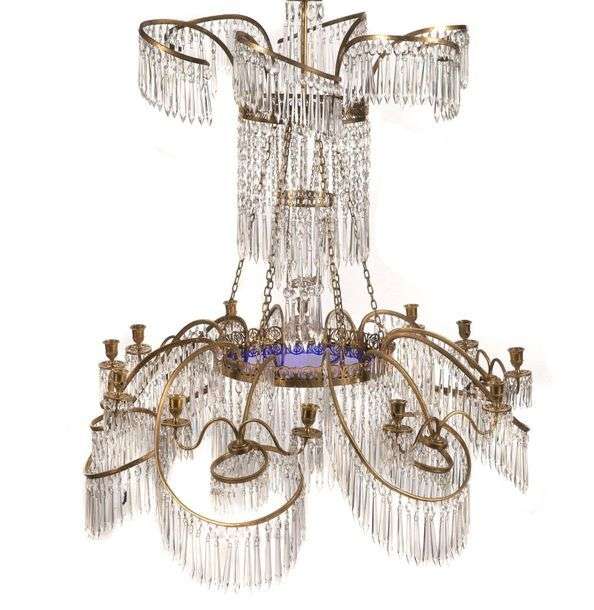
MANUFACTURE WERNER & MIETH, BERLIN
Exceptional chandelier with crystal pendants
cut in dagger and gilded bronze frame
openworked with palmettes forming a spiral
volutes falling in maze from where the twelve arms of light escape
.
Late 18th century, ca. 1790
H: approx. 95 cm
Illustrated, a chandelier from the same Werner & Mieth factory, in crystal and gilt bronze, Berlin, ca. 1797 in Berlin, Schloss Charlottenburg, Royal Apartments of King Friedrich Wilhelms II (fig.1)
In 1794, Christian Gottlob Werner and Gottfried Mieth officially applied for a licence to manufacture bronze from the "Königliche Manufactur - und - Commerz - Collegium", the "Chamber of Commerce and Royal Manufacturers". The main reason for this request was to formalize their position and confirm their partnership against the increasing hostility of companies towards them. Although they received a similar "licence" and were granted the hoped-for concession on 22 May 1794 by Friedrich Anton von Heinitz, director of the Academy of Arts, they were never recognised by a corporation of founding masters who were particularly unhappy with their success and the special relationship they had rapidly developed with the Prussian court.
In 1791, the manufactory employed six yellow copper founders, one red copper founder, three chiselers, a medallist and two apprentices, making a total of thirteen employees in addition to the three founders. This number increased to twenty-nine in 1797. Gold, silver, copper, brass, lead and mercury as well as molten glass and crystal, mainly from the Silesian glassworks, were used in the manufacture.
The production of the Werner & Mieth manufactory - thanks to the formal quality of its models and their great finesse - was soon recognised as far surpassing its main competitors, among others the master founder H. Ermish. Praised by the "Königliche Manufactur - und Commerz - Collegium" and by the Academy of Arts, it attracted the favour of th
Exceptional chandelier with crystal pendants
cut in dagger and gilded bronze frame
openworked with palmettes forming a spiral
volutes falling in maze from where the twelve arms of light escape
.
Late 18th century, ca. 1790
H: approx. 95 cm
Illustrated, a chandelier from the same Werner & Mieth factory, in crystal and gilt bronze, Berlin, ca. 1797 in Berlin, Schloss Charlottenburg, Royal Apartments of King Friedrich Wilhelms II (fig.1)
In 1794, Christian Gottlob Werner and Gottfried Mieth officially applied for a licence to manufacture bronze from the "Königliche Manufactur - und - Commerz - Collegium", the "Chamber of Commerce and Royal Manufacturers". The main reason for this request was to formalize their position and confirm their partnership against the increasing hostility of companies towards them. Although they received a similar "licence" and were granted the hoped-for concession on 22 May 1794 by Friedrich Anton von Heinitz, director of the Academy of Arts, they were never recognised by a corporation of founding masters who were particularly unhappy with their success and the special relationship they had rapidly developed with the Prussian court.
In 1791, the manufactory employed six yellow copper founders, one red copper founder, three chiselers, a medallist and two apprentices, making a total of thirteen employees in addition to the three founders. This number increased to twenty-nine in 1797. Gold, silver, copper, brass, lead and mercury as well as molten glass and crystal, mainly from the Silesian glassworks, were used in the manufacture.
The production of the Werner & Mieth manufactory - thanks to the formal quality of its models and their great finesse - was soon recognised as far surpassing its main competitors, among others the master founder H. Ermish. Praised by the "Königliche Manufactur - und Commerz - Collegium" and by the Academy of Arts, it attracted the favour of th