
&w=3840&q=75)
&w=3840&q=75)
&w=3840&q=75)
&w=3840&q=75)
&w=3840&q=75)
&w=3840&q=75)


25
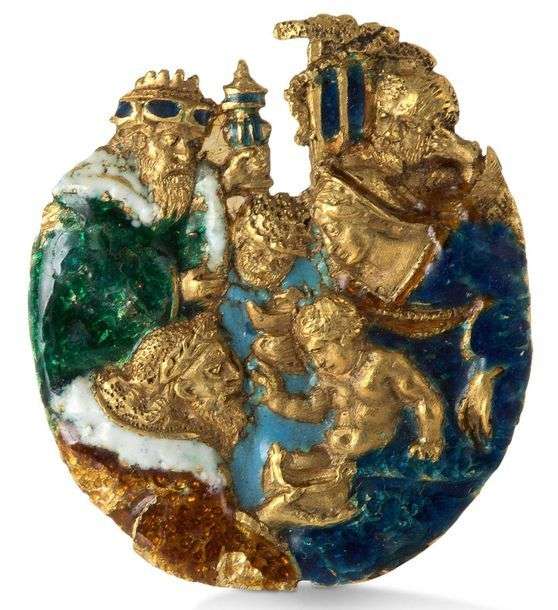
MÉDAILLON DÉCOUPÉ en demie ronde-bosse en or émaillé représentant l'Adorat
Estimate4 000 - 6 000 €
MEDAL CUT into a half-round gold enamel representing the Adoration of the Magi, green, light blue, dark blue, white and yellow enamels.
South Germany, end of the 16th century
Height: 2.4 cm - Width: 2.1 cm
In a Plexiglas base with a magnifying glass
PROVENANCE Private collection, France
This small medallion probably had to find its place in an oval grain of dizain depicting episodes from the Life of the Virgin or of Christ. The Louvre Museum preserves an example of these precious objects from the former Adolphe de Rothschild collection, which illustrates the Passion (inv. OA 5634). Made of enamelled gold and agate, it is composed of ten oblong grains, each grain opening to reveal two small cut-out scenes on a hard stone background (figs. a and a'). From a slightly later period, this Adoration of the Magi uses the same technique of great refinement with a later style similar to the Germanic sphere, reminiscent of a portable altarpiece made in a Munich workshop at the end of the 16th century and kept in the Kunsthistorisches Museum in Vienna (inv. Kunstkammer, 3218, fig. b).
South Germany, end of the 16th century
Height: 2.4 cm - Width: 2.1 cm
In a Plexiglas base with a magnifying glass
PROVENANCE Private collection, France
This small medallion probably had to find its place in an oval grain of dizain depicting episodes from the Life of the Virgin or of Christ. The Louvre Museum preserves an example of these precious objects from the former Adolphe de Rothschild collection, which illustrates the Passion (inv. OA 5634). Made of enamelled gold and agate, it is composed of ten oblong grains, each grain opening to reveal two small cut-out scenes on a hard stone background (figs. a and a'). From a slightly later period, this Adoration of the Magi uses the same technique of great refinement with a later style similar to the Germanic sphere, reminiscent of a portable altarpiece made in a Munich workshop at the end of the 16th century and kept in the Kunsthistorisches Museum in Vienna (inv. Kunstkammer, 3218, fig. b).