
&w=3840&q=75)
&w=3840&q=75)
&w=3840&q=75)
&w=3840&q=75)
&w=3840&q=75)
&w=3840&q=75)


116
[GALILÉE (Galileo Galilei, dit) (1564-1642)].
The item was sold for 8 846 €
Fees include commission and taxes.
[GALILÉE (Galileo Galilei, dit) (1564-1642)].
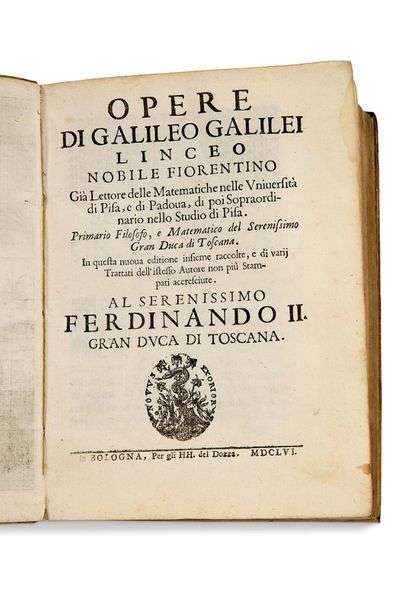
Opere di Galileo Galilei Linceo nobile fiorentino [...] In questa nuova editione insieme raccolte, e di varii trattati [...] accresciute. Bologna, HH. del Dozza, 1655-1656.
2 volumes in-4 (234 x 175 mm).
Collation: First volume: [14 ff.]- 48 pp. - 4 ff.]-160 pp. - 2 ff.]-68 pp.-127 pp. - 2 ff.]-264 pp. - 43 pp.| Second volume: [3 ff. of which 2 bl.]-60 pp. - 8 pp.-156 pp. with 2 ff. inserted between pp. 104 and 105 - 48 pp. - 4 ff.]-180 pp. - title page]- 54 pp. figures 53 to 106]
- [title page]-24 pp. 4 ff.] - [4 ff.]-238 pp.-[4 ff. of which 1 bl.] with 2 ff. inserted between pp. 132 and 133, several parts with separate paginations and titles (dated from 1655 to 1656)| in Latin and Italian.
Full vellum, smooth spine titled in ink 'Galileo
Opera T. I / T.II', title and tomaison on lower edges (contemporary binding).
First collective edition of the works of
Galileo, partly original, but not including the Dialogo of 1632 and the Nov-antiqua doctrina of 1636, indexed by the Church.
The unpublished works were provided to the scientific editor,
Carlo Manolessi, by the Duke of Tuscany
Ferdinand II, to whom the edition is dedicated.
They also include texts by other authors, opponents or defenders of Galileo, proving in particular that the Florentine astronomer was indeed the discoverer of sunspots (Dino Cinti, Biblioteca Galileiana, no. 132).
It is a rare complete copy of all its parts: it is rarely found because the different texts it contains, printed with paginations and titles in their own right, have often been separated.
Illustrations: Copper-engraved plates: frontispiece and full-page portrait included in the pagination in the first part of the first volume| a folding plate without text misplaced by the binder at the beginning of the first part of the same volume (whereas it illustrates the last part). Numerous woodcut vignettes in the text. An engraved medallion portrait of Galileo glued to paper at the begin
Opere di Galileo Galilei Linceo nobile fiorentino [...] In questa nuova editione insieme raccolte, e di varii trattati [...] accresciute. Bologna, HH. del Dozza, 1655-1656.
2 volumes in-4 (234 x 175 mm).
Collation: First volume: [14 ff.]- 48 pp. - 4 ff.]-160 pp. - 2 ff.]-68 pp.-127 pp. - 2 ff.]-264 pp. - 43 pp.| Second volume: [3 ff. of which 2 bl.]-60 pp. - 8 pp.-156 pp. with 2 ff. inserted between pp. 104 and 105 - 48 pp. - 4 ff.]-180 pp. - title page]- 54 pp. figures 53 to 106]
- [title page]-24 pp. 4 ff.] - [4 ff.]-238 pp.-[4 ff. of which 1 bl.] with 2 ff. inserted between pp. 132 and 133, several parts with separate paginations and titles (dated from 1655 to 1656)| in Latin and Italian.
Full vellum, smooth spine titled in ink 'Galileo
Opera T. I / T.II', title and tomaison on lower edges (contemporary binding).
First collective edition of the works of
Galileo, partly original, but not including the Dialogo of 1632 and the Nov-antiqua doctrina of 1636, indexed by the Church.
The unpublished works were provided to the scientific editor,
Carlo Manolessi, by the Duke of Tuscany
Ferdinand II, to whom the edition is dedicated.
They also include texts by other authors, opponents or defenders of Galileo, proving in particular that the Florentine astronomer was indeed the discoverer of sunspots (Dino Cinti, Biblioteca Galileiana, no. 132).
It is a rare complete copy of all its parts: it is rarely found because the different texts it contains, printed with paginations and titles in their own right, have often been separated.
Illustrations: Copper-engraved plates: frontispiece and full-page portrait included in the pagination in the first part of the first volume| a folding plate without text misplaced by the binder at the beginning of the first part of the same volume (whereas it illustrates the last part). Numerous woodcut vignettes in the text. An engraved medallion portrait of Galileo glued to paper at the begin