
&w=3840&q=75)
&w=3840&q=75)
&w=3840&q=75)
&w=3840&q=75)
&w=3840&q=75)
&w=3840&q=75)

103
AUBIGNÉ, Théodore Agrippa d' (1552-1630)
The item was sold for 1 137 €
Fees include commission and taxes.
AUBIGNÉ, Théodore Agrippa d' (1552-1630)
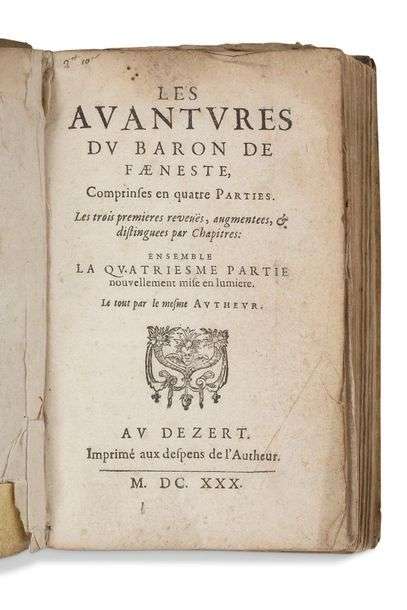
Baron de Fæneste's avantures, consisting of four parts. The first three parts are divided into chapters. Together, the fourth part newly brought to light, all by the same author.
Geneva], Au Dezert, Imprimé aux despens de l'autheur, 1630
In-12, 308 pp., in French. Full soft vellum with overlays, spine titled in ink (period binding).
Second edition of the first collective edition of the four parts of this satirical novel, considered by Hector de Backer as a forgery (cf. Tchemerzine, vol. I, p. 175), based on the edition given in 1630 in Geneva by Pierre Aubert, in which the fourth part of the work appeared for the first time. The first two parts were published in 1617 and the third in 1619.
Written in a language full of verve mixed with Gasconism, the work relates the interviews of the boastful Baron Fæneste and the humble and philosophical lord of Enay. A convinced Protestant, d'Aubigné sprinkled his writing with satires against Catholicism and its rites.
(Handwritten annotations in ink at the beginning of the volume, a few freckles).
Baron de Fæneste's avantures, consisting of four parts. The first three parts are divided into chapters. Together, the fourth part newly brought to light, all by the same author.
Geneva], Au Dezert, Imprimé aux despens de l'autheur, 1630
In-12, 308 pp., in French. Full soft vellum with overlays, spine titled in ink (period binding).
Second edition of the first collective edition of the four parts of this satirical novel, considered by Hector de Backer as a forgery (cf. Tchemerzine, vol. I, p. 175), based on the edition given in 1630 in Geneva by Pierre Aubert, in which the fourth part of the work appeared for the first time. The first two parts were published in 1617 and the third in 1619.
Written in a language full of verve mixed with Gasconism, the work relates the interviews of the boastful Baron Fæneste and the humble and philosophical lord of Enay. A convinced Protestant, d'Aubigné sprinkled his writing with satires against Catholicism and its rites.
(Handwritten annotations in ink at the beginning of the volume, a few freckles).