
&w=3840&q=75)
&w=3840&q=75)
&w=3840&q=75)
&w=3840&q=75)
&w=3840&q=75)
&w=3840&q=75)

195
SAND George (1804-1876)
The item was sold for 395 €
Fees include commission and taxes.
SAND George (1804-1876)
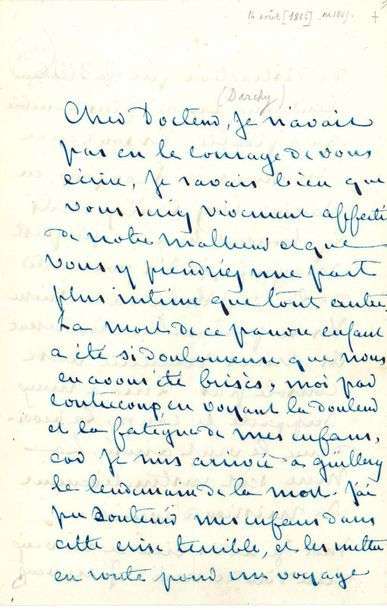
L.A.S. "G. Sand", Palaiseau August 14 [1864, to Doctor Pierre-Paul
DARCHY]| 4 pages and a half in-8 to his number.
Moving letter on the death of his grandson Marc (July 21, 1864).
"The death of this poor child was so painful that we were broken by it, I in turn, seeing the pain and fatigue of my children, for I arrived at Guillery the day after the death. I was able to support my children in this terrible crisis, and set them on a journey of distraction that the heat made even more painful than pleasant. They are currently in Ronjoux, in Savoie, at Buloz's house, [...] but Maurice does not console himself. Lina bore the blow better. Providence wants it this way, the mother instinctively feels her mission for the future.
I don't say anything and I don't want to say anything about myself. I don't even want to know what harm it does to me: what's the point? It's a tearing where conscience has nothing to do with it. I know well that there is no death, and in all that belief and reasoning can answer each other, I have always given feeling a greater power than demonstration. So I believe as much and more than ever that death is not an abomination and that my child is right where he is. But to lose him is a suffering for us and an immense sorrow if we compare it to the short duration of our life. It is not in proportion and we have to endure this law, the same for all those who see the objects of their affection leave. Maurice's pain has been added to mine and I suffer for two and for three, because poor
Lina has been well broken as well" .
Correspondence, XVIII, n° 11080.
L.A.S. "G. Sand", Palaiseau August 14 [1864, to Doctor Pierre-Paul
DARCHY]| 4 pages and a half in-8 to his number.
Moving letter on the death of his grandson Marc (July 21, 1864).
"The death of this poor child was so painful that we were broken by it, I in turn, seeing the pain and fatigue of my children, for I arrived at Guillery the day after the death. I was able to support my children in this terrible crisis, and set them on a journey of distraction that the heat made even more painful than pleasant. They are currently in Ronjoux, in Savoie, at Buloz's house, [...] but Maurice does not console himself. Lina bore the blow better. Providence wants it this way, the mother instinctively feels her mission for the future.
I don't say anything and I don't want to say anything about myself. I don't even want to know what harm it does to me: what's the point? It's a tearing where conscience has nothing to do with it. I know well that there is no death, and in all that belief and reasoning can answer each other, I have always given feeling a greater power than demonstration. So I believe as much and more than ever that death is not an abomination and that my child is right where he is. But to lose him is a suffering for us and an immense sorrow if we compare it to the short duration of our life. It is not in proportion and we have to endure this law, the same for all those who see the objects of their affection leave. Maurice's pain has been added to mine and I suffer for two and for three, because poor
Lina has been well broken as well" .
Correspondence, XVIII, n° 11080.