
&w=3840&q=75)
&w=3840&q=75)
&w=3840&q=75)
&w=3840&q=75)
&w=3840&q=75)
&w=3840&q=75)
&w=3840&q=75)
&w=3840&q=75)


248
Charles Guillaume DIEHL (1811-1885)
The item was sold for 14 300 €
Fees include commission and taxes.
Charles Guillaume DIEHL (1811-1885)
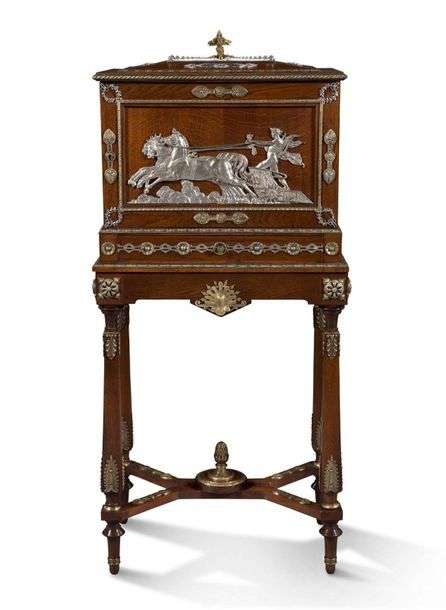
Cabinet forming a cigar cellar in natural oak, ornamented with chased and silvered bronze. The upper part is decorated with a decoration of Apollo on his chariot pulled by a quadrige. It opens on the front to a door revealing five flat drawers with cane bottoms. The case rests on four truncated cone-shaped legs joined by a spacer. Stylized palmette motifs, flowers, laurel wreaths, friezes of eggs and pine cones. Napoleon III
period H. 131| W. 61 P 37.5 cm
PROVENANCE Private
collection, Avignon
Born in Steinbach, Charles Guillaume Diehl (1811-1885) was a cabinetmaker of Germanic origin, who settled in Paris from 1840. He specialized in furniture and small objects, before moving to high cabinet making. In the course of his career, it was indeed the caskets (liquor cabinets, game cabinets, various boxes) that made him famous. He was awarded a bronze medal at the Universal Exhibition of 1867 for his famous medallion known as the Triumph of Merovinia decorated with a silver bronze decoration by Emmanuel Fremiet (1824-1910) with whom he collaborated, in a completely new Merovingian spirit. It is now kept in the Musée d'Orsay.
Cabinet forming a cigar cellar in natural oak, ornamented with chased and silvered bronze. The upper part is decorated with a decoration of Apollo on his chariot pulled by a quadrige. It opens on the front to a door revealing five flat drawers with cane bottoms. The case rests on four truncated cone-shaped legs joined by a spacer. Stylized palmette motifs, flowers, laurel wreaths, friezes of eggs and pine cones. Napoleon III
period H. 131| W. 61 P 37.5 cm
PROVENANCE Private
collection, Avignon
Born in Steinbach, Charles Guillaume Diehl (1811-1885) was a cabinetmaker of Germanic origin, who settled in Paris from 1840. He specialized in furniture and small objects, before moving to high cabinet making. In the course of his career, it was indeed the caskets (liquor cabinets, game cabinets, various boxes) that made him famous. He was awarded a bronze medal at the Universal Exhibition of 1867 for his famous medallion known as the Triumph of Merovinia decorated with a silver bronze decoration by Emmanuel Fremiet (1824-1910) with whom he collaborated, in a completely new Merovingian spirit. It is now kept in the Musée d'Orsay.