
&w=3840&q=75)
&w=3840&q=75)
&w=3840&q=75)
&w=3840&q=75)
&w=3840&q=75)
&w=3840&q=75)
&w=3840&q=75)
&w=3840&q=75)

165
LOUIS-ROLAND TRINQUESSE (PARIS, 1746 - 1800)
The item was sold for 715 €
Fees include commission and taxes.
LOUIS-ROLAND TRINQUESSE (PARIS, 1746 - 1800)
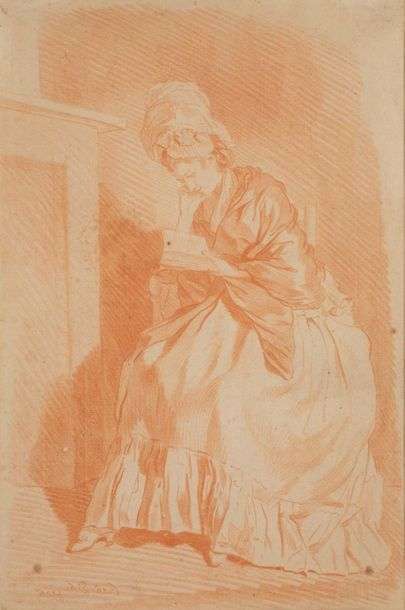
La lecture devant l'âtre, presumed portrait of Louise-Charlotte Marini
Counter-test of sanguine
36.8 x 25.1 cm
Dated: Ce 16 dbre 1776
Click here to bid
Portraitist of the elegant Paris of the reign of Louis XVI, author of an important production drawn with deep and fat sanguine, Trinquesse is one of those artists as recognizable as he is little known. Active over a short period, between 1770 and 1797, his biography is very fragmented. We remember especially his refusal to enter the Royal Academy, his choice to exhibit at the Salon de la Correspondance and then at the Louvre, during the Revolution, when the
Exhibitions became free and no longer regulated by the Academy.
This counter-proof was based on a drawing-matrix from a famous cycle of 58, successively featuring three young female models, Marianne Franmery, Louise-Charlotte Marini and Louise-Elisabeth Bain, sketched in an interior and in various charming positions, with all the spontaneity, casualness and nonchalance of this century.
The artist always lingers on their delicate faces, sometimes smiling, sometimes mutinous, or playful, and their ample, broadly pleated dresses with beautiful silky effects.
Bibliography
J. Cailleux, "The Drawings of Louis Roland Trinquesse." The Burlington Magazine, vol. 116, no. 851, 1974, pp. i-xiv.
La lecture devant l'âtre, presumed portrait of Louise-Charlotte Marini
Counter-test of sanguine
36.8 x 25.1 cm
Dated: Ce 16 dbre 1776
Click here to bid
Portraitist of the elegant Paris of the reign of Louis XVI, author of an important production drawn with deep and fat sanguine, Trinquesse is one of those artists as recognizable as he is little known. Active over a short period, between 1770 and 1797, his biography is very fragmented. We remember especially his refusal to enter the Royal Academy, his choice to exhibit at the Salon de la Correspondance and then at the Louvre, during the Revolution, when the
Exhibitions became free and no longer regulated by the Academy.
This counter-proof was based on a drawing-matrix from a famous cycle of 58, successively featuring three young female models, Marianne Franmery, Louise-Charlotte Marini and Louise-Elisabeth Bain, sketched in an interior and in various charming positions, with all the spontaneity, casualness and nonchalance of this century.
The artist always lingers on their delicate faces, sometimes smiling, sometimes mutinous, or playful, and their ample, broadly pleated dresses with beautiful silky effects.
Bibliography
J. Cailleux, "The Drawings of Louis Roland Trinquesse." The Burlington Magazine, vol. 116, no. 851, 1974, pp. i-xiv.